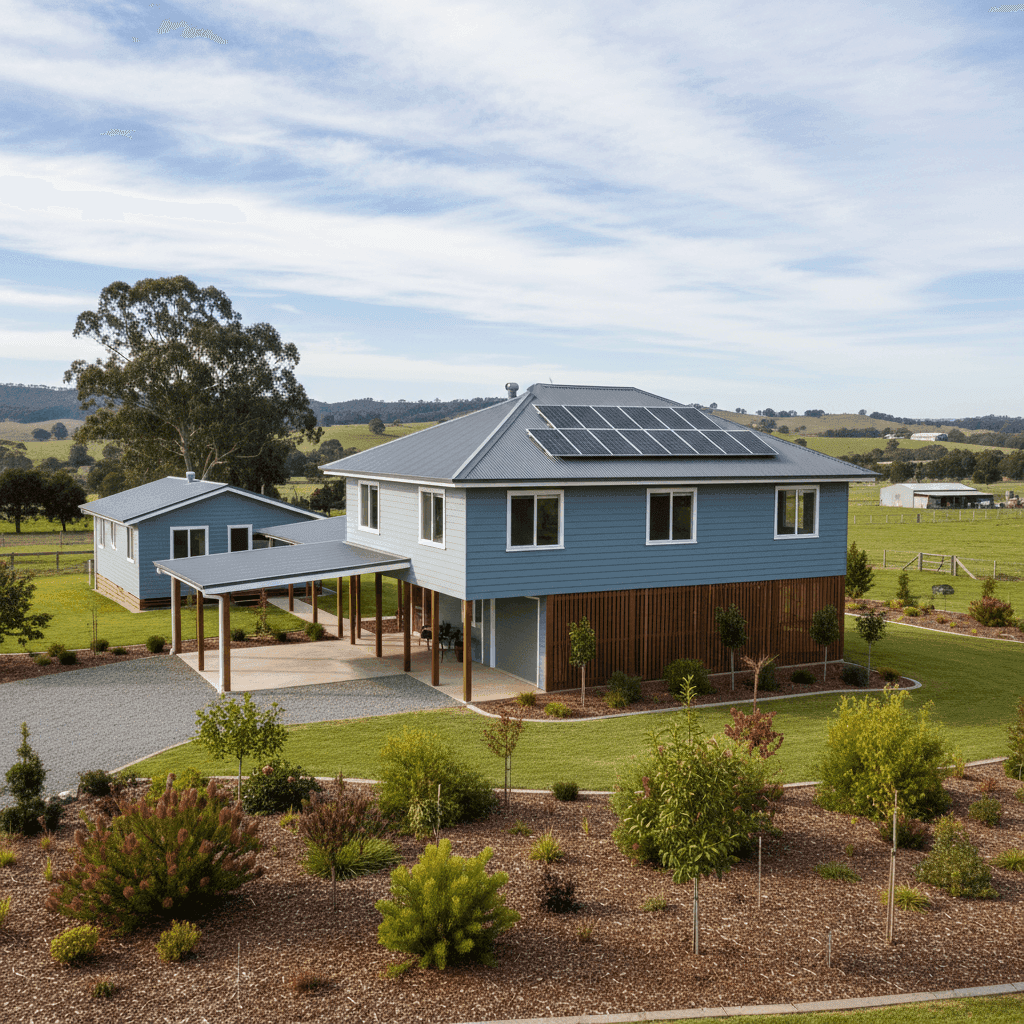
Home insurance costs in regional New South Wales can vary enormously — and if you own a free standing home in Aberdeen, NSW 2336, you may be wondering whether the quote sitting in your inbox is reasonable or whether you're paying well over the odds. In this article, we break down a real building insurance quote for a three-bedroom home in Aberdeen, compare it against local, state and national benchmarks, and share practical tips to help you get a fairer deal.
---
Is This Quote Fair?
The quote in question comes in at $7,254 per year (or $725 per month) for building-only cover on a 160 sqm free standing home insured for $458,000, with a $2,000 building excess.
Our price rating for this quote is EXPENSIVE — Above Average.
To put that in perspective:
- The suburb average for Aberdeen (NSW 2336) is just $2,199/yr, and the median sits at $2,164/yr
- Even at the 75th percentile of local quotes — meaning 75% of Aberdeen homeowners pay less — the figure is only $2,487/yr
- This quote is more than 3× the suburb average and sits dramatically above every local benchmark
That's a significant gap. While some of the premium can be explained by specific property characteristics (more on those below), a gap of this magnitude warrants serious scrutiny. It's a strong signal that shopping around could yield substantial savings.
---
How Aberdeen Compares
To understand whether Aberdeen itself is an expensive suburb to insure, it helps to zoom out. Here's how Aberdeen's local insurance data stacks up against broader benchmarks:
| Benchmark | Average Premium |
|---|---|
| Aberdeen (NSW 2336) suburb average | $2,199/yr |
| Aberdeen (NSW 2336) suburb median | $2,164/yr |
| LGA average (Muswellbrook) | $2,749/yr |
| NSW state average | $3,801/yr |
| National average | $2,965/yr |
Interestingly, Aberdeen actually comes in below both the NSW state average and the national average, suggesting it's a relatively affordable suburb to insure in general. The Muswellbrook LGA average of $2,749/yr is also modest by state standards. This makes the quoted premium of $7,254 stand out even more starkly — it's nearly double the NSW state average and more than 2.5× the national average.
It's worth noting that the suburb sample size for Aberdeen is 19 quotes, which is a reasonably small dataset. Premiums can vary based on individual property risk factors, so the suburb average may not capture every scenario — but it remains a useful reference point.
---
Property Features That Affect Your Premium
Several characteristics of this particular property are likely pushing the premium higher than the suburb norm. Let's work through the key ones:
Elevated Foundation (Stumps)
This home sits on stumps and is elevated by at least one metre. While an elevated foundation can offer flood resilience, insurers sometimes price stump-based homes differently due to the perceived structural complexity and the cost to repair or reinstate underfloor areas. Elevated homes in regional NSW can attract loading depending on the insurer's risk model.
Hardiplank / Hardiflex Exterior Walls
Fibre cement cladding (such as Hardiplank or Hardiflex) is a durable, fire-resistant material — but some insurers price it differently to brick veneer. The material's characteristics and the cost to repair or replace it at today's prices can influence the building sum insured and, in turn, the premium.
Steel / Colorbond Roof
A Colorbond steel roof is generally viewed favourably by insurers for its durability and fire resistance. This factor is unlikely to be driving the premium up significantly.
Solar Panels
The property has solar panels, which add to the replacement value of the building. Depending on the insurer, solar panels may or may not be automatically included in building cover — and if they are, they contribute to a higher effective sum insured.
Granny Flat
The presence of a granny flat is a meaningful factor. An additional dwelling on the property increases the total replacement cost, and some insurers will load the premium to account for the extended structure. It's worth confirming whether the quoted sum insured of $458,000 adequately (but not excessively) covers both the main dwelling and the granny flat.
Timber / Laminate Flooring
Timber and laminate floors can be costly to replace, particularly in elevated homes where subfloor access and moisture management add complexity. This may contribute modestly to the premium.
Sum Insured: $458,000
At 160 sqm with a granny flat, a sum insured of $458,000 works out to roughly $2,863 per sqm for the main dwelling alone — which is at the upper end for a standard-quality home in regional NSW. It's worth reviewing whether this figure accurately reflects current rebuild costs or whether it has been over-estimated.
---
Tips for Homeowners in Aberdeen
If you're facing a premium in this range, here are four practical steps worth taking:
1. Compare Multiple Quotes
This is the single most impactful thing you can do. Given that the suburb average is $2,199/yr and this quote is $7,254/yr, there is clearly significant variation between insurers. Different providers weigh risk factors — like elevated foundations, fibre cement cladding and granny flats — very differently. Get a comparison quote at CoverClub to see what competing insurers would charge for the same property.
2. Review Your Sum Insured
Make sure your building sum insured reflects the actual cost to rebuild your home — not its market value, and not an inflated estimate. Over-insuring is a common and costly mistake. Use a building cost calculator or speak to a local builder to get a realistic figure, factoring in the granny flat separately.
3. Consider a Higher Excess
The current building excess on this quote is $2,000. Opting for a higher voluntary excess can meaningfully reduce your annual premium. If you have the savings to cover a larger out-of-pocket cost in the event of a claim, this is a straightforward lever to pull.
4. Ask About Solar Panel Cover
Clarify with your insurer exactly how your solar panels are covered. Some policies include them as part of the building, others treat them as an optional extra, and some exclude them entirely. Making sure you're not paying to insure them twice — or leaving them uncovered — is important for both cost and protection.
---
Compare Your Home Insurance Today
Whether you're a long-time Aberdeen resident or new to the area, it pays to review your home insurance regularly. The data shows that premiums in this suburb can vary widely, and a quote that looks standard from one insurer may be far above the market rate.
Start a free comparison at CoverClub and see how your current quote stacks up. It takes just a few minutes and could save you thousands each year.