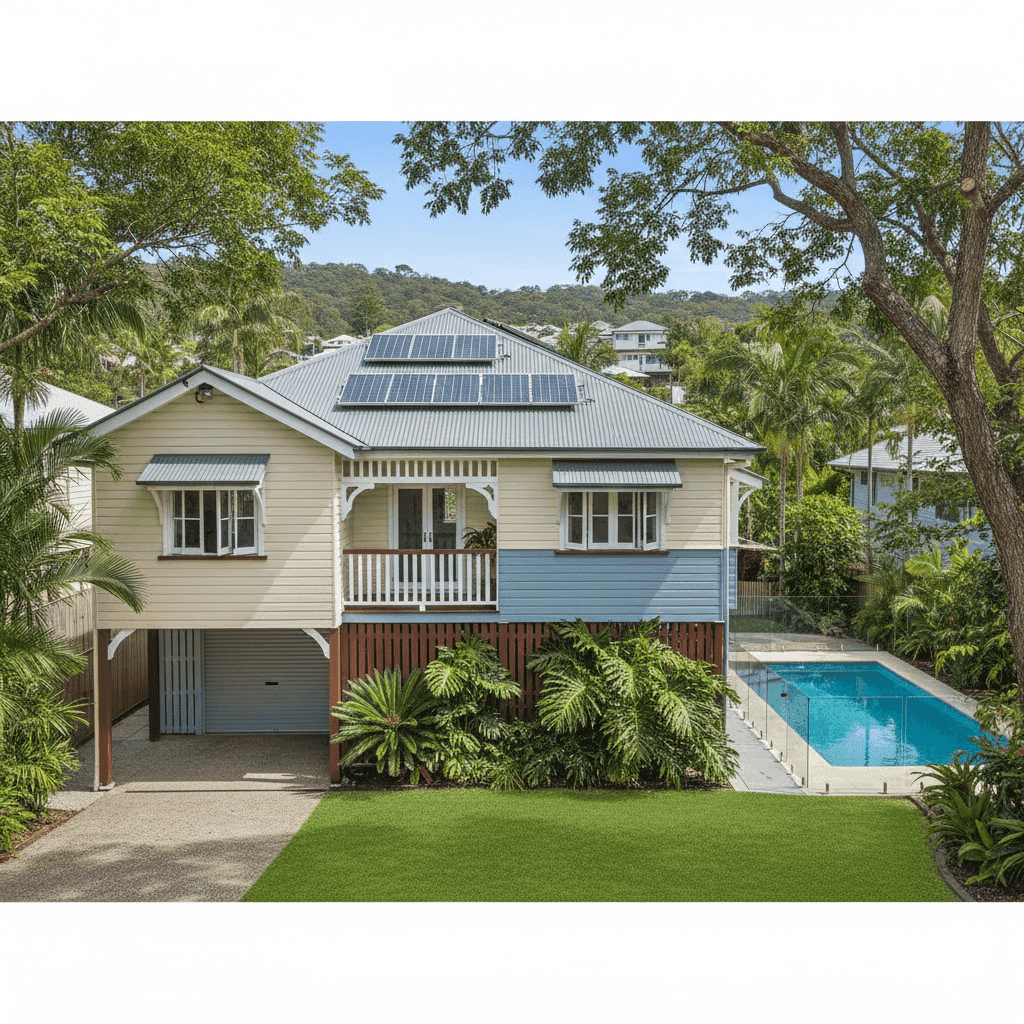
Ashgrove is one of Brisbane's most sought-after inner-north-west suburbs — a leafy, hilly pocket of Queensland that blends character homes with modern builds. This analysis looks at a real home and contents insurance quote for a four-bedroom, four-bathroom free-standing home in Ashgrove (QLD 4060), built in 2022 with premium finishes. If you're a homeowner in the area wondering whether your own premium stacks up, read on.
---
Is This Quote Fair?
The short answer: this quote is rated Expensive — sitting above average for the suburb, the state, and the nation.
The annual premium of $5,529 (or $543/month) covers both building (sum insured: $1,000,000) and contents ($220,000), with a $3,000 building excess and a $600 contents excess. While the coverage amounts are substantial — reflecting a high-value, well-appointed property — the premium itself is noticeably elevated compared to what most Ashgrove homeowners are paying.
To put it plainly: based on a sample of 47 quotes collected for Ashgrove (QLD 4060), the suburb average sits at $3,520/yr and the median at $3,398/yr. This quote comes in at roughly 57% above the suburb average — a significant gap that warrants a closer look at the property's risk profile.
That said, it's worth remembering that averages don't tell the whole story. A quote is the product of dozens of individual risk factors, and this particular property has several features that insurers treat as higher-risk or higher-value. More on those below.
---
How Ashgrove Compares
Understanding where Ashgrove sits in the broader insurance landscape helps contextualise any individual quote. Here's a snapshot:
| Benchmark | Average Premium | Median Premium |
|---|---|---|
| Ashgrove (QLD 4060) | $3,520/yr | $3,398/yr |
| Brisbane LGA | $4,485/yr | — |
| Queensland | $4,547/yr | $3,931/yr |
| National | $2,965/yr | $2,716/yr |
A few things stand out here. First, Ashgrove's suburb average of $3,520 is actually well below the Queensland state average of $4,547 — suggesting that, as a suburb, Ashgrove is relatively affordable to insure compared to much of Queensland. This likely reflects its inland position (no coastal storm surge risk), absence of a cyclone risk classification, and predominantly established residential character.
Second, Queensland as a whole is considerably more expensive to insure than the national average — about 53% higher on a median basis ($3,931 vs $2,716). This is a well-known reality driven by Queensland's exposure to severe weather events, including flooding, hailstorms, and cyclones in northern regions. You can explore Queensland-wide insurance data or national benchmarks for further context.
The quote in question, at $5,529, exceeds even the Queensland state average — which brings us to the property itself.
---
Property Features That Affect Your Premium
This isn't a standard entry-level home, and insurers price accordingly. Several characteristics of this property are likely pushing the premium higher:
High Sum Insured
A building sum insured of $1,000,000 is well above typical for a 153 sqm home, even a newly built one. Combined with $220,000 in contents cover, the total insured value of $1,220,000 represents significant exposure for any insurer. Premium scales with coverage — the more you're insured for, the more you pay.
Above-Average Fittings Quality
The property is rated as having above-average fittings — think high-end kitchens, premium bathrooms, engineered flooring, and quality fixtures throughout. Insurers account for this because replacing or repairing premium finishes costs considerably more than standard equivalents.
Weatherboard Timber Construction
Weatherboard wood external walls are a classic Queensland building material, beloved for their aesthetic but considered higher risk by insurers than brick veneer or full brick. Timber is more susceptible to fire, rot, and pest damage, which can translate into higher premiums.
Elevated on Stumps
The home is elevated by at least one metre on stumps — a hallmark of the traditional Queenslander style. While elevation can actually reduce flood risk in some scenarios, stumped foundations introduce additional structural complexity and replacement costs. Insurers factor in the cost of restumping or repairing sub-floor structures.
Steel/Colorbond Roof
A Colorbond steel roof is generally viewed positively by insurers — it's durable, fire-resistant, and low-maintenance. This feature is unlikely to be adding to the premium and may even be moderating it slightly.
Pool, Solar Panels & Ducted Climate Control
The presence of a swimming pool, solar panel system, and ducted climate control all add to the insured value of the property. Pools carry liability considerations; solar panels are expensive to replace; and ducted systems are a significant asset that must be covered under the building sum insured.
New Build (2022)
A 2022 construction year means the home is only a few years old — generally a positive factor, as newer homes are built to current codes with modern materials. This may be providing some downward pressure on the premium relative to an older equivalent.
---
Tips for Homeowners in Ashgrove
If you're looking to manage your home insurance costs in Ashgrove, here are four practical steps worth considering:
- Review your sum insured carefully. A $1,000,000 building sum insured is substantial for a 153 sqm home. Use a building cost calculator to verify whether your sum insured accurately reflects rebuild costs — over-insuring is a common and costly mistake.
- Compare quotes before renewing. Loyalty rarely pays in home insurance. Insurers regularly offer better rates to new customers, and the gap between the cheapest and most expensive quotes for the same property can be thousands of dollars. Get a fresh quote at CoverClub to see what's available.
- Consider adjusting your excess. This quote carries a $3,000 building excess. Opting for a higher excess (if you can comfortably self-insure smaller claims) can meaningfully reduce your annual premium. Conversely, a lower excess may cost more upfront but reduce out-of-pocket expenses at claim time.
- Ask about discounts for home security and safety features. Many insurers offer premium reductions for homes with monitored alarm systems, deadbolts, and fire safety equipment. Given the timber construction of this property, demonstrating active fire risk mitigation could be particularly valuable.
---
Ready to Find a Better Rate?
Whether you're reviewing your current policy or shopping for the first time, comparing multiple quotes is the single most effective way to ensure you're not overpaying. CoverClub makes it easy to benchmark your premium against real data from your suburb and state.