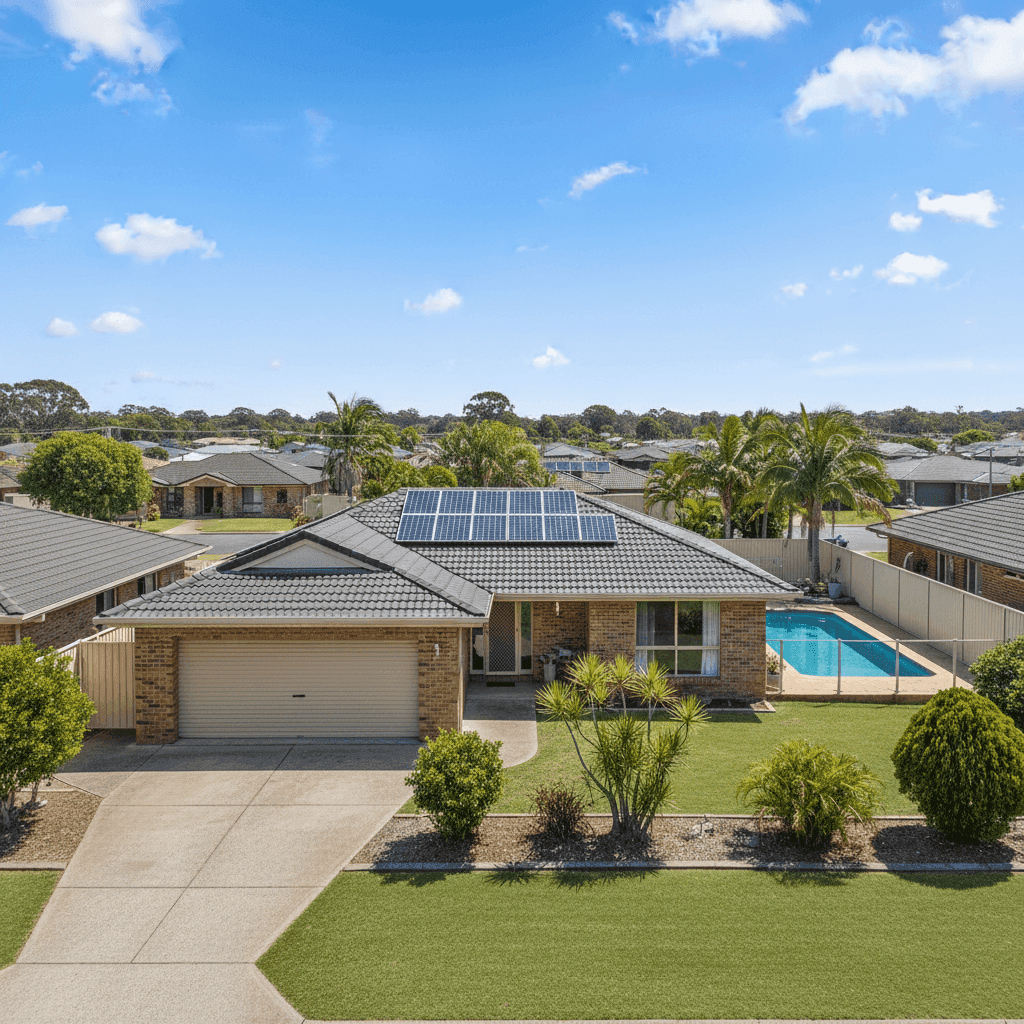
If you own a free standing home in Banora Point, NSW 2486, you're likely paying close attention to the cost of home and contents insurance — especially as premiums across Australia have climbed sharply in recent years. This article takes a detailed look at a real insurance quote for a three-bedroom, three-bathroom brick veneer home in Banora Point, breaks down whether the price is competitive, and offers practical tips to help you get better value on your cover.
---
Is This Quote Fair?
The quote in question comes in at $4,989 per year (or $478/month) for combined home and contents cover, with a building sum insured of $502,000 and contents valued at $50,000. Both the building and contents excess are set at $1,000.
Our pricing engine rates this quote as FAIR — Around Average, and the data backs that up. At $4,989 annually, this premium sits comfortably within the typical range for similar properties in the suburb, falling between the 25th percentile ($3,531/yr) and the 75th percentile ($5,997/yr) for Banora Point. It's also slightly below the suburb's average premium of $5,083/yr, which is a modest but meaningful saving.
In short, this isn't a bargain-basement price, but it's not an outlier either. For a property with a pool, solar panels, and ducted climate control — all features that add both value and risk exposure — landing near the suburb average is a reasonable outcome.
---
How Banora Point Compares
Understanding where your premium sits relative to broader benchmarks helps put the "fair" rating into sharper context. Here's how Banora Point stacks up:
| Benchmark | Average Premium | Median Premium |
|---|---|---|
| Banora Point (suburb) | $5,083/yr | $4,189/yr |
| NSW (state) | $9,528/yr | $3,770/yr |
| National | $5,347/yr | $2,764/yr |
| Tweed LGA | $26,089/yr | — |
A few things stand out here. The NSW state average of $9,528/yr is strikingly high, but this is heavily skewed by coastal and flood-prone areas — particularly parts of the Northern Rivers and greater Sydney — where premiums can be extreme. The state median of $3,770/yr is far more representative of typical NSW homeowners, and this quote sits above that figure.
Nationally, the average premium is $5,347/yr, so this quote is actually slightly below the national average — a positive sign. The national median of $2,764/yr reflects the fact that many Australian homeowners in lower-risk areas pay relatively modest premiums, pulling the midpoint down.
Perhaps the most striking figure is the Tweed LGA average of $26,089/yr. This number is heavily influenced by high-risk properties within the broader Tweed local government area — particularly those in flood zones or coastal erosion corridors. Banora Point, while part of the Tweed LGA, benefits from a more favourable risk profile, which is clearly reflected in its much lower suburb-level premiums.
You can explore the full data for this suburb at CoverClub's Banora Point stats page, compare it against NSW state-wide insurance data, or view national home insurance benchmarks.
Note: Suburb-level figures are based on a sample of 27 quotes, so results should be interpreted as indicative rather than exhaustive.
---
Property Features That Affect Your Premium
Every home is different, and insurers price risk based on a combination of location, construction, and the features present on the property. Here's how the key characteristics of this home likely influence the premium:
Brick Veneer Walls & Tiled Roof Brick veneer is one of the most common — and insurer-friendly — wall constructions in Australia. It offers solid fire resistance and durability, which typically attracts more competitive premiums compared to timber or weatherboard homes. Combined with a tiled roof, this construction profile is considered relatively low-risk by most insurers.
Slab Foundation A concrete slab foundation is generally viewed favourably by insurers. It's resistant to termite damage and tends to perform well in stable soil conditions, which are common in the Banora Point area.
Swimming Pool A pool adds meaningful value to the property but also introduces liability risk. Most insurers factor in the presence of a pool when calculating both building and liability components of a home policy. It's worth confirming your policy explicitly covers pool equipment, fencing, and any associated structures.
Solar Panels Solar panels are increasingly common on Australian homes, but they do add to the replacement cost of a property. A $502,000 building sum insured on a 139 sqm home built in 1990 should ideally account for the full cost of reinstating the solar system — not just the structure itself. It's worth verifying this with your insurer.
Ducted Climate Control Ducted air conditioning systems are a significant fixed asset. Like solar panels, they should be factored into your building sum insured to avoid being underinsured in the event of a total loss.
1990 Construction Homes built around 1990 are generally well-regarded by insurers — they predate some of the quality concerns associated with certain construction eras, but are old enough that electrical, plumbing, and roofing systems may warrant periodic inspection to remain in good condition and compliant with policy requirements.
No Cyclone Risk Banora Point is not classified as a cyclone risk area, which is a notable premium benefit. Properties in cyclone-prone parts of Queensland or the NT can pay significantly more for equivalent cover.
---
Tips for Homeowners in Banora Point
1. Review your building sum insured regularly With solar panels, ducted air conditioning, and a pool, the true replacement cost of this property could easily exceed a rough estimate. Use a building cost calculator — many insurers provide one — and update your sum insured at each renewal to avoid being caught underinsured.
2. Consider a higher excess to reduce your premium Both the building and contents excess on this policy are set at $1,000. Increasing the excess to $2,000 or more can meaningfully reduce your annual premium. This works well if you're financially comfortable absorbing a larger out-of-pocket cost in the event of a claim.
3. Ask about bundling discounts Many insurers offer discounts when you hold multiple policies — such as combining home and contents (already done here), car insurance, or landlord insurance. If you're not already bundling, it's worth asking your insurer what's available.
4. Compare quotes at renewal, not just when you first buy The insurance market shifts regularly, and loyalty doesn't always pay. Even if your current premium seems fair, running a comparison at renewal time could reveal a better deal for equivalent or superior cover. Get a fresh quote at CoverClub to see how your current policy stacks up.
---
Ready to Compare?
Whether you're reviewing an existing policy or shopping for the first time, understanding what you're paying — and why — is the first step to smarter insurance decisions. CoverClub makes it easy to compare home and contents quotes for properties across Australia, with transparent pricing data and suburb-level benchmarks.
Start comparing quotes for your Banora Point home today and make sure your cover is working as hard as you are.