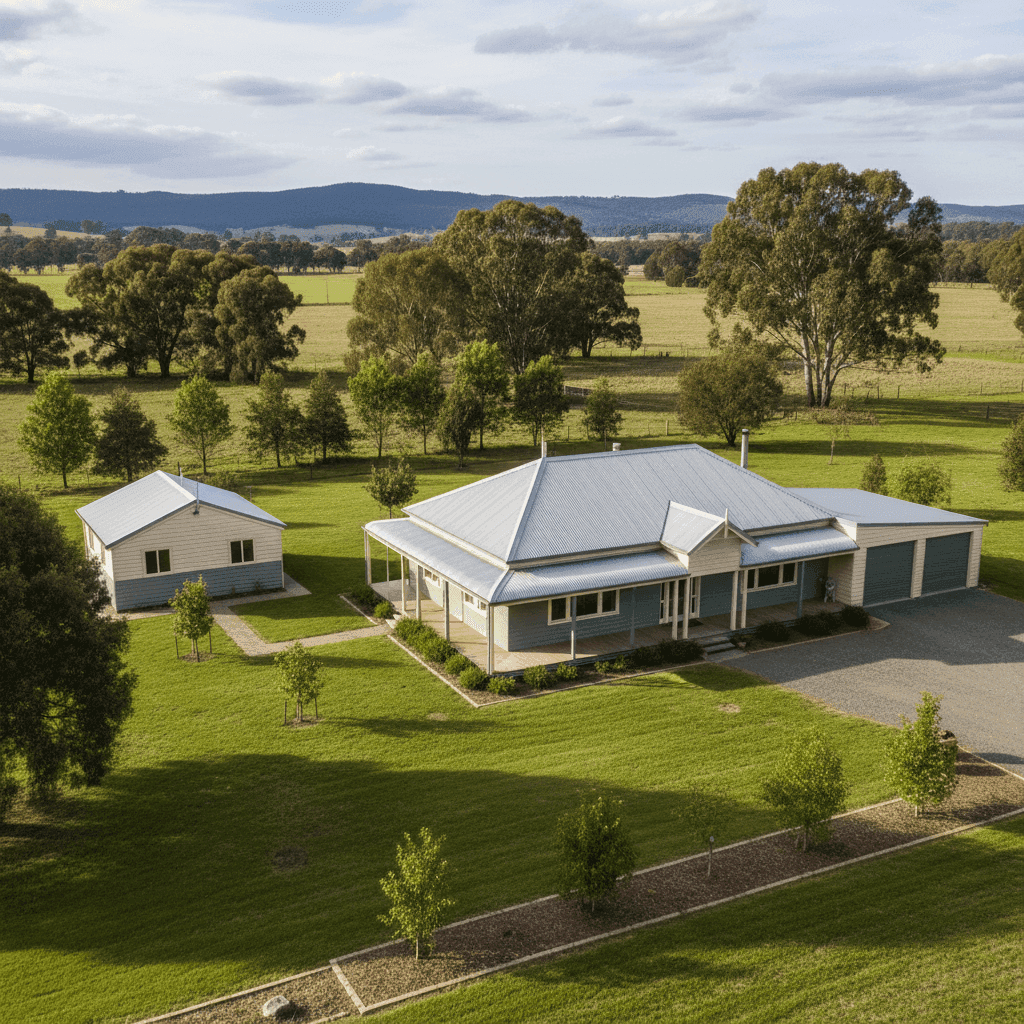
Tucked away in the rolling rural landscape of central Victoria, Barfold (VIC 3444) is a quiet locality in the Mitchell Shire — the kind of place where properties have character, space, and a genuine connection to the land. If you own a free-standing home here, understanding what you should be paying for home and contents insurance is just as important as knowing your property's value. This article breaks down a real insurance quote for a 2-bedroom, 1-bathroom free-standing home in Barfold and puts it in context against state and national benchmarks.
---
Is This Quote Fair?
The annual premium for this property came in at $1,617 per year (or around $159 per month), covering both building and contents with a building sum insured of $498,000 and contents valued at $50,000.
Our pricing engine rates this quote as CHEAP — below average — which is genuinely good news for the homeowner. A below-average premium doesn't mean below-average cover; it simply means this property and its characteristics have attracted competitive pricing relative to the broader market.
The building excess sits at $3,000, which is on the higher side and is likely one of the levers keeping the annual premium lower. The contents excess of $600 is more standard. Homeowners should weigh up whether the lower premium justifies the higher out-of-pocket cost in the event of a building claim — for many, it's a worthwhile trade-off, particularly if the home is well-maintained and in a lower-risk area.
---
How Barfold Compares
There isn't enough suburb-level data to produce a Barfold-specific average, but we can draw meaningful comparisons from the broader region and state. You can explore available Barfold insurance statistics here.
Here's how this quote stacks up:
| Benchmark | Annual Premium |
|---|---|
| This Quote | $1,617 |
| Mitchell LGA Average | $2,950 |
| VIC State Average | $2,921 |
| VIC State Median | $2,694 |
| National Average | $2,965 |
| National Median | $2,716 |
The savings here are substantial. Compared to the Victorian state average of $2,921, this homeowner is paying $1,304 less per year — a saving of roughly 45%. Against the national average of $2,965, the gap is even wider at $1,348.
Even measured against the Mitchell LGA average of $2,950 — the most geographically relevant comparison — this quote represents a significant undercut. Rural properties in Mitchell Shire can carry elevated risk profiles due to bushfire exposure and distance from emergency services, so achieving a premium this far below the LGA average is noteworthy.
---
Property Features That Affect Your Premium
Several characteristics of this property likely contribute to its competitive pricing:
Weatherboard Timber Walls
Weatherboard construction is common in older Victorian homes and carries a moderate risk profile. Timber can be more susceptible to fire and moisture damage than brick veneer, which can push premiums up — but it's also a well-understood construction type that insurers price with confidence.
Steel/Colorbond Roof
Colorbond roofing is generally viewed favourably by insurers. It's durable, resistant to corrosion, and holds up well in high-wind events. Compared to terracotta or concrete tiles, Colorbond roofs tend to attract lower premiums, particularly in areas prone to storms.
Stump Foundation
Homes on stumps (also called pier foundations) are elevated off the ground, which can reduce flood and moisture-related risk at ground level. However, they can be more vulnerable to certain structural events and may require periodic maintenance to keep stumps in good condition. Insurers factor this in, though it's not necessarily a premium-inflating feature.
Timber and Laminate Flooring
These flooring types are standard in homes of this era and construction style. They're relatively straightforward to repair or replace, which keeps contents and building claims manageable.
1989 Construction
At around 35 years old, this home sits in a middle-ground age bracket — old enough to have some wear, but not so old as to trigger significant concerns about outdated wiring or plumbing that might affect older homes. The building sum insured of $498,000 appears reasonable for a 139 sqm home with standard fittings in a regional Victorian setting.
Granny Flat on the Property
The presence of a granny flat is worth noting. Depending on the policy, a secondary dwelling may or may not be automatically covered under the main home policy. Homeowners should confirm with their insurer whether the granny flat's structure and any contents within it are explicitly included in the coverage — or whether a separate policy or endorsement is needed.
No Pool, Solar Panels, or Ducted Climate Control
The absence of these features simplifies the risk profile. Pools, solar installations, and ducted systems each add complexity (and potential claims exposure) to a home insurance policy. Not having them keeps things straightforward and can contribute to a leaner premium.
---
Tips for Homeowners in Barfold
1. Review your granny flat coverage explicitly Don't assume your granny flat is automatically covered under your main home and contents policy. Ask your insurer directly whether the secondary dwelling's structure and any contents are included — and get it in writing. If it's not covered, you may need a separate policy or a specific endorsement.
2. Reassess your building sum insured regularly Construction costs have risen sharply across regional Victoria in recent years. A sum insured of $498,000 for a 139 sqm home may be appropriate today, but it's worth recalculating annually using a building cost estimator to ensure you're not underinsured. Being underinsured can leave you significantly out of pocket after a major claim.
3. Consider your bushfire preparedness The Mitchell Shire includes areas with bushfire risk. Even if your immediate surroundings feel low-risk, it's worth checking your property's Bushfire Attack Level (BAL) rating and ensuring your policy covers bushfire damage explicitly. Maintaining defensible space around the home can also reduce risk and may be viewed favourably by insurers.
4. Weigh up your excess versus premium trade-off The $3,000 building excess on this policy is relatively high. If you're financially comfortable absorbing that cost in the event of a claim, the lower annual premium makes good sense. But if a $3,000 out-of-pocket expense would be a strain, it may be worth exploring policies with a lower excess — even if the annual premium is slightly higher.
---
Compare Quotes for Your Barfold Home
Whether you're a long-time Barfold resident or new to the area, it always pays to compare. Insurance premiums vary significantly between providers for the same property, and the difference can run to hundreds — or even thousands — of dollars per year. Get a home insurance quote at CoverClub to see how your current policy stacks up and whether there's a better deal waiting for you.