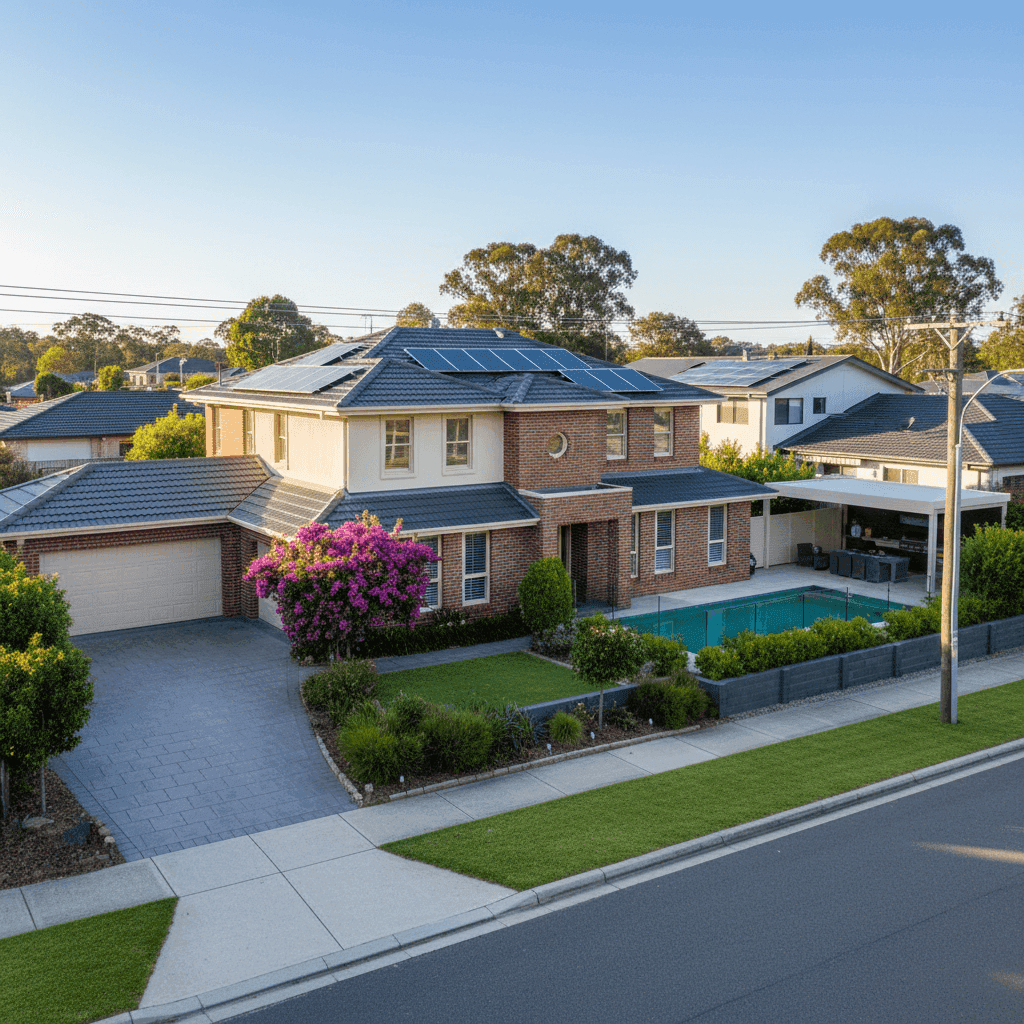
If you own a free standing home in Belmont North, NSW 2280, you're likely no stranger to the balancing act of finding solid insurance coverage without paying more than you need to. This article breaks down a real home and contents insurance quote for a five-bedroom property in the area, compares it against local, state, and national benchmarks, and offers practical tips to help you get better value on your next renewal.
---
Is This Quote Fair?
The quote in question comes in at $4,548 per year (or $441 per month) for combined home and contents cover, with a building sum insured of $1,096,000 and contents valued at $86,000. Both the building and contents excess are set at $1,000.
Our price rating for this quote is FAIR — Around Average, and the data backs that up. Within Belmont North, the average annual premium sits at $3,992, while the median is $3,651. This quote lands above both of those figures, but it's well within the suburb's 75th percentile of $4,888 — meaning roughly three-quarters of comparable quotes in the area cost less, but a meaningful portion cost more.
In other words, this isn't a bargain, but it's not an outlier either. Given the size and features of the property — 235 sqm, five bedrooms, four bathrooms, a pool, solar panels, and ducted climate control — a premium above the suburb median is entirely reasonable. Larger, better-equipped homes simply cost more to insure.
---
How Belmont North Compares
Understanding where your premium sits relative to broader benchmarks can be just as useful as knowing your suburb average. Here's how Belmont North stacks up:
| Benchmark | Average Premium | Median Premium |
|---|---|---|
| Belmont North (NSW 2280) | $3,992/yr | $3,651/yr |
| New South Wales | $9,528/yr | $3,770/yr |
| Australia (National) | $5,347/yr | $2,764/yr |
| Lake Macquarie LGA | $11,064/yr | — |
(Based on a sample of 41 quotes in the Belmont North suburb.)
A few things stand out here. The NSW state average of $9,528 looks alarming at first glance, but the state median of $3,770 tells a more grounded story — a handful of very high-risk or high-value properties are pulling that average upward significantly. The same dynamic plays out at the national level, where the average of $5,347 is nearly double the median of $2,764.
The Lake Macquarie LGA average of $11,064 is particularly eye-catching. This figure reflects the diversity of properties across the broader local government area, which includes coastal, lakeside, and bushfire-adjacent locations that can carry substantially higher premiums. Belmont North itself is relatively well-positioned within that broader context.
You can explore more detailed data for your area on the Belmont North suburb stats page, or compare it against the NSW state overview and national insurance statistics.
---
Property Features That Affect Your Premium
Every home is different, and insurers assess a wide range of property characteristics when calculating your premium. Here's how the features of this particular property come into play:
Brick veneer construction with a tiled roof Brick veneer is generally viewed favourably by insurers — it's durable, fire-resistant, and relatively low maintenance. Combined with a tiled roof, this construction profile is considered solid and tends to attract more competitive premiums compared to timber-framed or metal-roofed homes.
Slab foundation A concrete slab foundation is standard for homes of this era and is generally not a risk flag for insurers. It provides good structural stability and is less susceptible to subsidence issues than some other foundation types.
Built in 1996 Homes from the mid-1990s are in a sweet spot — they're modern enough to have been built under reasonably robust building codes, but old enough that some components (roofing, plumbing, electrical) may be approaching the age where wear and tear becomes a consideration. Keeping up with maintenance is key.
Swimming pool A pool adds both value and liability exposure. Insurers factor in the cost of pool-related damage (e.g., structural issues, equipment failure) as well as the potential for third-party liability claims. This will contribute to a higher premium compared to an equivalent home without a pool.
Solar panels Solar panels are increasingly common on Australian rooftops, but they do add to the replacement cost of a home. Insurers need to account for panel replacement in the event of storm, hail, or fire damage. Make sure your building sum insured specifically accounts for your solar system's value.
Ducted climate control Ducted systems are a significant installation — both in terms of cost and complexity. Their inclusion in the building sum insured is important, as replacement costs can run into the tens of thousands of dollars.
235 sqm building size, 5 bedrooms, 4 bathrooms This is a substantial home. The $1,096,000 building sum insured reflects the cost to rebuild a property of this size and specification, which is the most important figure to get right when taking out building insurance.
---
Tips for Homeowners in Belmont North
1. Review your building sum insured annually Construction costs have risen sharply in recent years. If your sum insured hasn't kept pace with current rebuild costs — particularly for a larger home with premium features like ducted air conditioning and a pool — you could be significantly underinsured. Use a building calculator or speak with a quantity surveyor to verify your figure.
2. Check that your solar panels are explicitly covered Not all policies automatically include solar panels in the building sum insured. Review your Product Disclosure Statement (PDS) carefully and confirm whether panels, inverters, and mounting hardware are covered — and for what events (storm, hail, fire, theft).
3. Compare quotes before your renewal date The insurance market is competitive, and premiums can vary significantly between providers for virtually identical cover. Don't let your policy auto-renew without shopping around. Even a FAIR-rated quote like this one could potentially be improved with a targeted comparison.
4. Consider your excess settings Both the building and contents excess on this quote are set at $1,000. Opting for a higher excess can reduce your annual premium — but make sure it's an amount you could genuinely afford to pay out of pocket in the event of a claim. Finding the right balance is personal, but it's worth modelling the trade-off.
---
Compare Your Home Insurance at CoverClub
Whether you're reviewing an existing policy or shopping for cover on a new property, CoverClub makes it easy to see how your premium stacks up. Get a home insurance quote today and find out if you're getting fair value — or if there's a better deal waiting for you.