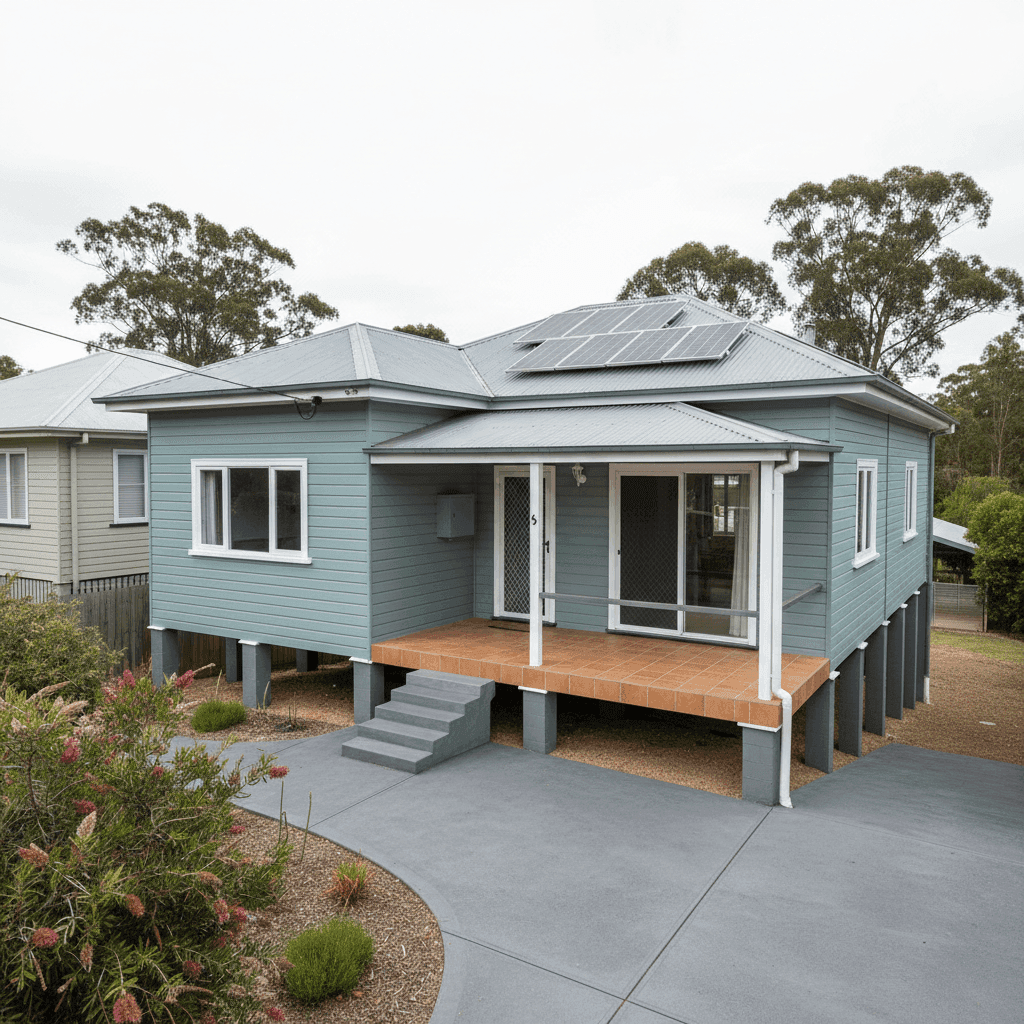
If you own a free standing home in Belmont North, NSW 2280, you've probably wondered whether you're paying a fair price for home insurance — or quietly overpaying year after year. This article breaks down a real home and contents insurance quote for a four-bedroom, three-bathroom weatherboard home in the suburb, and puts the numbers into context using suburb, state, and national benchmarks.
---
Is This Quote Fair?
The annual premium for this property came in at $4,782 per year (or $451/month), covering a building sum insured of $702,000 and $100,000 in contents — both with a $1,000 excess.
Our pricing engine has rated this quote as FAIR — Around Average, which means it's broadly in line with what similar properties in the area are attracting, but it's not the sharpest price on the market either.
To put that in perspective:
- The suburb average for Belmont North is $3,992/yr, and the median sits at $3,651/yr
- This quote lands between the 75th percentile ($4,888/yr) and the suburb average — meaning roughly 75% of comparable quotes in the area come in cheaper
- That said, it's still well below the suburb's upper range, so it's not an outlier
A "Fair" rating doesn't mean you should simply accept the price. It means there's room to compare — and potentially save — without sacrificing coverage quality.
---
How Belmont North Compares
Understanding where Belmont North sits within the broader insurance landscape helps frame whether this quote is genuinely reasonable.
| Benchmark | Average Premium | Median Premium |
|---|---|---|
| Belmont North (NSW 2280) | $3,992/yr | $3,651/yr |
| NSW (State) | $9,528/yr | $3,770/yr |
| National | $5,347/yr | $2,764/yr |
| Lake Macquarie LGA | $11,064/yr | — |
A few things stand out here. The NSW state average of $9,528/yr is dramatically higher than the state median of $3,770 — a sign that a relatively small number of very high-risk or high-value properties (think flood-prone or coastal areas) are pulling the average up significantly. Belmont North's premiums sit comfortably below both the state and national averages, which is a positive sign for homeowners in the area.
The Lake Macquarie LGA average of $11,064/yr looks alarming at first glance, but again, this is heavily skewed by higher-risk pockets within the local government area. Belmont North itself appears to be a more moderately priced suburb within the LGA.
Compared to the national average of $5,347/yr, this quote of $4,782 is actually slightly below — another reason the "Fair" rating holds up. You can explore how Belmont North stacks up in more detail on the Belmont North suburb stats page, or broaden your view with the NSW state insurance stats and national home insurance benchmarks.
---
Property Features That Affect Your Premium
Every home is different, and insurers price risk based on the specific characteristics of your property. Here's how the features of this particular home likely influence the premium:
Weatherboard Timber Walls
Weatherboard construction is one of the most common wall types in older Australian homes, but it carries a higher fire risk than brick or rendered concrete. Insurers typically apply a loading to timber-clad properties, which contributes to a higher base premium. Homes built in 1980 also fall into a bracket where maintenance history becomes important — ageing timber can mean increased risk of damage from storms or moisture ingress.
Steel / Colorbond Roof
On the plus side, a Colorbond steel roof is generally viewed favourably by insurers. It's durable, low-maintenance, and performs well in high-wind conditions compared to terracotta tiles or older corrugated iron. This feature likely helps moderate the premium.
Stump Foundation
Homes on stumps (also called pier or post foundations) can be more susceptible to movement and flood inundation depending on stump height. Insurers factor this in, particularly in coastal or low-lying areas. It's worth confirming your policy covers underfloor damage and vermin-related issues, as these can vary between providers.
Solar Panels
This property has solar panels installed, which adds replacement value to the building. Most standard home insurance policies cover rooftop solar as part of the building sum insured, but it's worth double-checking that your $702,000 building cover adequately accounts for the cost of replacing the system.
Ducted Climate Control
Ducted air conditioning systems are expensive to repair or replace — often $10,000–$25,000 or more for a full system. This is factored into both the building sum insured and, in some cases, the premium itself. Ensuring your building cover reflects the full replacement cost, including HVAC systems, is essential.
No Pool, Tiles Flooring, Standard Fittings
The absence of a pool removes a common liability risk. Tile flooring and standard-quality fittings are neutral factors — they're neither a significant risk driver nor a discount trigger, but they do help keep the building replacement cost estimate grounded.
---
Tips for Homeowners in Belmont North
1. Review Your Building Sum Insured Annually
Construction costs have risen sharply across Australia in recent years. A sum insured of $702,000 for a 130 sqm home works out to roughly $5,400 per square metre — which is on the higher end but may be appropriate given the age of the home, the stump foundation, and the inclusion of solar and ducted systems. Use a building cost calculator and revisit this figure each renewal to avoid being underinsured.
2. Compare at Least Three Quotes Before Renewing
This quote sits in a "Fair" range — not bad, but not market-leading either. With 41 quotes in the Belmont North sample, there's clearly a competitive market. Shopping around at renewal time is one of the simplest ways to save, and platforms like CoverClub make it easy to compare policies side by side.
3. Check What Your Policy Says About Timber Homes
Some insurers apply specific exclusions or conditions to weatherboard properties — particularly around fire, pest damage, or gradual deterioration. Before you renew, read the Product Disclosure Statement (PDS) carefully and ask your insurer directly about any clauses that apply to timber-clad homes.
4. Consider Increasing Your Excess to Reduce Premiums
Both the building and contents excess on this policy sit at $1,000. If you have sufficient savings to cover a higher out-of-pocket cost in the event of a claim, opting for a $2,000 or even $2,500 excess could meaningfully reduce your annual premium. Just make sure the saving is worth the additional risk you're absorbing.
---
Ready to Compare?
Whether you're renewing your current policy or shopping for cover on a new home, it pays to compare. CoverClub makes it simple to benchmark your premium against real quotes from across Australia — so you can walk into renewal season with confidence.