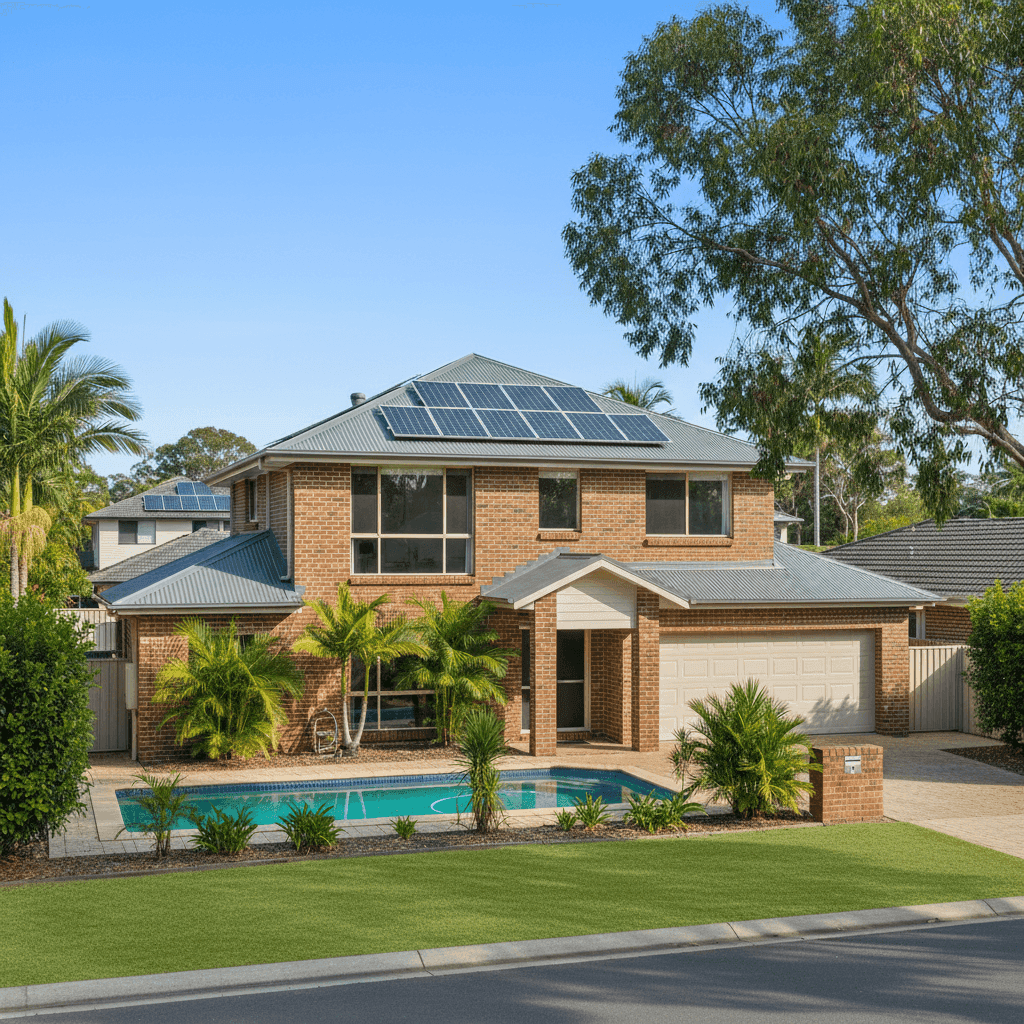
Benowa is one of the Gold Coast's most sought-after residential pockets — a leafy, established suburb in postcode 4217 that attracts families drawn to its quiet streets, quality schools, and proximity to everything the Gold Coast has to offer. If you own a free-standing home here, you already know the area commands premium real estate. But does your home insurance premium reflect good value, or are you paying more than you should?
This article breaks down a real home and contents insurance quote for a four-bedroom, four-bathroom free-standing home in Benowa, comparing it against local, state, and national benchmarks to help you understand exactly where you stand.
---
Is This Quote Fair?
The annual premium for this property came in at $3,561 per year (or $334/month), covering both building (sum insured: $1,052,000) and contents ($99,000), each with a $1,000 excess.
Our pricing engine has rated this quote as FAIR — Around Average.
That's a meaningful result. It tells you this isn't a standout bargain, but it's also not an overpriced outlier. In a suburb like Benowa, where property values are high and replacement costs are substantial, landing near the middle of the market is a reasonable outcome — particularly for a well-built brick veneer home on a slab foundation with a Colorbond roof.
The "fair" rating reflects the balance between the property's risk profile and the level of cover provided. With a building sum insured of just over $1 million and nearly $100,000 in contents cover, this is a comprehensive policy — and the price largely reflects that breadth of protection.
---
How Benowa Compares
To properly contextualise this quote, it helps to look at the numbers across three levels: the suburb, the state, and the nation.
Based on data from 71 quotes collected in the Benowa area:
| Benchmark | Premium |
|---|---|
| This Quote | $3,561/yr |
| Suburb Median | $3,419/yr |
| Suburb Average | $5,081/yr |
| Suburb 25th Percentile | $2,785/yr |
| Suburb 75th Percentile | $5,317/yr |
This quote sits just above the suburb median of $3,419 — meaning roughly half of comparable Benowa properties are paying less, and half are paying more. The fact that the suburb average is considerably higher at $5,081 suggests there are some very expensive policies in the area pulling that figure up, which is common in high-value suburbs where larger homes and higher sum-insured figures skew the data.
Zooming out to Queensland as a whole, the picture becomes more striking. The state average sits at a hefty $9,129/yr, though the median is a more moderate $3,903. Queensland's elevated averages are largely driven by high-risk areas — cyclone-prone coastal and far-north regions where premiums can be eye-watering. Benowa, notably, is not classified as a cyclone risk area, which is a meaningful advantage for homeowners in this suburb.
At the national level, the average premium is $5,347/yr with a median of $2,764. This quote sits comfortably between the national median and average — reinforcing the "fair" assessment.
For Gold Coast LGA context, the regional average is $8,161/yr — significantly above this quote, again reflecting the influence of higher-risk coastal and flood-prone properties across the broader LGA.
---
Property Features That Affect Your Premium
Every aspect of a home's construction and features feeds into how insurers calculate risk. Here's how this particular property's characteristics play out:
Brick Veneer Walls & Colorbond Roof Brick veneer is one of the most common and well-regarded construction types in Queensland. It offers solid fire resistance and structural integrity. Combined with a steel Colorbond roof — which is durable, lightweight, and highly resistant to corrosion — this home presents a relatively low-risk construction profile. Insurers generally view this combination favourably.
Concrete Slab Foundation Slab foundations are standard in Queensland and provide excellent stability. They're less susceptible to subsidence issues than older pier-and-beam constructions, which can translate to lower structural risk in insurer assessments.
Swimming Pool A pool adds both value and liability to a property. Insurers factor in the cost of pool infrastructure when assessing building replacement costs, and it can also influence public liability considerations within a home policy.
Solar Panels With solar panels on the roof, the building sum insured needs to account for the replacement cost of the system. Solar panels can be damaged by hail, storms, or falling debris, and quality home insurance should cover them as part of the building. It's worth confirming your policy explicitly includes solar panel cover.
Ducted Climate Control Ducted air conditioning is a significant fixed asset — it's built into the structure and typically covered under the building component of a policy. The cost of replacing a full ducted system can run into tens of thousands of dollars, which is reflected in the building sum insured.
235 sqm, 4 Bedrooms & 4 Bathrooms At 235 sqm with four bedrooms and four bathrooms, this is a well-appointed family home. The high bathroom-to-bedroom ratio suggests quality fittings and finishes, which contributes to the $1,052,000 building sum insured — a figure that needs to reflect true rebuild cost, not market value.
---
Tips for Homeowners in Benowa
1. Review Your Building Sum Insured Annually Construction costs have risen significantly in recent years. A sum insured set a few years ago may no longer reflect the true cost to rebuild your home. Use a building cost calculator or speak with a quantity surveyor to ensure you're not underinsured — particularly with a home of this size and quality.
2. Confirm Solar Panel and Pool Coverage Not all policies automatically include solar panels or pool equipment under the standard building definition. Read your Product Disclosure Statement (PDS) carefully to confirm these assets are explicitly covered, and check whether there are sub-limits that might leave you short after a claim.
3. Consider Your Excess Strategy Both the building and contents excesses on this policy sit at $1,000. While a higher excess typically reduces your annual premium, it also means more out-of-pocket expense at claim time. Review whether the premium saving from a higher excess genuinely justifies the increased financial exposure for your circumstances.
4. Don't Auto-Renew Without Comparing The insurance market in Benowa is active — 71 quotes in our dataset alone — and premiums vary widely. The difference between the 25th and 75th percentile in this suburb is over $2,500 per year. Shopping around at renewal time, even if your current insurer has treated you well, could yield meaningful savings without sacrificing cover quality.
---
Compare Your Home Insurance Today
Whether you're reviewing an existing policy or shopping for the first time, understanding where your premium sits relative to the market is the first step to making a confident decision. CoverClub makes it easy to see real data for your suburb and get a tailored quote in minutes. Don't leave money on the table — compare today and make sure your cover is working as hard as your home.