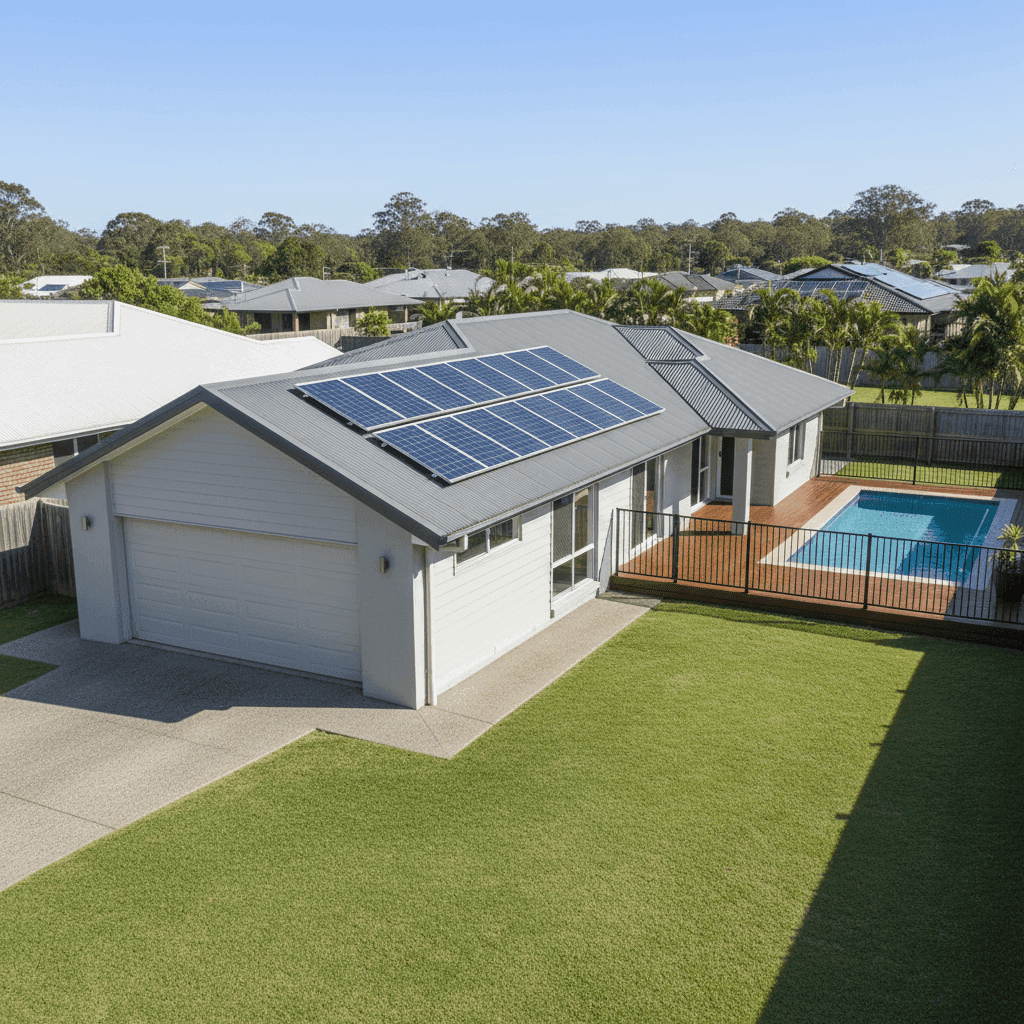
If you own a free standing home in Bethania, QLD 4205, you've probably wondered whether you're paying a fair price for home and contents insurance — or whether there's a better deal waiting to be found. Bethania is a quiet residential suburb in the City of Logan, sitting roughly 30 kilometres south of Brisbane's CBD. It's a popular choice for families, and its housing stock includes a solid mix of older brick and fibre-cement homes on generous blocks. In this article, we break down a real insurance quote for a 3-bedroom free standing home in the area, compare it against local and national benchmarks, and offer practical tips to help you make the most of your cover.
---
Is This Quote Fair?
The quote in question comes in at $3,077 per year (or $295 per month) for combined home and contents insurance, covering a building sum insured of $683,000 and contents valued at $102,000. Both the building and contents excess are set at $1,000.
Our price rating for this quote is FAIR — Around Average, which is a reasonable outcome for this type of property and location.
To understand what "fair" actually means in dollar terms, it helps to look at the spread of quotes we've seen across Bethania. Based on 49 quotes collected for postcode 4205, the suburb average sits at $4,141 per year, while the median is $2,998 per year. This quote of $3,077 lands just slightly above the suburb median — meaning roughly half of comparable properties in Bethania are insured for less, and half for more.
The 25th percentile for the suburb is $2,153/yr and the 75th percentile is $5,289/yr, so this quote sits comfortably within the middle band of the market. It's not the cheapest available, but it's a long way from the most expensive, and for a property with a pool, solar panels, and a building sum insured of nearly $700,000, it represents reasonable value.
---
How Bethania Compares
Context is everything when evaluating an insurance premium. Here's how this quote stacks up across three levels of comparison:
| Benchmark | Average | Median |
|---|---|---|
| Bethania (4205) | $4,141/yr | $2,998/yr |
| LGA (Logan) | $4,617/yr | — |
| Queensland | $9,129/yr | $3,903/yr |
| National | $5,347/yr | $2,764/yr |
A few things stand out here. First, Queensland's state average of $9,129 per year is extraordinarily high compared to both the suburb and national figures — this is largely driven by extreme premiums in cyclone-prone and flood-affected parts of North Queensland, which pull the state average up significantly. The state median of $3,903 is a more representative figure for south-east Queensland homeowners.
Second, Bethania's suburb average of $4,141 is actually below the Logan LGA average of $4,617, suggesting that Bethania sits in a relatively more insurable pocket of the region. This is consistent with Bethania's position away from the most flood-prone areas of Logan.
Compared to national benchmarks, this quote is slightly above the national median of $2,764 but well below the national average of $5,347. The national average, like Queensland's, is skewed upward by high-risk regions — so the median is typically the more useful comparison for a metropolitan fringe suburb like Bethania.
---
Property Features That Affect Your Premium
Several characteristics of this property directly influence what insurers charge. Understanding these factors can help you anticipate pricing and identify potential savings.
Hardiplank / Hardiflex external walls Fibre cement cladding like Hardiplank is generally viewed favourably by insurers. It's resistant to rot, termites, and fire, and it holds up well in Queensland's humid subtropical climate. Compared to older weatherboard or asbestos-clad homes of the same era, this material typically attracts more competitive premiums.
Steel / Colorbond roof A Colorbond roof is one of the most insurer-friendly roofing materials available in Australia. It's durable, low-maintenance, and performs well in high-wind events. Insurers tend to price these roofs more favourably than older tile or fibrous cement sheet roofs, particularly for homes built in the 1980s.
Concrete slab foundation Slab-on-ground construction is standard for Queensland homes of this vintage and is generally considered stable and predictable from an underwriting perspective. It reduces the risk of subfloor moisture issues and structural movement compared to raised timber stumped foundations.
Swimming pool A pool adds value to the property but also introduces additional liability and maintenance considerations. Most insurers factor pool ownership into their pricing, and it can contribute modestly to a higher premium — particularly for liability components of the policy.
Solar panels Solar panels are increasingly common on Queensland homes, and most insurers now include them as a standard part of building cover. However, their replacement cost can be significant, and insurers are aware of this. It's worth confirming with your insurer that your solar system is explicitly covered under your building sum insured.
1985 construction A home built in 1985 is now over 40 years old. While well-maintained homes of this era can be perfectly sound, insurers do factor in age when pricing risk — particularly around plumbing, electrical systems, and roofing. Keeping up with maintenance and having documentation of any upgrades can help when it comes to claims.
---
Tips for Homeowners in Bethania
1. Check that your building sum insured reflects current rebuild costs With construction costs rising sharply across south-east Queensland over the past few years, many homeowners are underinsured without realising it. A sum insured of $683,000 for a 130 sqm home works out to roughly $5,254 per square metre — which is within a reasonable range for a standard-quality build, but worth reviewing annually as labour and material costs fluctuate.
2. Confirm your solar panels and pool equipment are covered Don't assume these are automatically included at their full replacement value. Ask your insurer specifically whether solar panels, inverters, and pool equipment (pumps, filters, heating systems) are covered under your building policy and up to what limit.
3. Consider your excess level carefully Both building and contents excesses are set at $1,000 on this policy. Opting for a higher excess (say, $2,000 or $2,500) can meaningfully reduce your annual premium — but only makes sense if you have the financial buffer to cover that amount in the event of a claim. It's a worthwhile trade-off to model out.
4. Compare quotes at renewal, not just at inception Insurance loyalty rarely pays. Premiums can shift significantly from year to year, and the market is competitive. Even if your current insurer offers a renewal price that seems reasonable, it's worth running a comparison to see what else is available for your specific property profile.
---
Ready to Compare?
Whether you're reviewing your current policy or shopping for cover on a new property, CoverClub makes it easy to see what the market looks like for your specific home. Get a quote at CoverClub and compare your options side by side — no jargon, no pressure, just clear pricing information to help you make a confident decision.