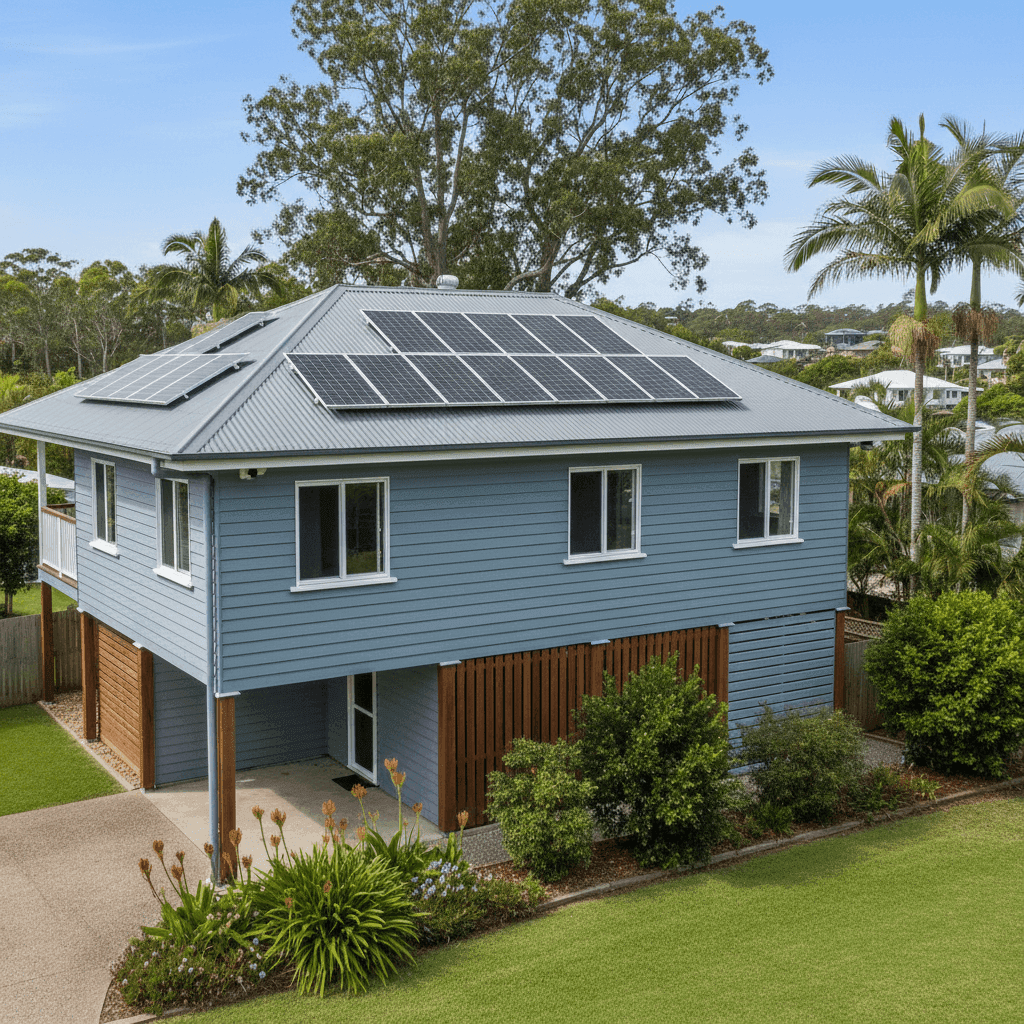
Home insurance in Queensland can vary enormously depending on where you live, what your home is made of, and how much cover you need. This article takes a close look at a real home and contents insurance quote for a three-bedroom, two-bathroom free standing home in Bli Bli, QLD 4560 — a relaxed riverside suburb on the Sunshine Coast — and puts it in context against local, state, and national benchmarks.
---
Is This Quote Fair?
The quote in question comes in at $3,298 per year (or $309 per month), covering a building sum insured of $539,000 and contents valued at $50,000, each with a $1,000 excess. Our pricing engine rates this as Fair — Around Average, which is a reasonable result for a property of this type and size in the current insurance climate.
"Fair" doesn't mean you're getting a bargain, but it does mean you're not being overcharged relative to comparable properties in the area. Given the elevated insurance costs seen across Queensland — driven by flood exposure, storm risk, and the broader pressures of climate-related claims — landing near the average is a solid outcome.
For a 214 sqm weatherboard home built in 1993 with above-average fittings, a sum insured of $539,000 is substantial but not unusual. Replacement costs for homes with quality fixtures and finishes have risen sharply in recent years, and underinsurance remains one of the most common pitfalls for Australian homeowners.
---
How Bli Bli Compares
To understand whether this premium is genuinely competitive, it helps to look at the broader data. Based on 81 quotes collected for Bli Bli (postcode 4560):
| Benchmark | Premium |
|---|---|
| This quote | $3,298/yr |
| Bli Bli suburb average | $3,303/yr |
| Bli Bli suburb median | $2,717/yr |
| Bli Bli 25th percentile | $2,016/yr |
| Bli Bli 75th percentile | $4,051/yr |
This quote sits almost exactly on the suburb average — just $5 below it — which confirms the "Fair" rating. However, it's worth noting that the median is noticeably lower at $2,717/yr. The gap between the average and median suggests a portion of Bli Bli properties are attracting significantly higher premiums (likely larger homes, higher-risk constructions, or greater sum-insured values), which pulls the average upward.
Zooming out to the Queensland state level, the picture becomes more striking:
- QLD state average: $4,547/yr
- QLD state median: $3,931/yr
- Sunshine Coast LGA average: $4,608/yr
This quote comes in $1,249 below the Queensland average and $1,310 below the Sunshine Coast LGA average — a meaningful saving. Queensland is one of the most expensive states for home insurance in Australia, largely due to its exposure to severe weather events including tropical storms, flooding, and hail.
Compared to national figures, the story is more nuanced:
- National average: $2,965/yr
- National median: $2,716/yr
At $3,298/yr, this quote is above the national average by around $333, which is expected for a Queensland property. Homeowners in southern states — particularly Victoria and South Australia — typically enjoy lower premiums due to reduced natural hazard exposure.
---
Property Features That Affect Your Premium
Several characteristics of this property have a direct bearing on the premium charged.
Weatherboard timber walls are a well-known risk factor for insurers. Timber is more susceptible to fire, termite damage, and general weathering than brick or rendered masonry. Many insurers apply a loading to weatherboard homes, particularly older ones, which can push premiums higher.
The 1993 construction year places this home in a generation of Queensland residential builds that predate some of the more stringent modern building codes. While it's not an especially old home, properties of this era may have older electrical systems, plumbing, or structural elements that increase the likelihood of a claim.
Stump foundations are common in Queensland and allow for airflow beneath the home — a practical design in a subtropical climate. However, stumps can deteriorate over time and may require periodic inspection and replacement. Some insurers factor this into their risk assessment.
A steel/Colorbond roof is generally viewed favourably. Colorbond is durable, low-maintenance, and performs well in high-wind and hail events compared to terracotta or concrete tiles. This likely has a moderating effect on the premium.
Solar panels add value to the property and are worth noting from a coverage perspective. Homeowners should confirm whether their policy explicitly covers solar panels under the building sum insured, as coverage can vary between insurers.
Above-average fittings quality is reflected in the higher building sum insured. Kitchens, bathrooms, and fixtures of above-average quality cost more to repair or replace, which is appropriately captured in the $539,000 sum insured.
---
Tips for Homeowners in Bli Bli
1. Review your sum insured annually Construction costs have risen significantly over the past few years. If your building sum insured hasn't been updated recently, there's a real risk you could be underinsured. Use a building cost calculator or speak with a quantity surveyor to verify your figure is still adequate.
2. Ask about timber/weatherboard loadings Not all insurers treat weatherboard homes the same way. Some apply significant loadings while others are more competitive for this construction type. Shopping around — or using a comparison service — can help you find an insurer that prices weatherboard homes more favourably.
3. Confirm your solar panels are covered With solar panels now a feature of this property, it's worth reading the fine print. Some policies cover panels as part of the building, others require a specific endorsement, and a few may exclude them altogether. Make sure you're not left exposed.
4. Consider a higher excess to reduce your premium At $1,000, the excess on this policy is fairly standard. If you have the financial capacity to absorb a larger out-of-pocket cost in the event of a claim, increasing your excess to $1,500 or $2,000 could reduce your annual premium by a meaningful amount.
---
Compare Your Options with CoverClub
Whether you're renewing your current policy or shopping for the first time, it pays to compare. CoverClub makes it easy to see how your quote stacks up against real data from your suburb, your state, and across the country. Get a home insurance quote today and find out if you're paying a fair price — or if there's a better deal waiting for you.