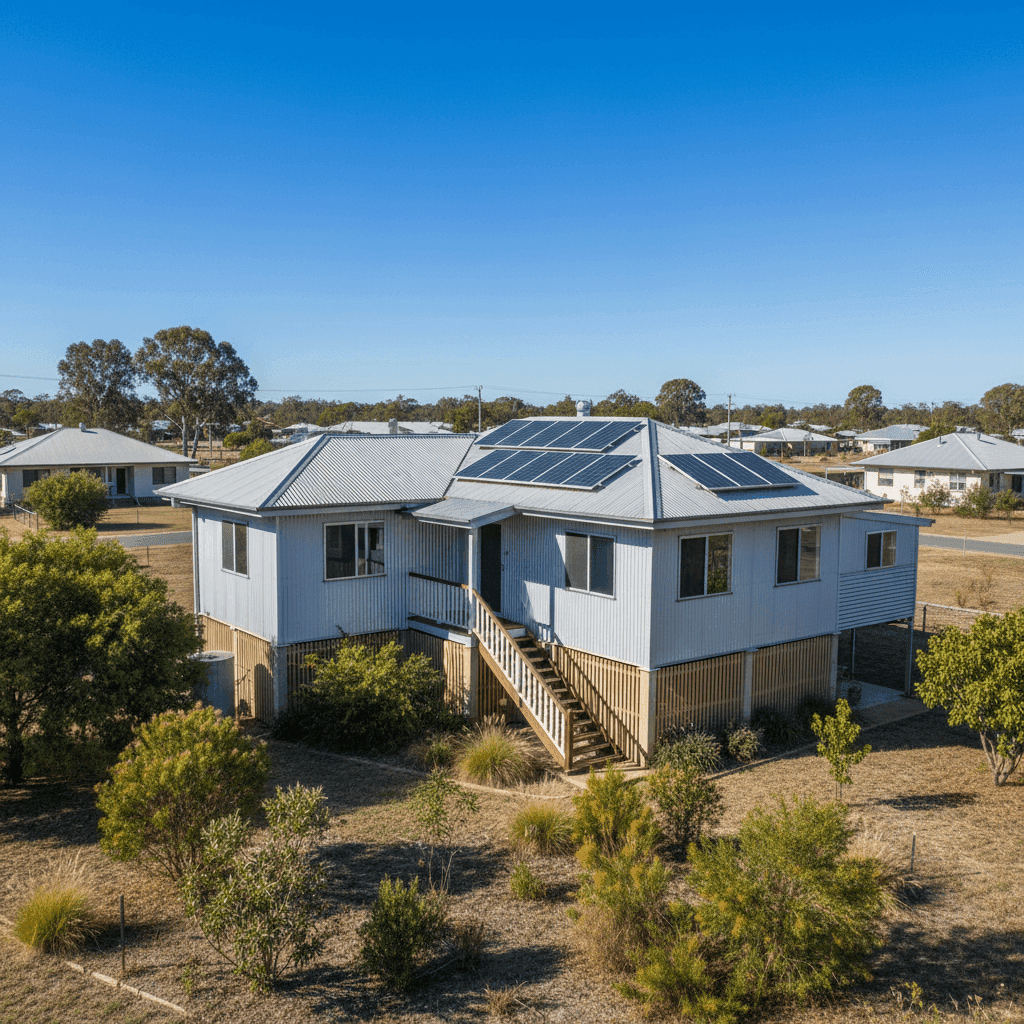
If you own a free standing home in Bluff, QLD 4702, you've probably wondered whether you're paying a fair price for home and contents insurance — or whether you could be doing better. This article breaks down a real insurance quote for a 2-bedroom, 2-bathroom property in Bluff, compares it against local, state, and national benchmarks, and offers practical tips to help you get the best value cover.
---
Is This Quote Fair?
The annual premium for this property came in at $1,516 per year (or roughly $145 per month), covering both building ($401,000 sum insured) and contents ($71,000). Our pricing engine rates this as CHEAP — below average for the area.
To put that in perspective: the average home and contents premium across quotes collected for Bluff sits at $3,592 per year, with a median of $3,885. That means this quote is approximately 58% below the suburb average — a genuinely strong result for the policyholder.
Even compared to the cheapest end of the local market, this quote holds up well. The 25th percentile of Bluff premiums (i.e., the price point where 75% of quotes are more expensive) is $2,294 per year — still nearly $800 more than what's quoted here. In short, this is an outlier in the best possible sense.
---
How Bluff Compares to QLD and Australia
Understanding how your suburb stacks up against broader markets is a useful reality check. Here's how Bluff sits within the wider landscape:
| Benchmark | Average Premium | Median Premium |
|---|---|---|
| Bluff (4702) | $3,592/yr | $3,885/yr |
| Queensland | $9,129/yr | $3,903/yr |
| National | $5,347/yr | $2,764/yr |
A few things stand out here. Queensland's average premium of $9,129 is exceptionally high — significantly above both the national average and the Bluff suburb average. This is largely driven by high-risk postcode areas across Far North Queensland, coastal flood zones, and cyclone-prone regions that push the state-wide average up dramatically. The QLD median of $3,903 is far more representative of what most Queensland homeowners actually pay, and it's very close to Bluff's own median.
At the national level, the average of $5,347 is similarly skewed by extreme-risk regions. The national median of $2,764 is actually below the Bluff suburb median, which suggests that Bluff sits in a moderately priced insurance zone — not the cheapest in Australia, but far from the most expensive either.
The quote analysed here, at $1,516, sits well below every benchmark — suburb, state, and national medians alike. You can explore more local data on the Bluff suburb insurance stats page, compare it against the Queensland state overview, or view national home insurance benchmarks.
> Note: The Bluff sample size for this comparison is 12 quotes, which is a relatively small dataset. Averages may shift as more data is collected, so treat suburb-level figures as indicative rather than definitive.
---
Property Features That Affect Your Premium
Every insurer assesses risk differently, but the physical characteristics of a property play a significant role in determining your premium. Here's how the features of this particular home likely influence its pricing:
Construction year (1965): Older homes can attract higher premiums due to ageing infrastructure — older wiring, plumbing, and structural materials can increase the likelihood of claims. That said, a well-maintained 1965 home with modern upgrades may not carry a significant penalty.
Aluminium external walls: Aluminium cladding is generally considered low-maintenance and resistant to rust and rot, which can be a positive from an insurer's perspective. It's also lightweight, which may reduce structural risk compared to heavier wall materials.
Steel/Colorbond roof: Colorbond is one of the most popular roofing materials in Australia for good reason — it's durable, fire-resistant, and performs well in a range of weather conditions. Insurers typically view it favourably, and it may contribute to a lower premium compared to older tile or fibrous cement roofing.
Stumps (raised foundation): Homes on stumps are common in Queensland, particularly in older builds. This foundation type can offer some protection from ground-level flooding and allows for ventilation beneath the floor. However, it can also introduce risks around subfloor maintenance and pest damage.
Solar panels: The presence of solar panels adds value to the property and should be reflected in the sum insured. Most home insurance policies cover solar panels as part of the building, but it's worth confirming this with your insurer to avoid being underinsured.
Ducted climate control: Ducted air conditioning is a significant fixture and contributes to the overall building replacement cost. Ensuring the sum insured accounts for the full cost of reinstating these systems is important.
No pool, no cyclone risk zone: The absence of a pool removes a common liability risk, and being outside a designated cyclone risk area means the property avoids the substantial premium loading that applies to many North Queensland homes.
---
Tips for Homeowners in Bluff
Whether you're reviewing an existing policy or shopping for new cover, these tips are worth keeping in mind:
1. Review your sum insured regularly Building costs have risen significantly across Australia in recent years. A sum insured that was adequate a few years ago may no longer cover the full cost of rebuilding your home. Factor in the cost of labour, materials, and any improvements — including your solar system and ducted air conditioning — when calculating your building cover.
2. Check that solar panels are explicitly covered Not all policies automatically include solar panels in building cover, or they may apply sub-limits. Ask your insurer directly whether your panels, inverter, and mounting hardware are fully covered under the building sum insured.
3. Don't auto-renew without comparing The fact that this quote came in well below the suburb average is a reminder that premiums can vary enormously between insurers for the same property. Shopping around at renewal time — even if you've been happy with your current insurer — can uncover meaningful savings.
4. Consider your excess carefully This policy carries a $1,000 building excess and a $500 contents excess. Opting for a higher excess is one way to reduce your annual premium, but make sure the excess is an amount you could comfortably pay in the event of a claim. Conversely, if your current excess feels too high, it may be worth comparing policies with lower excess options.
---
Compare Your Own Quote
Whether you're a long-time Bluff local or new to the area, it pays to know what you should be paying for home insurance. CoverClub makes it easy to compare real quotes for your property and see exactly how your premium stacks up against your neighbours. Get a home insurance quote today and find out if you're getting a fair deal — or leaving money on the table.