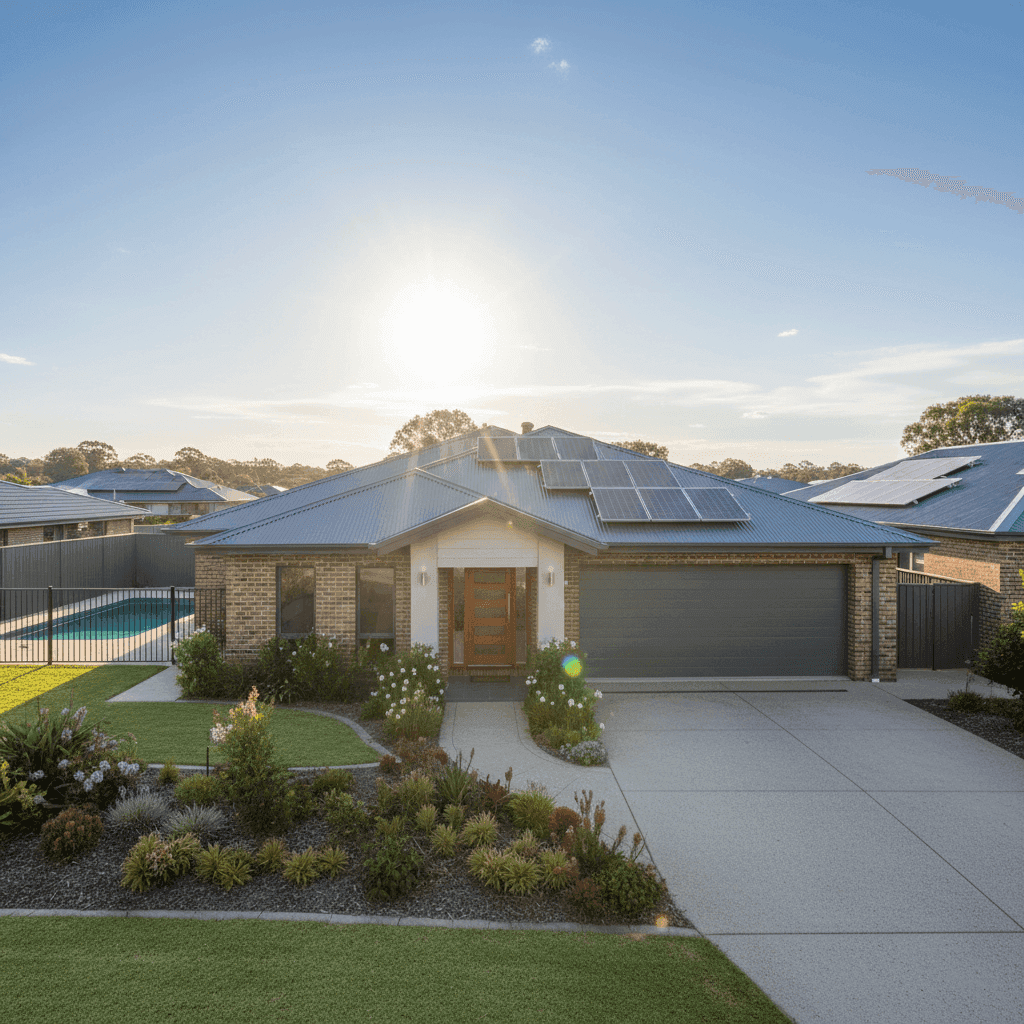
Bonville is a quiet, leafy suburb on the NSW Mid North Coast, sitting just inland from Coffs Harbour. It's a popular spot for families and sea-changers drawn to its relaxed lifestyle and well-established residential streets. But like anywhere in regional NSW, home insurance costs here deserve a close look — especially when you're insuring a substantial four-bedroom free-standing home with a pool, solar panels, and ducted climate control.
This article breaks down a recent Home and Contents insurance quote for a 4-bedroom, 2-bathroom brick veneer home in Bonville (postcode 2450), built in 2011 on a slab foundation with a Colorbond roof and timber/laminate flooring. The building is insured for $850,000 with $80,000 in contents cover, carrying a $5,000 excess on both components.
---
Is This Quote Fair?
The quoted annual premium comes in at $3,567 per year (or $335/month), and our pricing analysis rates this as FAIR — Around Average.
That rating reflects where the quote sits relative to comparable properties in the area. It's not a bargain, but it's not an outlier either. For a home of this size and specification — 214 sqm, with a pool, solar panels, and a high building sum insured of $850,000 — a premium in this range is broadly consistent with what the market is pricing for similar risks in the suburb.
The $5,000 excess on both building and contents is on the higher side. Insurers typically offer lower premiums in exchange for higher excesses, so part of what's keeping this quote "around average" rather than above it is likely that elevated excess figure. Homeowners comfortable absorbing a larger out-of-pocket cost in the event of a claim can often use this lever to reduce their annual outlay.
---
How Bonville Compares
To put this quote in context, here's how it stacks up against Bonville suburb averages, NSW state figures, and national benchmarks:
| Benchmark | Average | Median |
|---|---|---|
| Bonville (2450) | $3,039/yr | $2,876/yr |
| NSW | $3,801/yr | $3,410/yr |
| National | $2,965/yr | $2,716/yr |
At $3,567/yr, this quote sits above the Bonville suburb average of $3,039 and above the national average of $2,965 — but below the NSW state average of $3,801. It also falls comfortably within the suburb's interquartile range (25th percentile: $2,154 — 75th percentile: $3,852), which is why it earns a "Fair" rather than "Expensive" rating.
One figure that stands out is the Clarence Valley LGA average of $6,052/yr — significantly higher than the Bonville suburb figure. This suggests that while Bonville itself sits in a relatively favourable risk pocket within the LGA, other parts of Clarence Valley face considerably steeper premiums, likely driven by flood exposure, bushfire risk, or other localised hazards. Bonville homeowners are in a comparatively better position within their broader council area.
It's also worth noting the suburb sample size of 23 quotes — a reasonably small dataset, meaning suburb averages can shift as more data comes in. For the most up-to-date local benchmarks, check the Bonville stats page.
---
Property Features That Affect Your Premium
Several characteristics of this property have a meaningful influence on what insurers charge:
Brick Veneer Walls & Colorbond Roof This is a well-regarded construction combination in the Australian insurance market. Brick veneer offers solid fire resistance and structural durability, while Colorbond steel roofing is lightweight, long-lasting, and performs well in high-wind conditions. Insurers generally view this pairing favourably compared to, say, weatherboard cladding or terracotta tiles.
Slab Foundation A concrete slab is considered a stable, low-risk foundation type. It reduces exposure to underfloor moisture and pest damage, which can be a premium factor in older homes with suspended timber floors.
Timber & Laminate Flooring While aesthetically popular, timber and laminate floors carry a slightly higher replacement cost than concrete or basic carpet, which can nudge contents and building valuations upward. This is worth keeping in mind when reviewing your sum insured.
Swimming Pool Pools add both value and liability to a property. From an insurance perspective, they increase the replacement cost of the home and can be a source of claims (structural damage, pump and filtration systems, etc.). Not all policies cover pool equipment as standard, so it's worth confirming what's included.
Solar Panels Rooftop solar systems are increasingly common, but they're not always automatically covered under a standard building policy. Some insurers include them; others require a specific endorsement. With panels on this property, it's essential to confirm they're listed under the building sum insured and that the $850,000 figure accounts for their replacement value.
Ducted Climate Control Ducted air conditioning systems are expensive to repair or replace — easily $10,000–$20,000 for a full system. Ensuring this is captured in the building sum insured is important for avoiding underinsurance.
No Cyclone Risk Bonville is not classified as a cyclone risk area, which removes one of the more significant premium loading factors seen further north along the Queensland coast. This works in the homeowner's favour.
---
Tips for Homeowners in Bonville
1. Review your sum insured annually With a building insured for $850,000, it's critical to keep pace with rising construction costs. Building costs in regional NSW have increased substantially in recent years, and underinsurance remains one of the most common — and costly — mistakes homeowners make. Use a building cost calculator or speak with a quantity surveyor to validate your figure each year.
2. Confirm solar panels and pool equipment are explicitly covered Don't assume — ask your insurer directly whether solar panels and pool equipment (pumps, filters, heating systems) are included in your building cover. If they're not, request an endorsement or factor them into your sum insured.
3. Shop around at renewal time A "Fair" rating means this quote is competitive, but the market moves. Insurers reprice risk regularly, and loyalty doesn't always pay. Running a fresh comparison at renewal — particularly given the spread between the 25th and 75th percentile premiums in Bonville — could uncover meaningful savings.
4. Consider whether your excess is working for you The $5,000 excess on both building and contents is high. While it does help keep premiums down, it means you're effectively self-insuring the first $5,000 of any claim. If your financial position has changed, it may be worth modelling what a lower excess would cost in premium terms.
---
Compare Your Home Insurance Today
Whether you're renewing soon or just curious about what the market looks like, CoverClub makes it easy to see how your current premium stacks up. Get a home insurance quote in minutes and compare it against real data from properties like yours across Bonville, NSW, and beyond. You might be paying around average — or you might find room to do better.