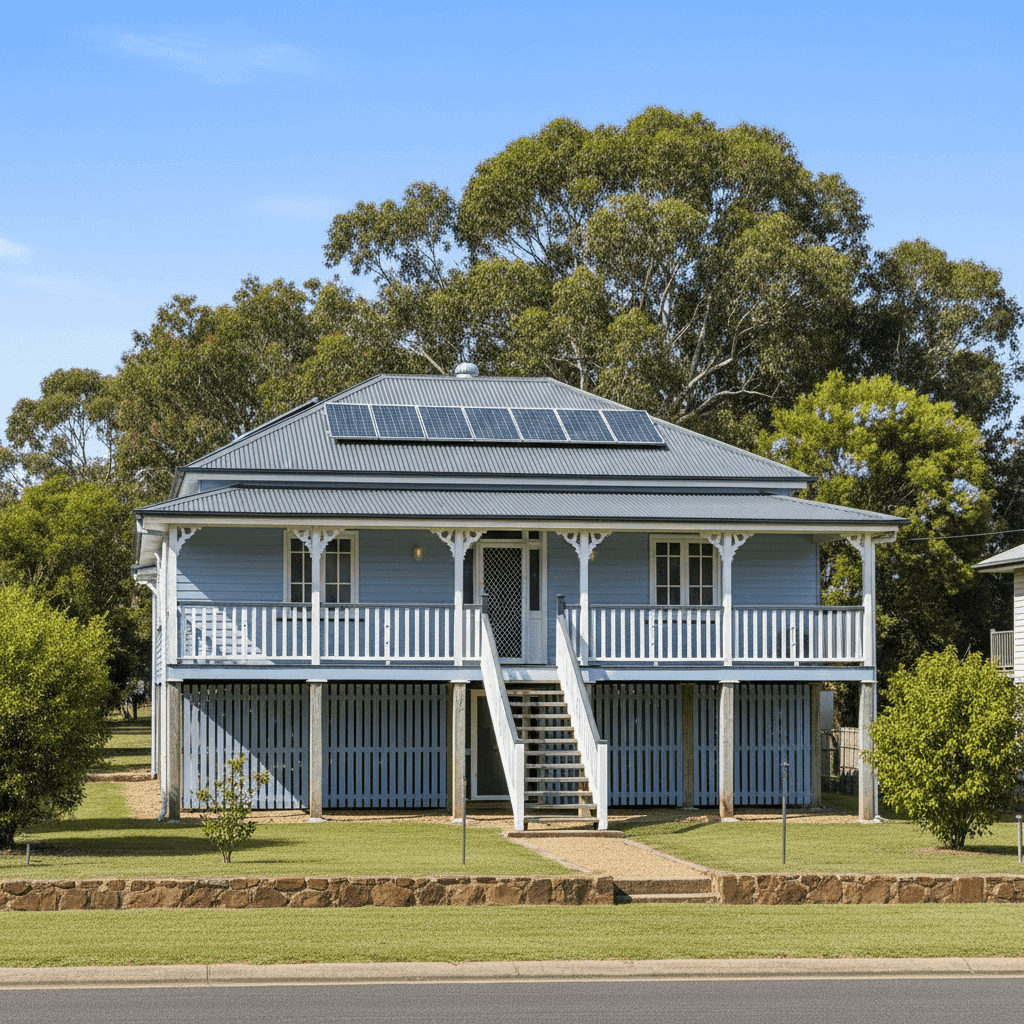
If you own a four-bedroom free standing home in Booie, QLD 4610, you're probably curious whether what you're paying for home insurance is competitive — or whether you're leaving money on the table. In this article, we break down a real home and contents insurance quote for a weatherboard property in Booie, compare it against suburb, state, and national benchmarks, and share practical tips to help you get better value on your cover.
---
Is This Quote Fair?
The quote in question comes in at $4,072 per year (or $394/month) for combined home and contents cover, with a building sum insured of $730,000 and contents valued at $25,000. The building excess is $5,000 and the contents excess is $1,000.
Our price rating for this quote is Expensive (Above Average).
To put that in perspective, the suburb average premium in Booie sits at $2,224/yr, with a median of $2,021/yr. This quote is roughly 83% above the suburb average and more than double the suburb median. Even when you look at the 75th percentile of quotes in the area — meaning 75% of comparable quotes are cheaper — that figure is $2,889/yr, still well below the $4,072 being paid here.
That said, it's worth understanding why a quote might sit above average before assuming it's simply overpriced. Several property-specific factors can legitimately push premiums higher, and we'll explore those in detail below.
---
How Booie Compares
Booie is a small rural locality in the South Burnett region of Queensland. Based on a sample of 58 quotes in the 4610 postcode, here's how the local market stacks up:
| Benchmark | Premium |
|---|---|
| Booie suburb average | $2,224/yr |
| Booie suburb median | $2,021/yr |
| Booie 25th percentile | $1,279/yr |
| Booie 75th percentile | $2,889/yr |
| South Burnett LGA average | $2,940/yr |
| QLD state average | $9,129/yr |
| QLD state median | $3,903/yr |
| National average | $5,347/yr |
| National median | $2,764/yr |
A few things stand out here. First, Booie's suburb averages are notably lower than both the Queensland state average and the national average. Queensland's state average of $9,129/yr is heavily skewed by high-risk coastal and cyclone-prone postcodes in Far North Queensland — Booie, which is not classified as a cyclone risk area, benefits from being inland and away from the most extreme weather zones.
At $4,072/yr, this quote is above the Booie suburb average and above the South Burnett LGA average of $2,940/yr, but it does sit comfortably below both the QLD state average and the national average. So while it's expensive relative to local comparisons, it's not out of step with broader Queensland pricing — and the property's specific characteristics likely account for some of the gap.
---
Property Features That Affect Your Premium
Several features of this property are worth examining through an insurance lens:
Weatherboard Timber Walls
Weatherboard wood cladding is one of the most common wall types in older Queensland homes, but it's also one that insurers view with caution. Timber is more susceptible to fire, rot, and termite damage than brick or rendered masonry, which typically translates to higher premiums. Homes with timber-framed external walls often attract a loading compared to brick equivalents.
Steel / Colorbond Roof
On the positive side, a Colorbond steel roof is generally well-regarded by insurers. It's durable, low-maintenance, and performs well in storms — a meaningful consideration in Queensland. This is unlikely to be pushing the premium up.
Stumps Foundation (Elevated)
This home sits on stumps and is elevated by less than one metre — a classic Queenslander-style construction. While stump foundations can be vulnerable to subfloor moisture and termite activity, the elevation also provides some flood resilience. The elevated design is a double-edged sword from an insurer's perspective.
Timber / Laminate Flooring
Timber and laminate floors can be costly to replace or repair after water damage or fire, which may contribute modestly to the building sum insured and, by extension, the premium.
Construction Year: 1989
At roughly 35 years old, this home falls into an age bracket where insurers may apply age loadings, particularly for a timber-clad property. Older homes can have ageing electrical systems, plumbing, and roofing that increase the likelihood of a claim.
Solar Panels
The property includes solar panels, which add to the replacement cost of the building. Solar systems can be expensive to repair or replace after hail, storm, or fire damage, and this is typically factored into the building sum insured calculation.
Ducted Climate Control
Ducted air conditioning is a significant fixed asset within the home and adds to the overall replacement cost, which flows through to the building sum insured and the premium.
Building Sum Insured: $730,000
At 205 sqm, a sum insured of $730,000 works out to approximately $3,561/sqm — which is on the higher end for a standard-finish property in a regional Queensland location. It's worth reviewing whether this figure accurately reflects the current cost to rebuild, as over-insuring can unnecessarily inflate your premium.
---
Tips for Homeowners in Booie
1. Review Your Sum Insured
Given the elevated building sum insured relative to the property size and standard fittings quality, it's worth getting a professional building replacement cost estimate. If the figure is higher than necessary, bringing it in line with a realistic rebuild cost could reduce your premium meaningfully — without leaving you underinsured.
2. Compare Multiple Quotes
The gap between the 25th percentile ($1,279/yr) and this quote ($4,072/yr) in the same suburb is substantial. Insurers price risk very differently, and shopping around through a comparison platform like CoverClub can surface significantly cheaper options for the same level of cover.
3. Consider a Higher Excess
The building excess on this policy is already set at $5,000, which is relatively high and should be helping to keep the premium lower than it might otherwise be. If you haven't already, confirm that this excess level is appropriate for your financial situation — a higher excess can reduce premiums, but you need to be comfortable covering that amount out of pocket in the event of a claim.
4. Maintain the Property Proactively
For a timber weatherboard home of this age, regular maintenance — treating for termites, repainting external timber, checking gutters and roof flashings — not only protects the property but can also support your insurer's willingness to offer competitive renewal pricing. Some insurers ask about maintenance history during the application process.
---
Ready to Find a Better Deal?
Whether you're renewing your current policy or shopping for the first time, it pays to compare. At CoverClub, we help Australian homeowners benchmark their premiums against real market data and find competitive quotes tailored to their property. Get a quote today and see how much you could save on your Booie home insurance.