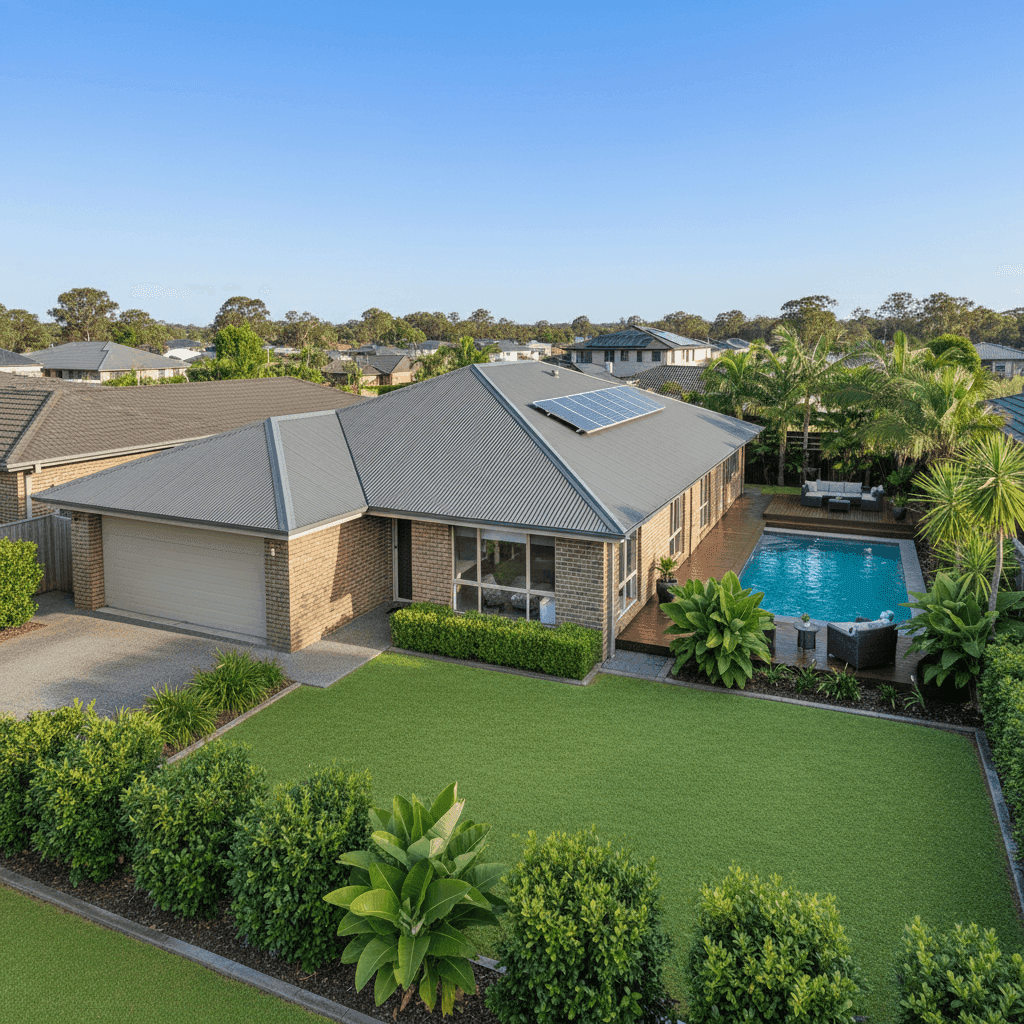
If you own a four-bedroom free standing home in Bracken Ridge, QLD 4017, you're probably curious about whether your home insurance premium is competitive — or whether you're leaving money on the table. This article breaks down a real home and contents insurance quote for a property in this northern Brisbane suburb, benchmarks it against local, state, and national data, and offers practical advice for homeowners in the area.
---
Is This Quote Fair?
The quote in question comes in at $2,066 per year (or roughly $202 per month) for combined home and contents cover, with a building sum insured of $797,000 and contents valued at $50,000. The building excess is set at $2,000, while the contents excess sits at $1,000.
Our pricing engine rates this quote as Fair — Around Average.
That's a reasonable result. It doesn't represent the cheapest cover available in the suburb, but it's meaningfully below what many Bracken Ridge homeowners are paying. Given the property's characteristics — a 1980-built brick veneer home on a slab foundation with a Colorbond roof, timber and laminate flooring, a swimming pool, and solar panels — this premium reflects a relatively well-managed risk profile.
A "Fair" rating means the quote sits comfortably within the normal range for comparable properties, neither an exceptional bargain nor an overpriced outlier. For homeowners who value certainty and comprehensive cover, this is a solid benchmark to work from.
---
How Bracken Ridge Compares
To understand where this quote lands, it helps to zoom out and look at the broader pricing landscape.
According to data from CoverClub's Bracken Ridge suburb stats, based on a sample of 43 quotes in postcode 4017:
| Benchmark | Premium |
|---|---|
| Suburb 25th percentile | $1,888/yr |
| This quote | $2,066/yr |
| Suburb median | $2,723/yr |
| Suburb average | $3,088/yr |
| Suburb 75th percentile | $3,705/yr |
At $2,066, this quote sits just above the 25th percentile for the suburb — meaning roughly three-quarters of comparable quotes in Bracken Ridge are more expensive. That's a strong result.
Compared to the broader Queensland state average of $4,547/yr, this quote is 55% cheaper — a substantial saving. The state median of $3,931 further underscores how competitive this premium is relative to Queensland as a whole, where flood-prone areas, cyclone zones, and high-value coastal properties push premiums up significantly.
Looking at national benchmarks, the picture is equally favourable. The national average sits at $2,965/yr and the national median at $2,716/yr — both well above this quote. Even within the Brisbane LGA, where the average premium is $4,485/yr, this quote stands out as notably affordable.
In short: if you're paying around $2,066 for home and contents cover on a property like this in Bracken Ridge, you're doing better than most.
---
Property Features That Affect Your Premium
Several characteristics of this property work in favour of a lower premium, while a couple of others add modest complexity to the risk assessment.
Brick veneer construction is generally viewed favourably by insurers. It offers solid fire resistance and structural durability, which typically translates to lower building premiums compared to weatherboard or lightweight cladding.
Colorbond steel roofing is another positive. It's lightweight, resistant to ember attack, and holds up well in severe weather events — all factors that reduce the likelihood of a significant claim.
Slab foundation properties are generally straightforward to insure. There's no underfloor space to worry about, which reduces certain subsidence and pest-related risks.
Timber and laminate flooring can add some replacement cost sensitivity to a contents or building claim, but at standard fittings quality, this is unlikely to move the needle significantly on pricing.
The swimming pool does add a small premium loading — pools introduce liability exposure and can be costly to repair or replace following storm or structural damage. However, this is a common feature in Brisbane's northern suburbs and insurers price it accordingly.
Solar panels are increasingly standard on Australian homes and most insurers now include them as part of the building sum insured. It's worth confirming with your insurer that your panels are covered under the building policy, particularly for storm damage or electrical faults.
The property was built in 1980, which places it in an era where construction standards were generally solid but pre-date some modern building codes. Insurers may factor in the age of electrical systems, plumbing, and roofing when assessing risk, so it's worth ensuring these have been updated or maintained in good condition.
Notably, Bracken Ridge is not classified as a cyclone risk area, which is a meaningful premium advantage compared to properties further north in Queensland.
---
Tips for Homeowners in Bracken Ridge
1. Review your building sum insured regularly A sum insured of $797,000 for a 235 sqm home works out to approximately $3,391 per square metre — broadly in line with current construction costs in southeast Queensland. However, building costs have risen sharply in recent years, so it's worth recalculating your replacement cost annually to avoid being underinsured. Use a quantity surveyor estimate or an online building cost calculator to stay current.
2. Check your pool and solar panel coverage Make sure your policy explicitly covers your swimming pool and solar panel system. Some policies treat solar panels as a separate item or apply specific sub-limits. Confirm what's included and whether accidental damage, storm damage, and electrical breakdown are all covered.
3. Consider your excess levels carefully This quote carries a $2,000 building excess and a $1,000 contents excess. Choosing a higher excess is one of the most effective ways to reduce your annual premium — but only if you're confident you could cover that cost out of pocket in the event of a claim. If cash flow is a concern, a lower excess with a slightly higher premium may be the smarter trade-off.
4. Compare quotes at renewal time Insurance loyalty rarely pays off. Insurers frequently offer better rates to new customers than to existing ones, so it's worth shopping around every 12 months. Even if your current insurer is competitive, knowing what else is available gives you leverage to negotiate or switch.
---
Ready to Compare?
Whether you're reviewing an existing policy or shopping for cover for the first time, comparing quotes is the single most effective way to make sure you're not overpaying. Get a home insurance quote at CoverClub and see how your premium stacks up against real data from your suburb and across Australia.