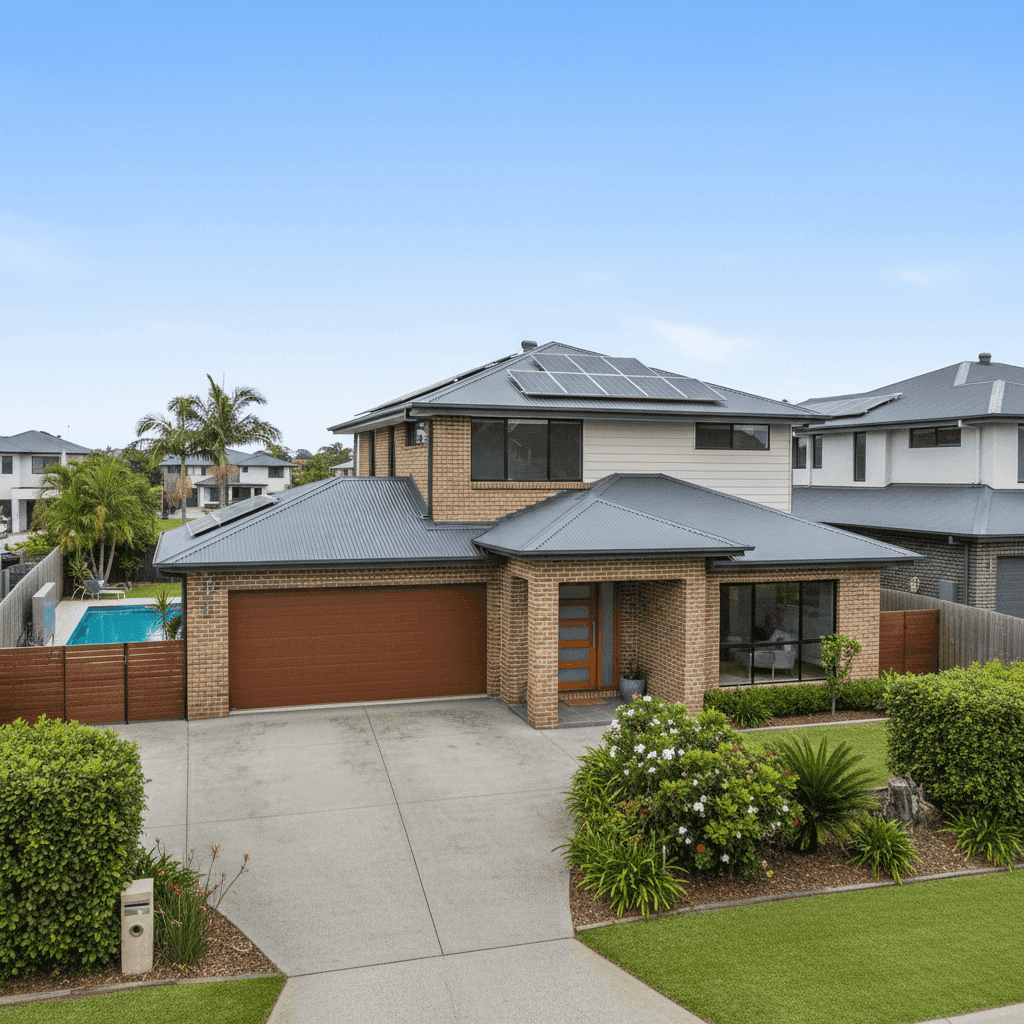
If you own a free standing home in Bundall, QLD 4217, you're sitting in one of the Gold Coast's most sought-after pockets — and like any savvy homeowner, you want to know whether you're paying a fair price for your home and contents insurance. This article breaks down a real quote for a four-bedroom, four-bathroom brick veneer home in Bundall, compares it against local, state, and national benchmarks, and offers practical tips to help you get the best value cover.
---
Is This Quote Fair?
The quote in question comes in at $3,470 per year (or $333/month) for combined home and contents insurance, covering a building sum insured of $1,300,000 and contents valued at $200,000. Both the building and contents excess are set at $1,000.
Our pricing engine has rated this quote as FAIR — Around Average, and the data backs that up. At $3,470/yr, this premium sits:
- 5.5% below the Bundall suburb average of $3,671/yr
- 2% above the Bundall suburb median of $3,402/yr
- Well within the typical range for the suburb (25th–75th percentile: $2,405–$5,136/yr)
In short, this isn't a bargain-basement price, but it's also not excessive. For a well-appointed, newly constructed home with a pool, solar panels, and above-average fittings, landing near the suburb median is a reasonable outcome. There's likely some room to improve, but there's no immediate cause for alarm.
---
How Bundall Compares
To put this quote in proper context, it helps to zoom out and look at the broader picture. You can explore the full data at our Bundall suburb stats page, the QLD state overview, or the national insurance stats.
| Benchmark | Average Premium | Median Premium |
|---|---|---|
| Bundall (QLD 4217) | $3,671/yr | $3,402/yr |
| Gold Coast LGA | $8,161/yr | — |
| Queensland (State) | $9,129/yr | $3,903/yr |
| National | $5,347/yr | $2,764/yr |
A few things stand out here. The Queensland state average of $9,129/yr looks alarming at first glance, but this figure is heavily skewed by high-risk coastal and flood-prone areas across the state — particularly in North Queensland, where cyclone and storm surge exposure drives premiums through the roof. The state median of $3,903/yr is a far more representative number for most QLD homeowners, and this quote sits comfortably below it.
Similarly, the Gold Coast LGA average of $8,161/yr reflects the diversity of risk profiles across the region — from beachfront properties and flood zones to elevated hinterland homes. Bundall itself, while part of the Gold Coast, benefits from a relatively contained risk profile, which is reflected in its more modest suburb averages.
Nationally, the average premium of $5,347/yr is pulled upward by high-cost states and regions. The national median of $2,764/yr is lower than this quote, which is worth noting — but that figure spans a huge range of property types, sizes, and locations across Australia, many of which are far simpler and lower-value than this property.
Given the $1.3 million building sum insured and $200,000 contents, a premium near the Bundall suburb average is genuinely reasonable.
---
Property Features That Affect Your Premium
Several characteristics of this property have a direct bearing on the premium calculated. Here's how each one plays a role:
Brick veneer construction & Colorbond roof Brick veneer walls offer solid fire resistance and structural durability, which insurers generally view favourably. A steel/Colorbond roof is similarly well-regarded — it's lightweight, resistant to ember attack, and durable in storms. This combination typically works in the homeowner's favour when it comes to pricing.
Slab foundation A concrete slab foundation is a standard and stable choice in Queensland's climate. It reduces the risk of subsidence and pest-related structural damage compared to raised timber stumps, and insurers tend to price this positively.
New construction (2026) A brand-new home is one of the strongest factors in keeping premiums competitive. New builds comply with the latest Australian building codes, which include improved cyclone, flood, and fire resilience standards. There's also far less risk of hidden structural defects or ageing systems.
Above-average fittings Higher-quality fittings — think stone benchtops, premium cabinetry, and quality fixtures — increase the cost to rebuild, which is reflected in the $1.3 million building sum insured. This is appropriate; underinsuring a high-spec home is a common and costly mistake.
Swimming pool A pool adds to the replacement cost of the property and introduces some liability considerations. It contributes modestly to the overall premium.
Solar panels Solar panels are increasingly common on Queensland homes, but they do add to the insured value of the structure. Some insurers also factor in the cost of replacing panels after storm or hail damage. It's worth confirming your policy explicitly covers rooftop solar.
Timber/laminate flooring Timber and laminate floors are attractive but can be expensive to replace after water damage. This is particularly relevant in Queensland where heavy rainfall events are common. Ensuring your contents or building policy adequately covers floor replacement is important.
Ducted climate control Ducted air conditioning systems are a significant fixed asset and should be covered under your building policy. At above-average quality, this system adds meaningful value to the rebuild cost.
---
Tips for Homeowners in Bundall
1. Review your sum insured annually With a new build and above-average fittings, construction costs can shift significantly year to year. Queensland has seen elevated building costs in recent years due to labour and material pressures. Use a building cost calculator or ask your insurer to reassess your sum insured each renewal to avoid being underinsured.
2. Confirm solar panels and pool equipment are covered Not all standard home insurance policies automatically cover solar panel systems or pool equipment (pumps, filters, heating) as part of the building. Read your Product Disclosure Statement (PDS) carefully and ask your insurer to confirm these are included — and to what value.
3. Compare quotes before each renewal A "fair" rating means you're near the market average — but that doesn't mean you can't do better. Insurers reprice their books regularly, and loyalty doesn't always pay. Running a fresh comparison at renewal time is one of the simplest ways to save money without reducing your cover. Get a new quote at CoverClub to see what's available in your area.
4. Consider your excess strategically Both the building and contents excess on this policy are set at $1,000. Opting for a higher excess — say $2,000 — can meaningfully reduce your annual premium. If you have a strong emergency fund and are unlikely to make small claims (which can affect your claims history), a higher excess is often a smart trade-off.
---
Compare Your Home Insurance Today
Whether you're renewing soon or just curious about whether your current policy stacks up, CoverClub makes it easy to compare home and contents insurance quotes across Australia's leading insurers. See how your premium measures up against your neighbours and find cover that fits your home — and your budget. Start your free comparison at CoverClub today.