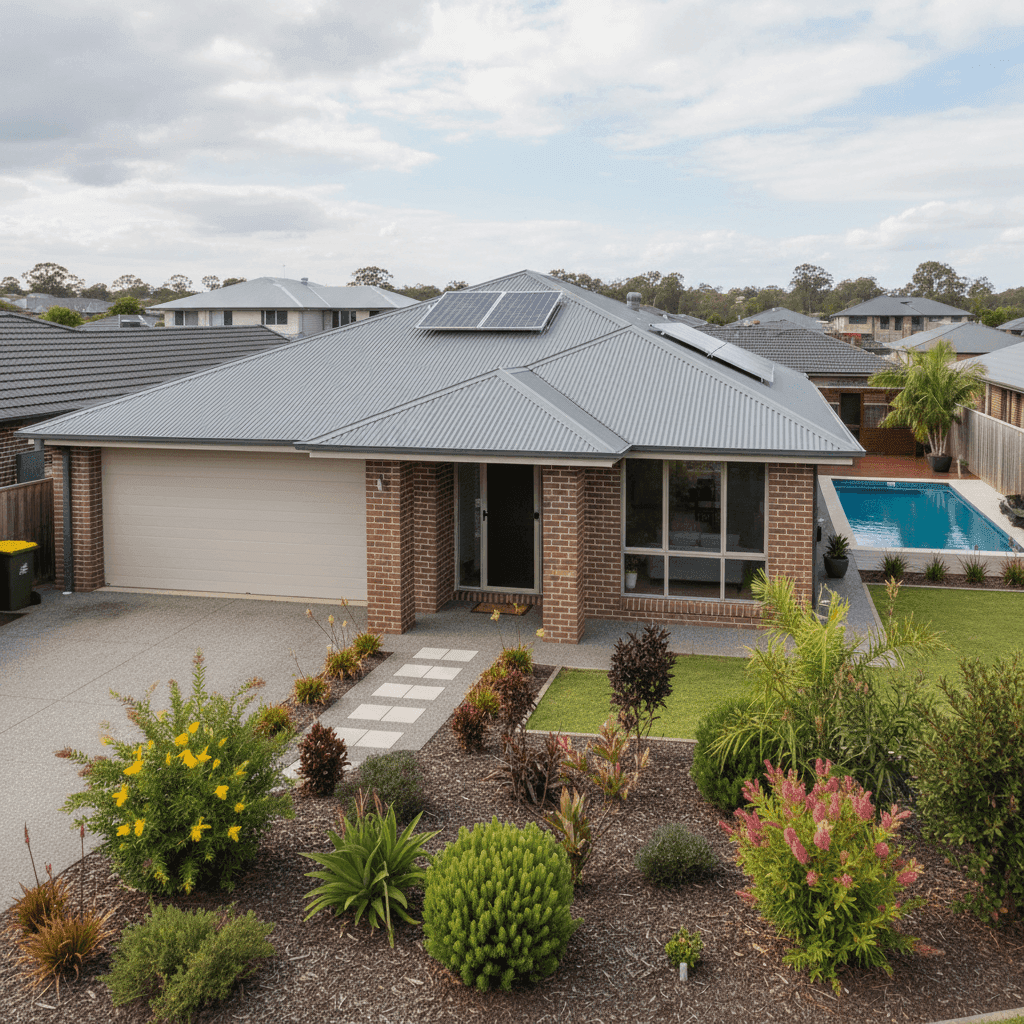
If you own a four-bedroom free standing home in Caboolture, QLD 4510, you've probably wondered whether your home insurance premium is reasonable — or whether you're quietly overpaying. This article breaks down a real home and contents insurance quote for a property in the area, benchmarks it against local, state and national data, and offers practical tips to help you get the best value cover.
---
Is This Quote Fair?
The quote in question comes in at $2,786 per year (or $267/month) for combined home and contents cover, with a building sum insured of $911,000 and contents valued at $76,000. Both the building and contents excess are set at $1,000.
Our pricing analysis rates this quote as FAIR — around average for the area. That's a reasonable outcome, but it doesn't necessarily mean there's no room to improve. "Fair" means the premium sits within a normal range for comparable properties in Caboolture — it's not a bargain, but it's not an outlier either.
To put it in perspective: the suburb average premium for Caboolture is $2,515/year, and the median sits at $2,548/year. This quote is roughly $238–$271 above those benchmarks, placing it in the upper half of the local distribution. The 75th percentile for the suburb is $3,291/year, so there's still meaningful headroom before this quote would be considered expensive. Based on 83 quotes analysed for the Caboolture area, the spread is wide — ranging from $1,797/year at the 25th percentile up to $3,291/year at the 75th.
---
How Caboolture Compares
One of the most striking findings in this data is just how affordable Caboolture is relative to the broader Queensland market.
The [QLD state average premium](https://coverclub.com.au/stats/QLD) is $9,129/year — more than three times this quote. Even the state median of $3,903/year is noticeably higher than what homeowners in Caboolture typically pay. This reflects the significant impact of cyclone-prone regions in North Queensland, which dramatically inflate the state-wide averages. Caboolture, located in South East Queensland, is not classified as a cyclone risk area, which is a major factor keeping premiums comparatively low.
Zooming out to the national picture, the Australian average premium is $5,347/year, while the national median is $2,764/year. Interestingly, this particular quote of $2,786/year sits almost exactly at the national median — a strong indicator that it's a broadly reasonable price for the level of cover provided.
At the LGA level, the Moreton Bay average is $3,435/year, which is higher than the Caboolture suburb average. This suggests that Caboolture itself is one of the more affordably insured pockets within the Moreton Bay region, likely due to its inland position and lower flood or storm surge exposure compared to some coastal parts of the LGA.
| Benchmark | Premium |
|---|---|
| This Quote | $2,786/yr |
| Caboolture Suburb Average | $2,515/yr |
| Caboolture Suburb Median | $2,548/yr |
| Moreton Bay LGA Average | $3,435/yr |
| QLD State Average | $9,129/yr |
| National Average | $5,347/yr |
| National Median | $2,764/yr |
---
Property Features That Affect Your Premium
Several characteristics of this property influence where the premium lands — some favourably, others less so.
Brick veneer construction with a Colorbond steel roof is generally well-regarded by insurers. Brick veneer offers solid fire and impact resistance, while Colorbond roofing is durable, lightweight and performs well in storms. This combination typically attracts more competitive premiums compared to, say, weatherboard cladding or older tile roofs.
Slab foundation and tile flooring are both low-maintenance, low-risk features from an insurance perspective. Slabs eliminate the underfloor moisture and pest risks associated with raised timber stumps, and tiles are resilient against water damage — relevant in a subtropical climate like Caboolture's.
The swimming pool adds to the replacement cost of the property and introduces some liability considerations, which can nudge premiums upward slightly. Insurers factor in the cost of pool fencing compliance, equipment replacement, and the general complexity of insuring a property with water features.
Solar panels are increasingly common on Queensland homes and are typically covered under building insurance, but they do add to the total sum insured. With a 214 sqm home built in 2005 and a building sum insured of $911,000, the valuation appears comprehensive and accounts for modern inclusions like the solar system and ducted climate control.
Ducted climate control is another feature that increases the replacement value of the home. These systems are expensive to install and replace, and insurers will factor this into the building sum insured calculation.
The property's 2005 construction year means it was built under relatively modern building codes, which generally means better cyclone strapping, improved waterproofing and stronger structural standards than older homes — all of which can work in your favour at renewal time.
---
Tips for Homeowners in Caboolture
1. Review your sum insured annually Building costs have risen significantly across Australia over the past few years. Make sure your $911,000 building sum insured still reflects what it would actually cost to rebuild your home from scratch — including demolition, professional fees and the cost of your solar and ducted systems. Underinsurance is one of the most common and costly mistakes homeowners make.
2. Shop around at renewal A "fair" rating means you're not being gouged, but it doesn't mean you can't do better. Insurers price risk differently, and a quote that's competitive with one provider may be significantly cheaper with another. Use a comparison tool like CoverClub to benchmark your renewal quote before you accept it.
3. Consider your excess strategically Both the building and contents excess on this policy are set at $1,000. Opting for a higher voluntary excess — say, $2,000 or $2,500 — can meaningfully reduce your annual premium if you're comfortable covering smaller claims yourself. Just make sure the savings justify the increased out-of-pocket cost in a claim scenario.
4. Maintain your pool and solar equipment Insurers can reduce or deny claims if damage results from poor maintenance. Keep your pool fencing compliant with Queensland regulations, service your solar inverter and panels regularly, and document any maintenance work. This protects both your safety and your claim entitlements.
---
Get a Better Deal on Your Home Insurance
Whether you're renewing an existing policy or shopping for the first time, comparing quotes is the single most effective way to ensure you're not overpaying. CoverClub makes it easy to see how your premium stacks up against real data from your suburb and beyond.
Get a home insurance quote for your Caboolture property today and see how your current cover compares — in minutes, for free.