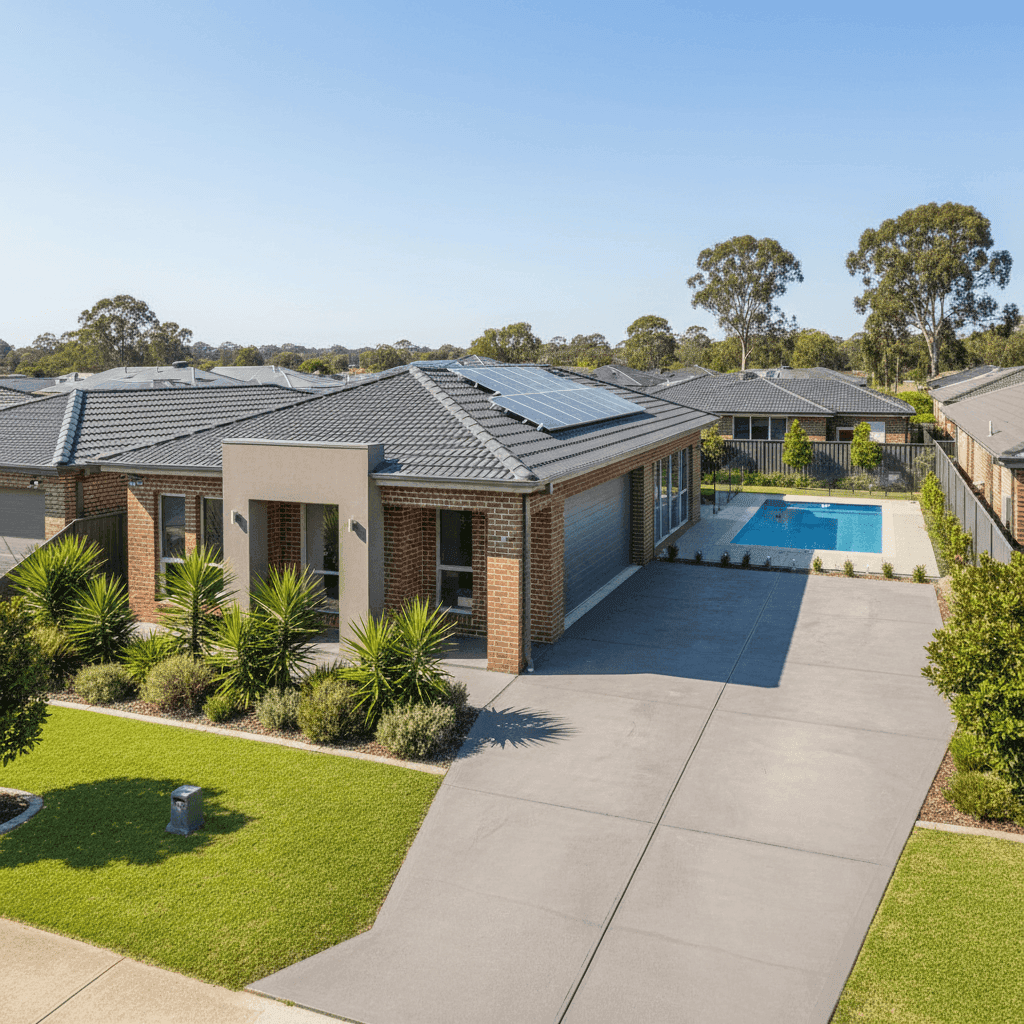
Caroline Springs, a well-established suburb in Melbourne's west, has grown into one of the region's most popular family destinations — and with that growth comes the very real responsibility of protecting your home. This article takes a close look at a recent home and contents insurance quote for a four-bedroom, four-bathroom free-standing home in Caroline Springs (VIC 3023), breaking down whether the price stacks up and what local homeowners should keep in mind when shopping for cover.
---
Is This Quote Fair?
The quote in question comes in at $1,947 per year (or $191 per month) for combined home and contents cover, with a building sum insured of $900,000 and contents valued at $89,000. Both the building and contents excess are set at $5,000.
Our pricing analysis rates this quote as Fair — Around Average, and the data backs that up. The suburb median for Caroline Springs sits at $1,885 per year, meaning this quote lands just $62 above the midpoint. It falls comfortably within the middle band of the local market — above the 25th percentile of $1,553 but well below the 75th percentile of $2,379. In other words, roughly half of comparable properties in the area are being quoted more than this, and a quarter are paying significantly more.
A $5,000 excess on both building and contents is on the higher side, and it's worth noting that opting for a higher excess is one of the most common ways insurers reduce the upfront premium. If cash flow is a concern in the event of a claim, it may be worth exploring whether a lower excess option is available and what the premium difference looks like.
Overall, for a property of this size and specification, this quote represents reasonable value — not a bargain, but not an overcharge either.
---
How Caroline Springs Compares
Understanding where your premium sits relative to broader benchmarks is one of the most useful tools a homeowner has. Here's how this quote measures up:
| Benchmark | Annual Premium |
|---|---|
| This Quote | $1,947 |
| Caroline Springs Suburb Average | $2,149 |
| Caroline Springs Suburb Median | $1,885 |
| LGA Average (Brimbank) | $1,707 |
| VIC State Average | $3,000 |
| VIC State Median | $2,718 |
| National Average | $5,347 |
| National Median | $2,764 |
The numbers tell an interesting story. This quote sits below the suburb average and only marginally above the median — a solid outcome. It also tracks well below both the Victorian state average of $3,000 and the national average of $5,347, which is heavily skewed by high-risk regions including flood-prone and cyclone-affected areas.
Interestingly, the Brimbank LGA average of $1,707 is notably lower than the Caroline Springs suburb average of $2,149. This suggests some variation within the LGA, potentially reflecting differences in property size, construction type, and the features of individual homes. You can explore more localised data for Caroline Springs on the CoverClub suburb stats page, which draws on 73 quotes from properties in the 3023 postcode.
Victoria, as a state, generally benefits from lower insurance premiums compared to Queensland and Northern Australia, where cyclone and flood risk drive costs significantly higher. Caroline Springs in particular is not classified as a cyclone risk area, which removes one of the more significant premium loading factors seen elsewhere in the country.
---
Property Features That Affect Your Premium
Every property is different, and insurers price risk based on a combination of construction characteristics, location factors, and additional features. Here's how the specifics of this home likely influence the premium:
Brick Veneer Construction & Tiled Roof Brick veneer is one of the most common — and insurer-friendly — wall types in Australian suburbia. It offers solid fire resistance and structural durability. Combined with a tiled roof, this home presents a relatively low-risk construction profile, which generally translates to more competitive premiums compared to timber-framed or steel-clad homes.
Concrete Slab Foundation A slab foundation is standard for homes built in this era and region. It's considered stable and is less susceptible to subsidence than older pier-and-beam constructions, which can be a positive factor in risk assessment.
Built in 2011 At around 14 years old, this home is relatively modern. Newer builds tend to comply with more recent building codes, which can reduce the likelihood of certain types of structural claims. Insurers often view homes built post-2000 more favourably than older stock.
Swimming Pool A pool adds liability considerations to any home insurance policy. Most insurers factor this into their pricing, as pools can increase the risk of personal injury claims. Ensuring your policy includes adequate liability cover is essential if you have a pool.
Solar Panels Solar panels are increasingly common across Melbourne's west, and most insurers now include them as part of standard building cover — but it's always worth confirming this with your insurer. Panels represent a significant asset, and coverage for accidental damage or storm damage should be explicitly confirmed in your Product Disclosure Statement (PDS).
Ducted Climate Control Ducted systems are a fixed building feature and are typically covered under building insurance. Given the cost of replacing or repairing a ducted system, it's important that your sum insured accounts for this.
$900,000 Building Sum Insured For a 235 sqm home in Caroline Springs, this sum insured works out to approximately $3,830 per square metre — a figure that aligns reasonably well with current construction cost estimates in metropolitan Victoria. Underinsurance is a common and costly mistake; if rebuild costs have risen since you last reviewed your policy, it's worth reassessing.
---
Tips for Homeowners in Caroline Springs
1. Review your sum insured annually Construction costs in Victoria have risen significantly over recent years. The cost to rebuild your home today may be materially higher than it was when you first took out your policy. Use a building cost calculator or speak with a local builder to sense-check your sum insured figure.
2. Confirm solar panel and pool coverage Both features add value and risk to your property. Before renewing, read your PDS carefully to confirm that solar panels are covered for accidental damage and storm events, and that your policy includes adequate public liability cover for your pool.
3. Consider the trade-off on excess A $5,000 excess has helped keep this premium competitive, but it means you'll need to cover the first $5,000 of any claim yourself. If you'd prefer lower out-of-pocket exposure in a claim scenario, ask your insurer what a $1,000 or $2,500 excess would cost — the premium difference may be smaller than you expect.
4. Compare quotes before renewing Loyalty doesn't always pay in insurance. Premiums can shift significantly from year to year, and the market in Caroline Springs is active — with 73 quotes in the CoverClub dataset, there's genuine competition to tap into. Shopping around at renewal time is one of the simplest ways to avoid overpaying.
---
Find a Better Deal on CoverClub
Whether you're reviewing your current policy or buying cover for the first time, comparing quotes is the smartest first step. CoverClub makes it easy to see how your premium stacks up against real data from your suburb and state. Get a home insurance quote today and find out if you're paying a fair price — or if there's a better deal waiting for you.