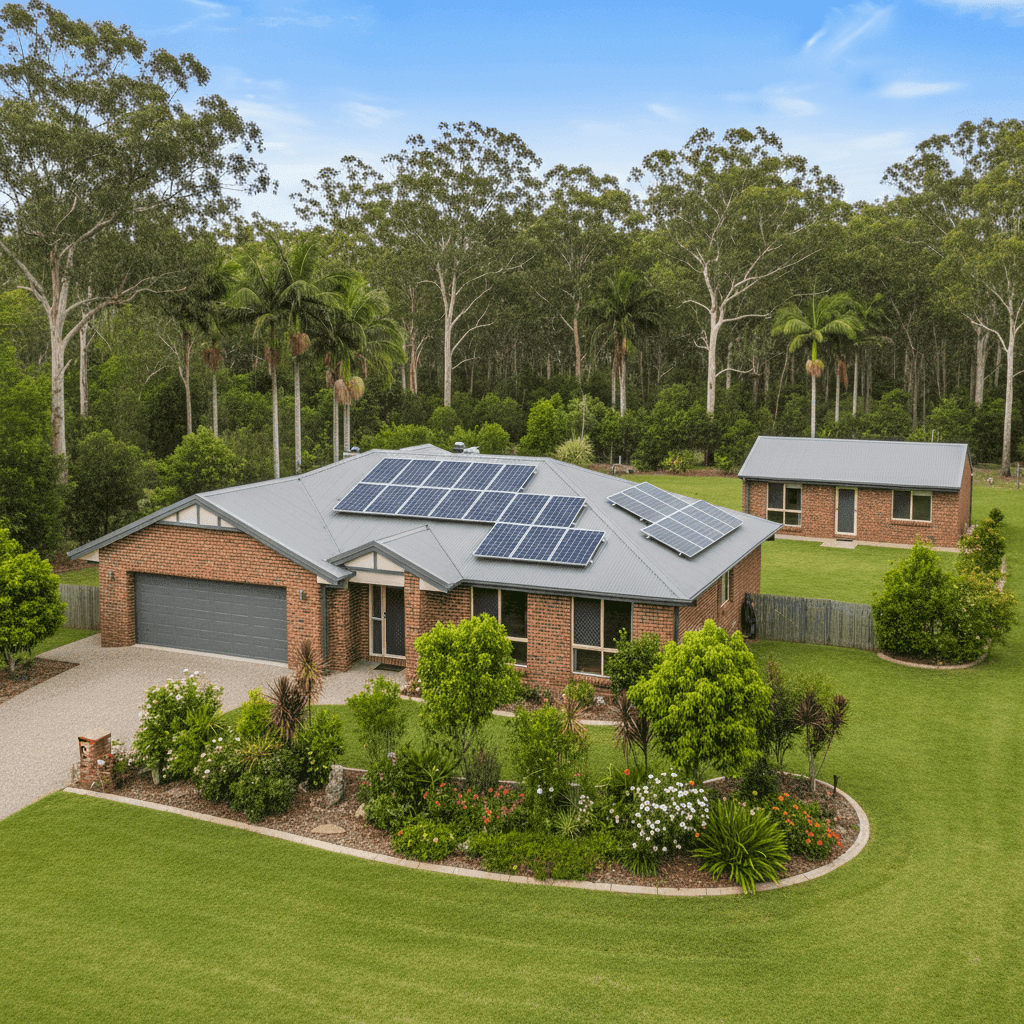
Cedar Creek is a semi-rural suburb nestled in the scenic hinterland of South East Queensland, sitting within the Gold Coast Local Government Area. It's the kind of place that attracts families looking for space, greenery, and a quieter pace of life — often on larger blocks with substantial homes to match. For a four-bedroom, two-bathroom free-standing home built in 2003, securing the right home and contents insurance is an important financial decision. This article breaks down a recent quote of $5,336 per year (or $521/month) for a property in Cedar Creek, and examines whether that figure represents good value in the current market.
---
Is This Quote Fair?
The short answer: yes, broadly speaking. This quote has been rated Fair (Around Average), and when you dig into the numbers, that assessment holds up.
At $5,336 per year, this premium sits:
- $1,015 below the Cedar Creek suburb average of $6,351/yr
- $549 above the suburb median of $4,787/yr
- Well within the suburb's interquartile range of $3,256/yr (25th percentile) to $6,544/yr (75th percentile)
In practical terms, this means the quote is comfortably in the middle of what Cedar Creek homeowners are actually paying — not the cheapest on the market, but far from the top end either. The fact that it comes in below the suburb average is a positive sign, suggesting the insurer has priced this property reasonably rather than applying a blanket loading.
It's worth noting that the building sum insured of $933,000 is substantial. Rebuild costs in South East Queensland have risen sharply in recent years due to labour shortages and materials inflation, so ensuring your home is adequately insured to value is critical. Underinsurance remains one of the most common — and costly — mistakes Australian homeowners make.
---
How Cedar Creek Compares
To put this quote in proper context, it helps to zoom out and look at the broader pricing landscape. You can explore the full data on the Cedar Creek suburb stats page, the Queensland state overview, or the national insurance statistics.
| Benchmark | Annual Premium |
|---|---|
| This quote | $5,336 |
| Cedar Creek suburb average | $6,351 |
| Cedar Creek suburb median | $4,787 |
| Gold Coast LGA average | $8,161 |
| QLD state average | $4,547 |
| QLD state median | $3,931 |
| National average | $2,965 |
| National median | $2,716 |
A few things stand out here. First, the Gold Coast LGA average of $8,161 is remarkably high — significantly above both the state and national figures. This reflects the elevated risk profile of many Gold Coast properties, including coastal flood exposure, storm surge risk, and the concentration of high-value homes. Cedar Creek, being inland and hinterland in character, generally escapes the worst of these coastal risk factors, which likely explains why its suburb average ($6,351) is lower than the broader LGA figure.
Second, the gap between Queensland and national averages is notable. At $4,547/yr (average) and $3,931/yr (median), QLD premiums are considerably higher than the national equivalents of $2,965 and $2,716 respectively. This is a well-documented phenomenon driven by Queensland's exposure to severe weather events — cyclones in the north, flooding across the south-east, and intense storm seasons that generate significant claims each year.
For Cedar Creek specifically, the suburb sample size of 19 quotes provides a reasonable — if not exhaustive — data set. The wide spread between the 25th percentile ($3,256) and 75th percentile ($6,544) suggests meaningful variation in property characteristics, sum insured values, and insurer pricing across the suburb.
---
Property Features That Affect Your Premium
Several characteristics of this particular property influence how insurers assess and price the risk:
Brick Veneer Walls & Colorbond Roof This is a well-regarded construction combination in the Australian insurance market. Brick veneer offers solid fire and impact resistance, while Colorbond steel roofing is durable, lightweight, and performs well in high-wind events. Insurers generally view this pairing favourably compared to, say, weatherboard cladding with terracotta tiles.
Slab Foundation A concrete slab foundation is standard for homes of this era in Queensland and is generally considered a neutral-to-positive risk factor. It eliminates the subsidence and pest-access concerns sometimes associated with raised or timber-framed subfloors.
Solar Panels The presence of solar panels adds to the insured value of the property and can introduce specific risks — including damage from hail, storm, or fire originating from faulty panels. Homeowners should confirm with their insurer that solar panels are explicitly covered under the building policy, as coverage terms vary between providers.
Granny Flat This property includes a granny flat, which is a meaningful factor in the insurance equation. A secondary dwelling adds replacement cost, increases the total sum insured, and may introduce additional liability considerations. It's essential to ensure the granny flat is specifically listed and covered under the policy — some standard policies require this to be declared separately.
Tile Flooring & Standard Fittings Tiled flooring and standard-quality fittings are practical choices that keep replacement costs predictable. High-end or bespoke finishes can push rebuild estimates significantly higher, so standard fittings generally translate to more straightforward sum insured calculations.
No Cyclone Risk Area Cedar Creek falls outside Queensland's designated cyclone risk zones, which removes one of the most significant premium loading factors seen further north. This is a meaningful advantage for homeowners in this part of the state.
---
Tips for Homeowners in Cedar Creek
1. Review your sum insured regularly With a building sum insured of $933,000, it's important this figure reflects current rebuild costs — not the original purchase price or an outdated estimate. Construction costs have risen sharply since 2020. Use a quantity surveyor or an online rebuild calculator to validate your figure at least every two years.
2. Confirm granny flat coverage explicitly Don't assume your granny flat is automatically covered. Contact your insurer to confirm it's listed as an insured structure and that the sum insured accounts for its full rebuild cost. Gaps in coverage here can be financially devastating after a claim.
3. Check your solar panel coverage Ask your insurer specifically whether your solar panels are covered for storm damage, hail, and electrical fault. Some policies cover them as part of the building; others require a separate endorsement. Knowing this before you need to claim is far better than discovering the gap afterwards.
4. Shop the market at renewal Insurance loyalty rarely pays off in Australia. Premiums can vary significantly between providers for the same property and level of cover. Given Cedar Creek's suburb range spans from $3,256 to $6,544+, there is genuine scope to find a more competitive rate without sacrificing cover quality. Set a reminder to compare quotes before each annual renewal.
---
Compare Home Insurance Quotes for Your Cedar Creek Property
Whether you're reviewing an existing policy or shopping for cover on a new purchase, comparing multiple quotes is the single most effective way to ensure you're not overpaying. Get a home insurance quote at CoverClub and see how your property stacks up against the latest suburb, state, and national benchmarks. It takes just a few minutes and could save you hundreds of dollars a year.