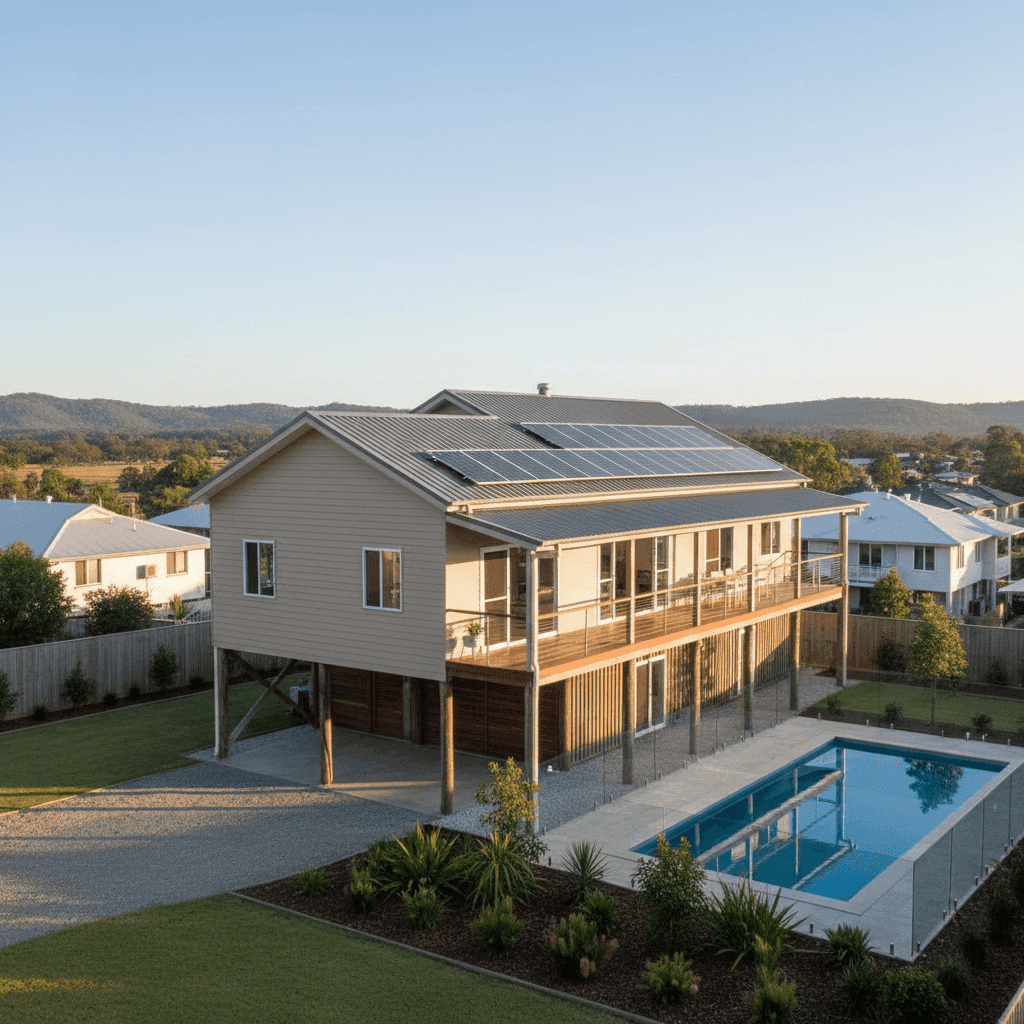
Cedar Vale is a quiet semi-rural suburb tucked into the southern fringe of the Logan region in Queensland, popular with families drawn to its acreage blocks, leafy surrounds, and easy freeway access to Brisbane. It's also the kind of location where home insurance deserves careful attention — elevated homes on poles, timber flooring, and proximity to bushland all play a role in how insurers price your risk. This article breaks down a real home and contents insurance quote for a four-bedroom, two-bathroom free-standing home in Cedar Vale (postcode 4285), and puts the numbers into context so you can judge whether you're getting a fair deal.
---
Is This Quote Fair?
The annual premium for this property came in at $3,934 per year (or $377/month), covering a building sum insured of $734,000 and $50,000 in contents — with a $1,000 excess on both building and contents claims.
Our pricing engine has rated this quote as Fair (Around Average), which means it sits comfortably within the typical range for comparable properties in the area — not a bargain, but not an outlier either.
To put that in perspective:
- The suburb average for Cedar Vale is $3,245/yr, and the median sits at $3,178/yr
- This quote is roughly $689 above the suburb average and $756 above the suburb median
- However, it falls below the 75th percentile of $3,996/yr, meaning at least a quarter of Cedar Vale quotes come in higher
So while this premium is on the upper side of "average" for the suburb, it hasn't crossed into expensive territory. The elevated building sum insured of $734,000 — which is on the higher end for a 214 sqm home — is likely a significant driver of where this quote lands.
---
How Cedar Vale Compares
Understanding where Cedar Vale sits in the broader insurance landscape helps frame whether local premiums are high, low, or somewhere in between. Here's how the numbers stack up:
| Benchmark | Average Premium | Median Premium |
|---|---|---|
| Cedar Vale (suburb) | $3,245/yr | $3,178/yr |
| Logan LGA | $4,617/yr | — |
| Queensland (state) | $9,129/yr | $3,903/yr |
| National | $5,347/yr | $2,764/yr |
A few things stand out here. Queensland's average premium of $9,129/yr is dramatically higher than the national average — largely because cyclone-prone coastal and far-north Queensland properties pull that figure up significantly. Cedar Vale, sitting in the state's south-east corner and outside any designated cyclone risk zone, benefits from considerably more moderate pricing.
Interestingly, this quote of $3,934/yr sits very close to the Queensland state median of $3,903/yr, suggesting it's broadly representative of what a mid-range QLD homeowner pays — even though Cedar Vale itself tends to price a touch lower than the state median.
Compared to the Logan LGA average of $4,617/yr, this quote is actually a solid $683 cheaper, which is a meaningful saving for a property of this size and specification.
You can explore more localised data on the Cedar Vale suburb stats page, compare it against the Queensland state overview, or see how it stacks up against national home insurance benchmarks.
> Note: The suburb sample size for Cedar Vale is 13 quotes, so while the data is directionally useful, it's worth keeping in mind that averages based on smaller samples can shift as more data comes in.
---
Property Features That Affect Your Premium
This isn't a cookie-cutter brick veneer on a flat suburban block. Several features of this home meaningfully influence how insurers assess and price the risk:
Elevated Foundation on Poles
The home is elevated by at least one metre on a pole foundation — a hallmark of the classic Queensland elevated home style. This design offers excellent natural ventilation and can reduce flood risk from surface water, but it also means the subfloor space is exposed and the structure may be more susceptible to wind uplift. Insurers factor in both the benefits and the engineering complexity of pole homes when calculating premiums.
Hardiplank / Hardiflex External Walls
Fibre cement cladding like Hardiplank is durable, low-maintenance, and reasonably fire-resistant — generally viewed favourably by insurers compared to traditional weatherboard. It's a solid material choice that shouldn't significantly inflate your premium.
Steel / Colorbond Roof
Colorbond steel roofing is widely regarded as one of the more insurer-friendly roofing materials in Australia. It's resistant to fire, rot, and pests, and performs well in storm conditions. This is a positive factor for your premium.
Timber and Laminate Flooring
Timber and laminate floors can be costly to repair or replace following water damage or flooding — more so than concrete or tile. This is a relevant consideration in a region that can experience heavy rainfall events, and insurers will account for replacement costs in their calculations.
Pool, Solar Panels, and Ducted Climate Control
The presence of a swimming pool, rooftop solar panels, and ducted air conditioning all add to the overall replacement value of the property. These are high-value fixtures that need to be adequately covered, and they contribute to a higher building sum insured — which in turn affects the premium.
---
Tips for Homeowners in Cedar Vale
1. Review Your Building Sum Insured Annually
At $734,000, the building sum insured is substantial. Construction costs in Queensland have risen sharply in recent years, so it's worth reviewing this figure each year to ensure you're neither underinsured nor paying for more cover than you need. Use a building cost calculator or speak to a quantity surveyor if you're unsure.
2. Consider a Higher Excess to Reduce Your Premium
Both the building and contents excess on this policy sit at $1,000. Opting for a higher voluntary excess — say $2,000 or $2,500 — can meaningfully reduce your annual premium. Just make sure the excess is an amount you could comfortably cover out of pocket in the event of a claim.
3. Bundle Building and Contents Cover
This quote already combines building and contents insurance, which is a smart move. Many insurers offer discounts for bundling, and managing a single policy is simpler come renewal time. If you're currently holding separate policies, it's worth checking whether consolidating them saves you money.
4. Shop Around at Renewal
Insurance loyalty doesn't often pay. Premiums can vary significantly between insurers for the same property and level of cover. Make it a habit to compare quotes before your policy renews each year — even if your current insurer's price seems reasonable. A "Fair" rating is a good starting point, but there may be better value available elsewhere.
---
Find a Better Deal with CoverClub
Whether you're a first-time homeowner in Cedar Vale or a long-time resident reassessing your cover, comparing quotes is the single most effective way to ensure you're not overpaying. CoverClub aggregates real insurance data from across Australia so you can see exactly how your premium stacks up — and find a policy that suits your home, your budget, and your peace of mind.
Get a home insurance quote today and see what Cedar Vale homeowners are actually paying.