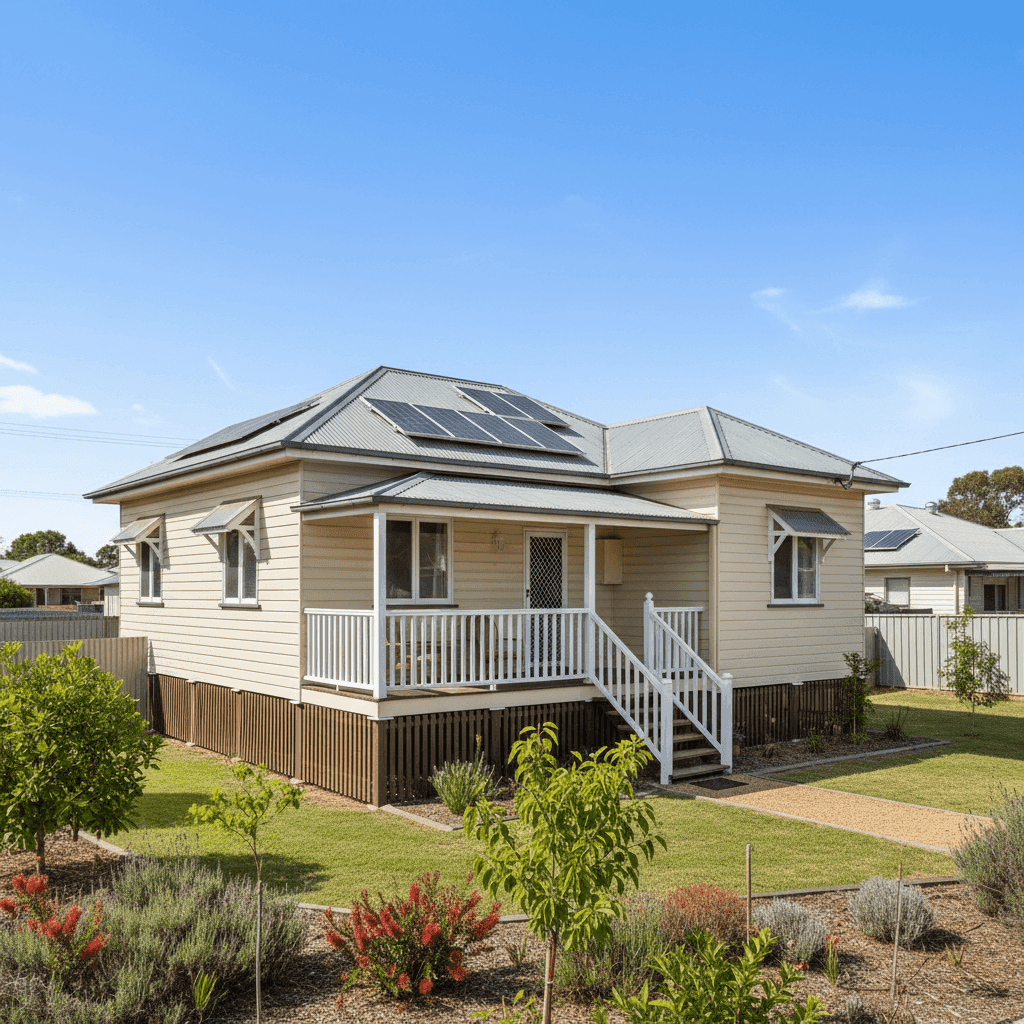
If you own a free standing home in Chinchilla, QLD 4413, you're probably wondering whether the insurance premium you've been quoted is genuinely competitive — or whether you're paying more than you should. Chinchilla sits in Queensland's Western Downs region, a predominantly rural and agricultural area where home insurance pricing can vary dramatically depending on the specific property and insurer. This article breaks down a real building-only quote for a 2-bedroom, 1-bathroom home in the area, and puts it into context against local, state, and national benchmarks.
---
Is This Quote Fair?
The quote in question comes in at $3,052 per year (or $286/month) for building-only cover on a 105 sqm free standing home, with a sum insured of $442,000 and a building excess of $5,000.
Our price rating for this quote is FAIR — Around Average, which means it sits in a reasonable range relative to what other homeowners in Chinchilla are paying. It's neither a standout bargain nor an obvious overpay, but context matters a great deal here.
When you look at the suburb-level data for Chinchilla (QLD 4413), the median premium across 79 quotes is $3,649/year, meaning this quote actually comes in below the local median — a positive sign. The 25th percentile sits at $2,600/year, so while there are cheaper options out there, this quote is well within the mainstream range. The suburb's average premium, however, is a striking $20,771/year — a figure heavily skewed by a small number of very high-cost quotes, which is why the median is a much more reliable yardstick for most homeowners.
---
How Chinchilla Compares
Understanding where Chinchilla sits in the broader insurance landscape helps put this quote in sharper perspective.
| Benchmark | Average Premium | Median Premium |
|---|---|---|
| Chinchilla (4413) | $20,771/yr | $3,649/yr |
| Western Downs LGA | $18,732/yr | — |
| Queensland | $9,129/yr | $3,903/yr |
| National | $5,347/yr | $2,764/yr |
A few things stand out here. First, both the suburb and LGA averages are extraordinarily high compared to Queensland's state-wide figures and the national average. This is largely driven by extreme outlier premiums — possibly for properties with significant flood, bushfire, or storm risk — that inflate the mean considerably.
Second, the median premiums tell a more grounded story. At $3,649/year locally and $3,903/year across QLD, the medians are actually fairly close to each other, and both sit above the national median of $2,764/year. This reflects the reality that Queensland homeowners generally pay more for insurance than their counterparts in other states, owing to a higher frequency of severe weather events including storms, flooding, and hail.
The quote of $3,052/year lands below both the local and state medians, which is a reasonable outcome for a well-constructed property with standard fittings.
---
Property Features That Affect Your Premium
Several characteristics of this particular property will have influenced the final premium. Here's how they play into the insurer's risk assessment:
Weatherboard timber walls are one of the most significant factors. Timber-clad homes are considered higher risk than brick veneer or double-brick construction because they are more susceptible to fire and can deteriorate over time if not well maintained. Insurers typically apply a loading to timber-framed and weatherboard homes.
Construction year: 1940 adds another layer of consideration. Homes built over 80 years ago may have older wiring, plumbing, and structural elements that don't meet modern building standards. Some insurers are cautious about heritage-era homes, which can push premiums upward — or in some cases, limit available cover.
Stump foundations are common in older Queensland homes and are generally well-understood by insurers in this region. However, they can be a factor in subsidence or termite-related claims, so it's worth ensuring your policy covers these risks explicitly.
Steel/Colorbond roofing is actually a positive for insurers — it's durable, fire-resistant, and performs well in high-wind events. This likely helps moderate the premium compared to older tile or fibrous cement roofing.
Solar panels are present on this property and are worth noting. Not all building policies automatically cover solar panels as part of the building sum insured, so it's important to confirm with your insurer that the panels and their associated inverter equipment are explicitly included in your $442,000 sum insured.
Ducted climate control adds to the replacement cost of the home and is factored into the sum insured. Ensuring your building sum insured is accurate — neither under- nor over-insured — is critical, particularly for a home with this level of installed fixtures.
The 105 sqm building size and standard fittings quality suggest a modest, practical home, which generally attracts a more straightforward premium calculation compared to larger homes with high-end finishes.
---
Tips for Homeowners in Chinchilla
Whether you're reviewing an existing policy or shopping for new cover, here are four practical steps worth taking:
- Check your sum insured carefully. At $442,000 for a 105 sqm home with timber construction, solar panels, and ducted air conditioning, it's important to verify this figure reflects true rebuild costs — not just market value. Use a building cost calculator or ask a local builder for a rough estimate. Underinsurance is a common and costly mistake.
- Ask specifically about timber and heritage home cover. Some insurers have restrictions or exclusions for homes built before a certain year or with certain wall materials. Read the Product Disclosure Statement (PDS) carefully to understand what is and isn't covered for a weatherboard home of this age.
- Confirm solar panel coverage. As mentioned above, solar panels and inverters aren't always automatically included in building cover. Ask your insurer directly, and if necessary, request an endorsement to ensure they're covered under your building sum insured.
- Compare multiple quotes. The wide spread between the 25th percentile ($2,600/yr) and the 75th percentile ($14,971/yr) in Chinchilla shows that different insurers price this suburb very differently. Shopping around could save you hundreds — or even thousands — of dollars annually without sacrificing cover quality.
---
Ready to Compare Home Insurance in Chinchilla?
Whether this quote reflects your own situation or you're simply curious about what you should be paying, the best move is always to compare. At CoverClub, we make it easy to see how quotes stack up across multiple insurers in one place. Enter your address and get started today — it takes just a few minutes and could make a real difference to what you pay.