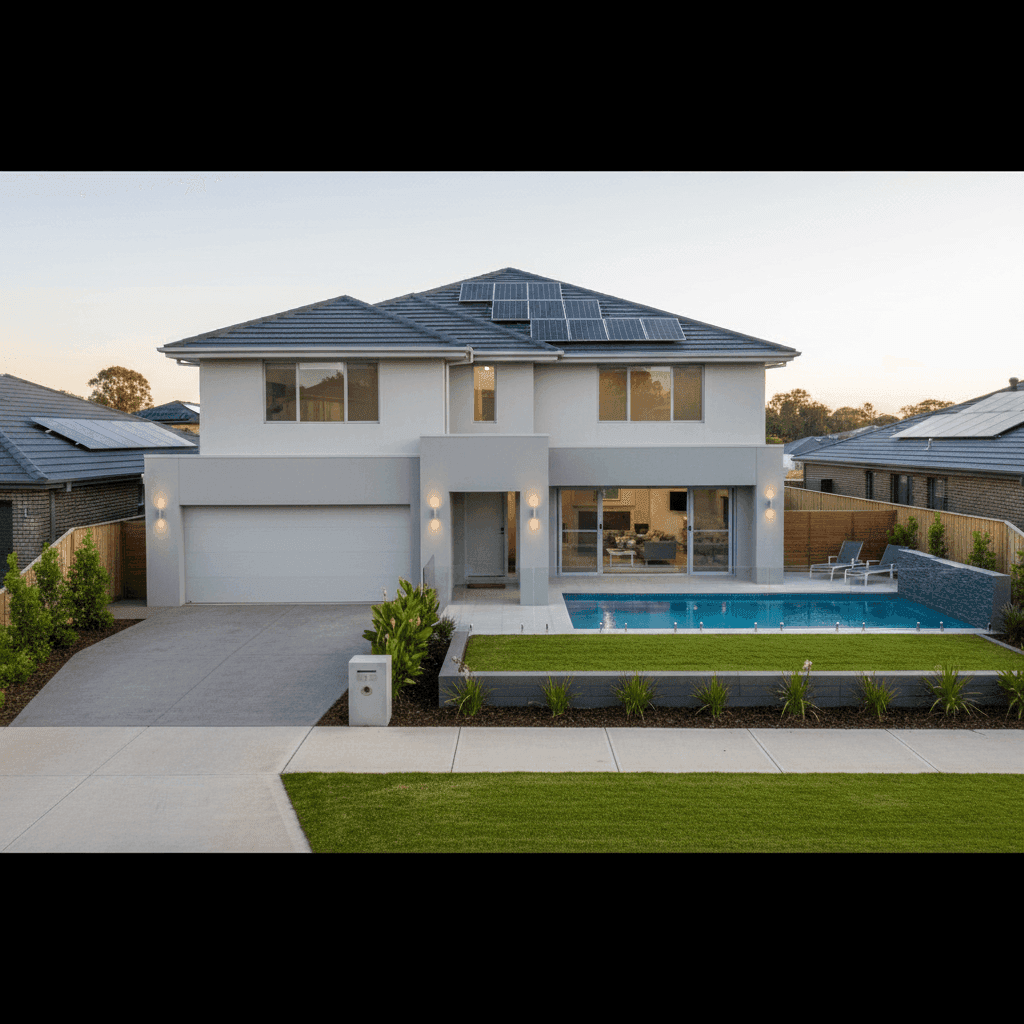
Chisholm is a modern residential suburb in the Hunter Valley region of New South Wales, sitting within the Cessnock Local Government Area. It's known for its relatively new housing stock and family-friendly streetscapes — and this particular property is a strong example of what the area has to offer: a spacious, six-bedroom free standing home built in 2015, complete with a pool, solar panels, and ducted climate control across 420 square metres of living space.
When it comes to insuring a property like this, the numbers can be eye-opening. This quote came in at $4,955 per year (or $468/month) for combined Home and Contents cover, with a $1,600,000 building sum insured and $200,000 in contents cover. So — is that a fair price? Let's dig into the data.
---
Is This Quote Fair?
Based on our pricing analysis, this quote is rated Expensive (Above Average) for the Chisholm area.
The suburb average premium for Chisholm sits at just $1,757 per year, with a median of $1,682. This quote at $4,955 is nearly three times the local average — a significant gap that warrants some explanation.
However, context matters enormously here. The suburb average is based on a sample of 38 quotes across a range of property types, sizes, and sum insured values. A six-bedroom, 420 sqm home with a $1.6 million building sum insured is well above what most Chisholm properties are insured for. Larger homes with higher replacement costs will always attract higher premiums, so a direct comparison to the suburb average can be misleading without accounting for those differences.
Still, if you're paying close to $5,000 a year, it's worth making sure you're getting competitive value — and that's exactly what this analysis aims to help with.
---
How Chisholm Compares
To put this quote in proper perspective, it helps to zoom out and look at the broader picture.
| Benchmark | Average Premium | Median Premium |
|---|---|---|
| Chisholm (NSW 2322) | $1,757/yr | $1,682/yr |
| Cessnock LGA | $2,462/yr | — |
| New South Wales | $9,528/yr | $3,770/yr |
| National | $5,347/yr | $2,764/yr |
A few things stand out here. First, the NSW state average of $9,528 is dramatically skewed by high-value and high-risk properties — Sydney's flood-prone suburbs, coastal homes, and prestige properties all pull that figure upward. The NSW median of $3,770 is a more reliable benchmark, and this quote of $4,955 sits above it.
Compared to national figures, this quote is just above the national average of $5,347 — but below it when you consider the median of $2,764. For a large, well-appointed home in a low-risk inland suburb, a premium in the $4,000–$5,000 range isn't unreasonable, but there's likely room to shop around.
Within the Cessnock LGA, the average sits at $2,462 — again, lower than this quote, but the LGA average encompasses a wide variety of properties, many of which are smaller and older than this one.
---
Property Features That Affect Your Premium
Several characteristics of this property directly influence what insurers charge. Understanding them helps you assess whether your quote is justified.
Size and sum insured are the biggest drivers here. At 420 sqm and a $1,600,000 building sum insured, this is a large home with a high replacement cost. Rebuilding a six-bedroom home of this scale with above-average fittings quality is genuinely expensive, and insurers price accordingly.
Hebel panel external walls are worth noting. Autoclaved Aerated Concrete (AAC) like Hebel is increasingly popular in new builds due to its thermal and acoustic properties, but some insurers treat it differently to brick or timber — occasionally applying loadings due to specialist repair requirements. It's worth checking that your insurer is familiar with Hebel construction.
Tiled roof on a slab foundation is generally viewed favourably by insurers. Tiles are durable and fire-resistant, and a concrete slab foundation is considered low-risk compared to timber stumps or pier-and-beam systems that can be affected by subsidence or termites.
A swimming pool adds to your premium in two ways: it increases the replacement cost of the property, and it introduces liability considerations. Make sure your policy includes legal liability cover, particularly if you have children or frequently entertain guests.
Solar panels are a feature that many homeowners overlook when reviewing their insurance. Panels are typically covered under building insurance, but the inverter and associated equipment may need to be specifically listed. Confirm with your insurer that your system is fully covered.
Ducted climate control is another high-value item that contributes to the overall replacement cost of the home. These systems can cost tens of thousands of dollars to replace, and they should be factored into your building sum insured.
Vinyl flooring throughout is relatively cost-effective to replace compared to hardwood timber or stone, which is a minor positive from an insurer's perspective.
---
Tips for Homeowners in Chisholm
1. Review your building sum insured regularly. With construction costs continuing to rise across Australia, a sum insured set a few years ago may no longer reflect the true cost of rebuilding your home. Under-insurance is one of the most common and costly mistakes homeowners make. Use a building cost calculator or speak with a quantity surveyor to ensure your $1.6 million figure is still accurate.
2. Confirm your Hebel walls are correctly noted on your policy. Not all insurers have the same appetite for AAC/Hebel construction. Make sure your wall type is accurately recorded, and ask whether there are any loadings applied. If so, it may be worth comparing quotes from insurers who specialise in or are more comfortable with modern construction methods.
3. Check your pool and solar panel coverage in detail. Both features are common sources of claim disputes. Ask your insurer specifically: Are the solar panels covered for accidental damage? Is the pool equipment (pump, filter, heating) included? Is there liability cover for pool-related incidents? Getting clarity upfront avoids nasty surprises at claim time.
4. Compare quotes before your renewal date. Loyalty doesn't always pay in insurance. Insurers often offer better rates to new customers than to existing ones. Set a reminder to compare at least 30 days before your renewal, giving you time to negotiate or switch without a coverage gap.
---
Ready to Find a Better Rate?
Whether you're renewing soon or just curious about what else is out there, comparing quotes is the fastest way to know if you're getting a fair deal. At CoverClub, you can enter your property details and see how your current premium stacks up — it takes just a few minutes and could save you hundreds of dollars a year. Explore the Chisholm suburb insurance stats to benchmark your own premium, or browse national home insurance data to see how your costs compare across Australia.