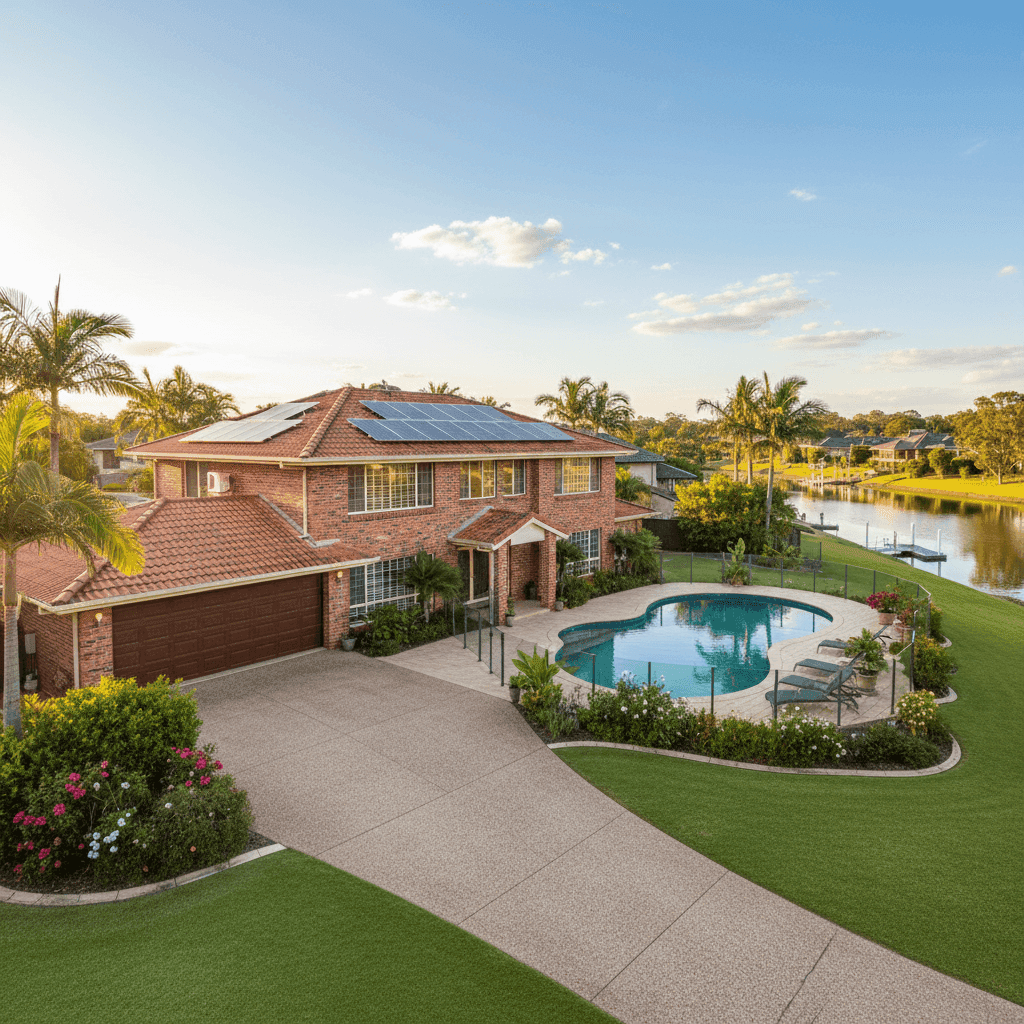
Clear Island Waters is one of the Gold Coast's most sought-after residential pockets — a leafy, canal-fringed suburb in postcode 4226 where well-appointed family homes sit alongside manicured gardens and sparkling waterways. If you own a free standing home here, understanding what you should be paying for home and contents insurance is just as important as knowing your property's market value. This article breaks down a real insurance quote for a four-bedroom, two-bathroom brick veneer home in Clear Island Waters, and puts the numbers in context so you can judge whether your own policy stacks up.
---
Is This Quote Fair?
The quote in question comes in at $3,547 per year (or $333 per month) for combined home and contents cover, with a building sum insured of $1,296,000 and contents valued at $147,000. Both the building and contents excess are set at $5,000.
Our pricing engine rates this quote as CHEAP — below average for the area. That's a meaningful finding. With a building insured for well over a million dollars and a pool, solar panels, and ducted climate control all adding complexity to the risk profile, landing below the suburb average is a genuinely positive outcome for the homeowner.
To put it plainly: if you're paying around $3,547 annually for this level of cover in Clear Island Waters, you're doing better than most of your neighbours.
---
How Clear Island Waters Compares
The numbers tell a compelling story when you stack this quote against local, state, and national benchmarks.
| Benchmark | Premium |
|---|---|
| This quote | $3,547/yr |
| Suburb average (Clear Island Waters) | $10,317/yr |
| Suburb median | $10,015/yr |
| Suburb 25th percentile | $4,758/yr |
| Suburb 75th percentile | $13,641/yr |
| QLD average | $9,129/yr |
| QLD median | $3,903/yr |
| National average | $5,347/yr |
| National median | $2,764/yr |
| Gold Coast LGA average | $8,161/yr |
A few things stand out here. The Clear Island Waters suburb average of $10,317 is remarkably high — nearly three times this quote. Even the suburb's 25th percentile (meaning 75% of quotes are higher) sits at $4,758, which is still above what this homeowner is paying. That positions this quote in the very cheapest tier of the local market.
Zooming out, the Queensland state average of $9,129 reflects the elevated risk environment across much of the state — driven by flood, storm, and cyclone exposure in various regions. Clear Island Waters, while not classified as a cyclone risk area, sits within the broader Gold Coast market where premiums trend high. The national average of $5,347 is also comfortably above this quote, reinforcing the "cheap" rating.
It's worth noting the difference between averages and medians. The QLD median of $3,903 is far below the state average, suggesting a skewed distribution where some very high-risk properties push the average up significantly. This quote, at $3,547, sits just below even the state median — a solid result.
---
Property Features That Affect Your Premium
Every insurer prices risk differently, but the physical characteristics of a property are always central to the calculation. Here's how this home's features likely influenced the quote:
Brick Veneer Walls & Tiled Roof Brick veneer construction with a tiled roof is generally viewed favourably by insurers. Both materials are durable, fire-resistant, and relatively straightforward to repair or replace. Compared to weatherboard or metal cladding, brick veneer tends to attract more competitive premiums.
Slab Foundation A concrete slab foundation is the standard in Queensland and is considered low-risk from an insurer's perspective. There's no subfloor cavity to worry about, which reduces exposure to certain types of water and pest damage.
Tiled Flooring Like the roof and walls, tiled internal flooring is a resilient, low-maintenance material that holds up well against water damage — a key consideration in Queensland's wet season. It's a minor but positive factor in the risk assessment.
Swimming Pool A pool adds to the replacement cost of the property and is a liability consideration, but it's a common feature in Gold Coast homes and most insurers price it in without dramatic premium increases — provided the policy explicitly covers it.
Solar Panels Solar systems represent a meaningful replacement cost (often $10,000–$25,000 or more), and homeowners should confirm their policy covers panels for storm damage, hail, and electrical faults. The high building sum insured of $1,296,000 suggests this has been factored in.
Ducted Climate Control Ducted air conditioning is a significant fixed asset and contributes to the overall building replacement cost. Again, the above-average sum insured reflects this kind of premium fitout.
Above-Average Fittings Quality The property is rated as having above-average fittings — think stone benchtops, quality appliances, and higher-end fixtures. This lifts the rebuild cost and is one reason the building sum insured is set well above $1 million.
No Cyclone Risk Clear Island Waters falls outside designated cyclone risk zones, which is a meaningful premium advantage compared to properties further north in Queensland. This likely contributes to the competitive pricing on this quote.
---
Tips for Homeowners in Clear Island Waters
1. Don't underinsure your rebuild cost With above-average fittings, a pool, solar panels, and ducted air conditioning, the cost to rebuild this home from scratch could easily exceed expectations. The $1,296,000 sum insured looks appropriate, but it's worth revisiting annually — construction costs in Queensland have risen sharply in recent years.
2. Review your contents coverage carefully At $147,000, the contents sum insured needs to genuinely reflect everything inside your home. High-value items like jewellery, art, electronics, and outdoor furniture should be itemised. Many homeowners discover they're underinsured on contents only after they make a claim.
3. Compare quotes regularly — not just at renewal The wide spread between the suburb's 25th percentile ($4,758) and 75th percentile ($13,641) shows that insurers price this suburb very differently. Shopping around can make a dramatic difference. Use CoverClub's free quote comparison tool to see what multiple insurers would charge for your specific property.
4. Understand your excess before you claim Both the building and contents excess on this policy sit at $5,000. That's on the higher end and will meaningfully reduce the payout on smaller claims. Make sure this level of out-of-pocket expense is something you're comfortable absorbing — and if not, explore whether a lower excess option is available (usually at a higher premium).
---
Ready to See What You Could Be Paying?
Whether you're a Clear Island Waters local or anywhere else in Australia, it pays to know where your premium sits relative to the market. CoverClub makes it easy to compare home and contents insurance quotes in minutes — just enter your address and get a clear picture of your options. Get a free quote today and find out if you're paying more than you should be.