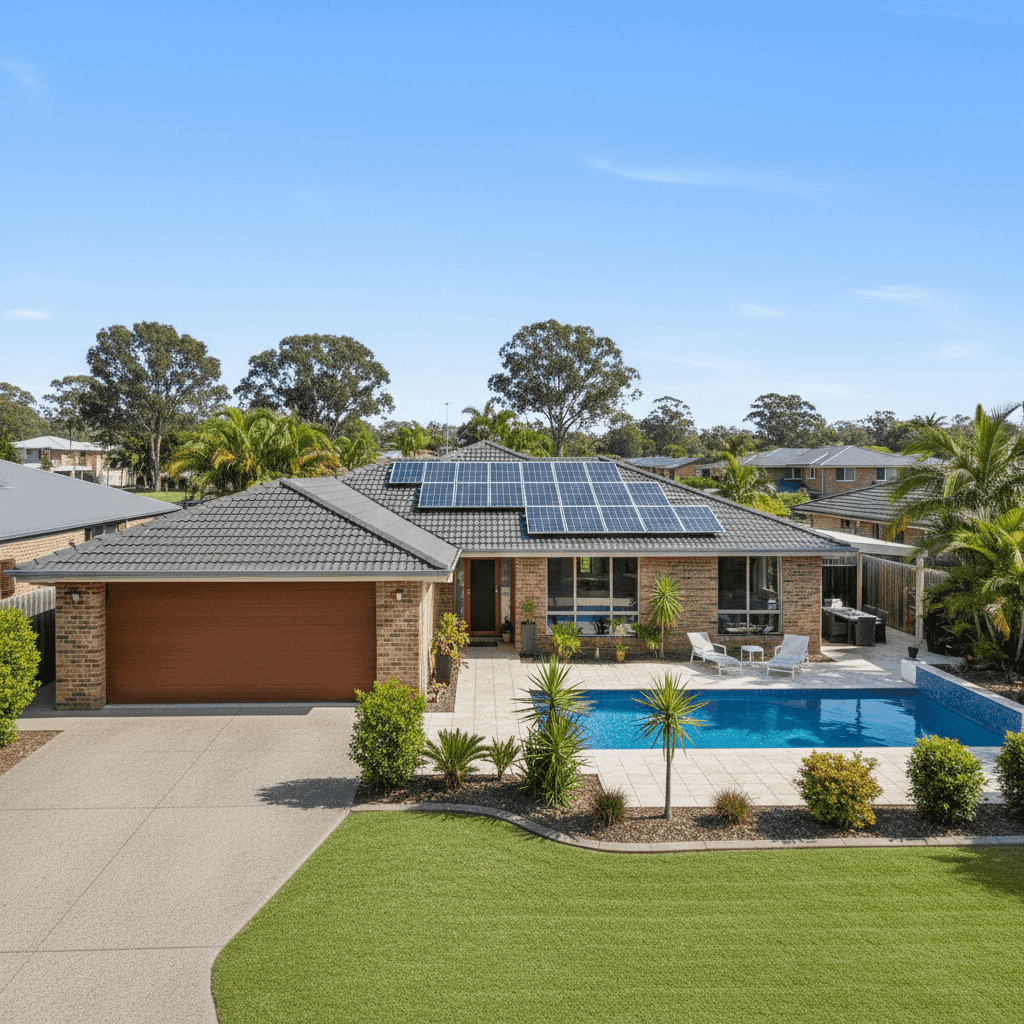
Cleveland is one of Redland City's most sought-after suburbs — a bayside community on Brisbane's southeastern fringe known for its relaxed lifestyle, ferry access to North Stradbroke Island, and a strong mix of established family homes. If you own a sizeable free standing home here, understanding what you should be paying for home and contents insurance is genuinely worthwhile. Premiums in Queensland can vary enormously depending on location, property features, and the insurer you choose.
This article breaks down a real insurance quote for a 5-bedroom, 3-bathroom free standing home in Cleveland (postcode 4163), covering both building and contents, and puts it into context against suburb, state, and national benchmarks.
---
Is This Quote Fair?
The quote in question comes in at $4,425 per year (or $417 per month) for combined home and contents cover, with a building sum insured of $1,128,000 and contents valued at $84,000. Both the building and contents excess are set at $1,000.
Our price rating for this quote is FAIR — Around Average, and the data backs that up.
Compared to the suburb average for Cleveland of $4,686 per year, this quote sits about 5.6% below what other homeowners in the area are typically paying. That's a modest but meaningful saving. It's also worth noting the suburb's 75th percentile sits at $6,498 — meaning roughly a quarter of Cleveland homeowners are paying significantly more than this.
Where it's less competitive is against the suburb median of $3,540 per year. The median is often a more reliable benchmark than the average (which can be skewed by outliers), and this quote is around $885 above the midpoint. For a home of this size and value, that's not alarming — but it does suggest there may be room to sharpen the premium with the right insurer.
---
How Cleveland Compares
To put this quote in proper perspective, it helps to zoom out and look at the broader picture.
| Benchmark | Premium |
|---|---|
| This Quote | $4,425/yr |
| Cleveland Suburb Average | $4,686/yr |
| Cleveland Suburb Median | $3,540/yr |
| Redland LGA Average | $3,178/yr |
| QLD State Average | $9,129/yr |
| QLD State Median | $3,903/yr |
| National Average | $5,347/yr |
| National Median | $2,764/yr |
A few things stand out here. First, Queensland's state average of $9,129 is extraordinarily high — driven largely by cyclone-prone regions in Far North Queensland, where premiums can be eye-watering. Cleveland, sitting in the southeast corner of the state and outside designated cyclone risk areas, benefits significantly from this. Homeowners here are largely shielded from the catastrophic premium loadings that affect Cairns, Townsville, and the Whitsundays.
Compared to the QLD state average, this Cleveland quote is less than half the price — a stark illustration of just how much geography influences insurance costs in this state.
Against the national average of $5,347, the quote looks competitive, coming in about $922 cheaper. Nationally, premiums have been climbing steadily as insurers price in flood, bushfire, and storm risk across the country, so landing below that benchmark is a positive sign.
The Redland LGA average of $3,178 is notably lower than this quote, but it's important to remember that LGA averages include a wide range of property types, sizes, and values — many of which will be smaller homes with lower sums insured. A 5-bedroom home with a $1.128M building sum insured naturally attracts a higher premium than a modest 3-bedroom dwelling.
---
Property Features That Affect Your Premium
Several characteristics of this property influence its insurance cost — some favourably, some less so.
Brick veneer construction with a tiled roof is generally viewed positively by insurers. Brick veneer offers solid fire resistance and structural durability, while tiles are considered more resilient than Colorbond or corrugated iron in many risk assessments. Together, these materials can contribute to lower premiums compared to timber-framed or clad homes.
Slab foundation is standard for Queensland homes built in the 1990s and is generally unremarkable from an insurance perspective — no subfloor space means less exposure to certain moisture-related risks.
Tile flooring throughout is another modest positive. Tiles are durable, easy to replace in sections, and less susceptible to water damage than carpet or timber flooring.
Above-average fittings quality does push the sum insured higher, which flows through to the premium. Kitchens and bathrooms with premium fixtures, stone benchtops, and quality joinery cost more to rebuild or repair — and the insurer's exposure reflects that.
The swimming pool adds a small but notable premium loading. Pools require specific liability cover and can be costly to repair or reinstate following storm or structural damage.
Solar panels are increasingly common on Queensland rooftops, and most insurers now include them under standard building cover — but the replacement value of a quality solar system on a home this size can be substantial, contributing to the overall sum insured.
Ducted climate control is another above-average inclusion that adds to the building's replacement value. Ducted systems are expensive to install and reinstate, and their presence is consistent with the above-average fittings quality noted for this property.
At 315 square metres, this is a large home by any measure. Rebuild costs scale with floor area, and at this size, the $1,128,000 building sum insured is not unreasonable for a well-appointed home in southeast Queensland.
---
Tips for Homeowners in Cleveland
1. Review your sum insured regularly Building costs in Queensland have risen sharply over the past few years due to labour shortages and material price increases. A sum insured that was accurate two years ago may now be insufficient. Use a quantity surveyor or your insurer's rebuild cost calculator to sense-check your coverage annually.
2. Compare quotes — don't just renew automatically Insurers adjust their pricing models constantly, and loyalty doesn't always pay. The 60-quote sample for Cleveland shows a wide spread from $2,383 (25th percentile) to $6,498 (75th percentile) — meaning the difference between the cheapest and most expensive quotes in this suburb can be thousands of dollars for a similar property. Run a comparison at CoverClub to see what's available.
3. Check your contents cover reflects reality $84,000 in contents cover is a reasonable starting point for a home of this size, but it's easy to underestimate. High-value items like jewellery, art, bicycles, and electronics may need to be listed separately as specified items to be fully covered. Do a room-by-room audit annually.
4. Ask about discounts for security and safety features Some insurers offer premium reductions for homes with monitored alarm systems, deadlocks, or fire suppression equipment. It's always worth asking — even a 5–10% discount on a $4,425 premium saves a meaningful amount each year.
---
Compare Your Home Insurance Today
Whether you're reviewing an existing policy or shopping for the first time, comparing quotes is the single most effective way to ensure you're not overpaying. CoverClub makes it easy to see how your premium stacks up against real data from your suburb and beyond.
Get a home insurance quote for your Cleveland property and see how the market compares — it takes just a few minutes and could save you hundreds.
For more suburb-level data, visit the Cleveland insurance stats page or explore Queensland-wide premium trends.