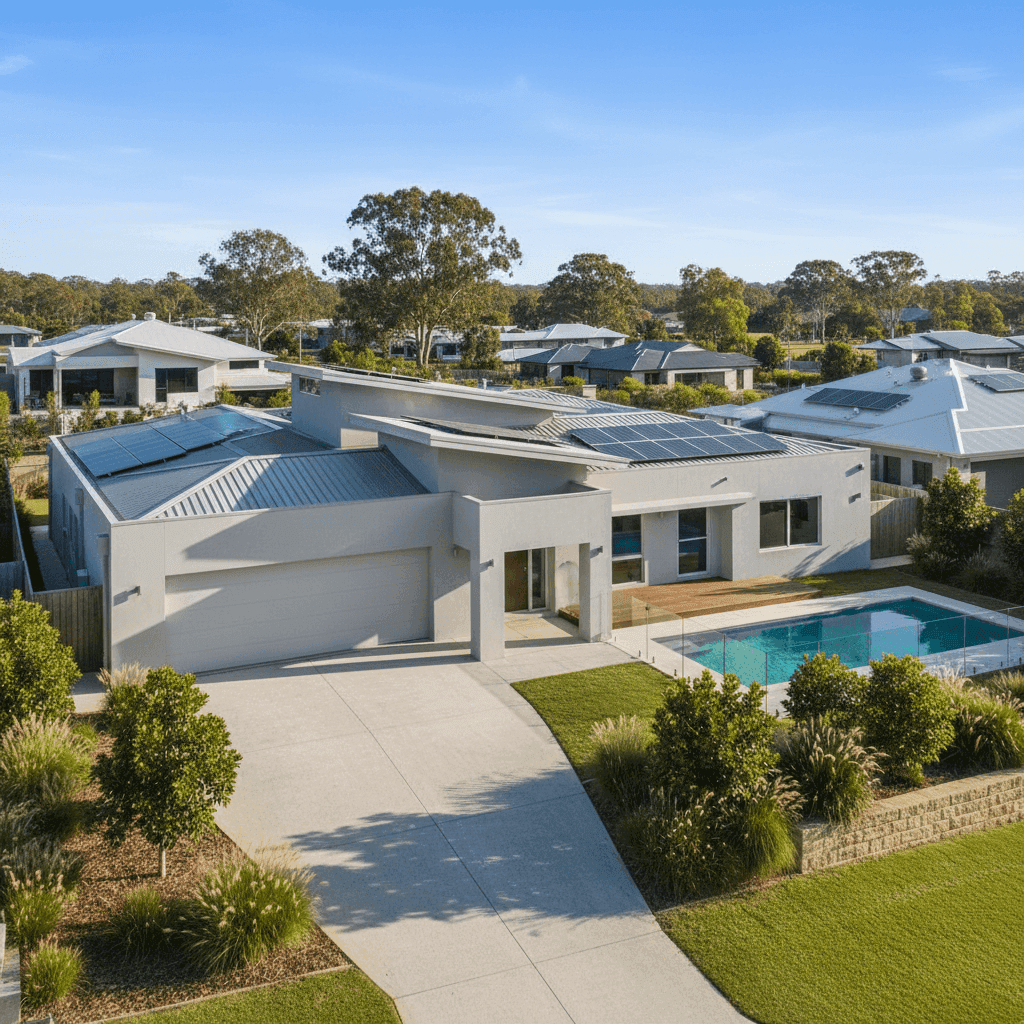
Cleveland, QLD is a sought-after bayside suburb on the Redland Coast — known for its relaxed lifestyle, proximity to Moreton Bay, and well-established family homes. This analysis looks at a home and contents insurance quote for a five-bedroom, free-standing home in the 4163 postcode, helping you understand what's driving the premium and whether it stacks up against the market.
---
Is This Quote Fair?
The annual premium for this property came in at $6,870 per year (or $652/month), which our pricing model rates as Expensive — Above Average.
To put that in context, the suburb average for Cleveland sits at $4,686/year, with a median of $3,540/year. This quote lands above the 75th percentile for the suburb (which is $6,498/year), meaning it's pricier than roughly three-quarters of comparable quotes in the area.
That said, "above average" doesn't automatically mean "unfair." This is a large, high-spec property — 315 square metres, top-of-the-range fittings, a pool, solar panels, and ducted climate control — with a substantial building sum insured of $1,899,000. Insuring a home of this calibre at replacement value will naturally attract a higher premium than a more modest dwelling. The real question is whether the price is competitive for what's being covered.
Given the features involved, the premium is elevated but not entirely surprising. Homeowners in this situation should still shop around to ensure they're not overpaying relative to what the market offers for similar properties.
---
How Cleveland Compares
Understanding where this quote sits relative to broader benchmarks gives valuable perspective:
| Benchmark | Premium |
|---|---|
| This Quote | $6,870/yr |
| Cleveland Suburb Average | $4,686/yr |
| Cleveland Suburb Median | $3,540/yr |
| Redland LGA Average | $3,178/yr |
| QLD State Average | $9,129/yr |
| QLD State Median | $3,903/yr |
| National Average | $5,347/yr |
| National Median | $2,764/yr |
A few things stand out here. Queensland's state average of $9,129/year is dramatically higher than the national average — a reflection of the elevated risk profile across much of the state, particularly in cyclone-prone and flood-affected regions. Cleveland, while not classified as a cyclone risk area, still sits within a broader QLD insurance landscape shaped by significant weather events.
Interestingly, this quote is well below the QLD state average, which is a positive sign. It's also above the national average of $5,347/year, but that's largely explained by the property's size and high sum insured. You can explore how QLD premiums compare broadly across the state to get a fuller picture.
The Redland LGA average of just $3,178/year is notably lower than the suburb average, suggesting there's a wide spread of property types and values across the council area — with this property sitting firmly at the premium end.
---
Property Features That Affect Your Premium
Several characteristics of this home have a direct bearing on what insurers charge. Here's how each one plays into the pricing:
Size and Sum Insured At 315 sqm with a building sum insured of $1,899,000, this is a large and valuable home. Rebuild costs are the primary driver of building insurance premiums — the more it would cost to reconstruct, the more you'll pay to insure it.
Top-of-the-Range Fittings High-end finishes — think stone benchtops, premium appliances, designer fixtures and custom joinery — significantly increase the cost to reinstate a home after a claim. Insurers price this risk accordingly, and it's one of the more impactful variables on your premium.
Concrete External Walls Concrete construction is generally viewed favourably by insurers. It's highly resistant to fire, wind, and pests, which can help moderate premiums compared to timber-framed homes. This is a positive factor for this property.
Swimming Pool A pool adds to the insured value of the property and can introduce liability considerations. Most home insurance policies cover the pool structure under building cover, but it does contribute to a higher sum insured.
Solar Panels Solar systems are increasingly common in Queensland, and most insurers cover them under building insurance. However, they add to the replacement value of the home and can be a factor in premium calculations, particularly for larger systems.
Ducted Climate Control Ducted air conditioning is another high-value fixed installation that increases the cost to rebuild or repair. Like solar panels, it's covered under building insurance but adds to the overall sum insured.
Slab Foundation and Tile Flooring A concrete slab foundation is standard for homes of this era and is considered a low-risk construction method. Tile flooring is also durable and doesn't carry the same water damage risk as timber or carpet in wet areas.
No Cyclone Risk Cleveland is not classified as a cyclone risk area, which is a meaningful premium advantage for Queensland homeowners. Properties in northern QLD can see premiums skyrocket due to cyclone loading — avoiding this factor keeps costs more manageable.
---
Tips for Homeowners in Cleveland
1. Review Your Sum Insured Regularly With a building sum insured of $1,899,000, it's worth revisiting this figure annually. Construction costs in Queensland have risen sharply in recent years, and being underinsured can leave you significantly out of pocket after a major claim. Use a building cost calculator or consult a quantity surveyor to confirm your figure is accurate.
2. Bundle Building and Contents Thoughtfully This quote covers both building ($1,899,000) and contents ($50,000). The contents value appears modest relative to the size and quality of the home — if you have high-value furniture, electronics, artwork or jewellery, consider whether $50,000 is truly sufficient. Underinsuring contents is a common mistake.
3. Compare Quotes Before Renewal Insurers don't always reward loyalty. With this quote rated as above average for the suburb, it's worth using a comparison platform like CoverClub to see what other providers are offering for the same level of cover. Even saving $500–$1,000 per year adds up significantly over time.
4. Ask About Discounts for Security and Safety Features Concrete construction, a modern build (2001), and features like monitored alarms or deadbolts may qualify you for discounts with certain insurers. It's always worth asking — some providers don't advertise these savings upfront.
---
Ready to Compare?
Whether you're renewing your current policy or shopping for the first time, comparing quotes is one of the simplest ways to make sure you're not overpaying. Get a home insurance quote on CoverClub and see how your premium stacks up against the suburb, state, and national benchmarks — all in one place. You can also explore detailed Cleveland suburb insurance statistics to better understand the local pricing landscape.