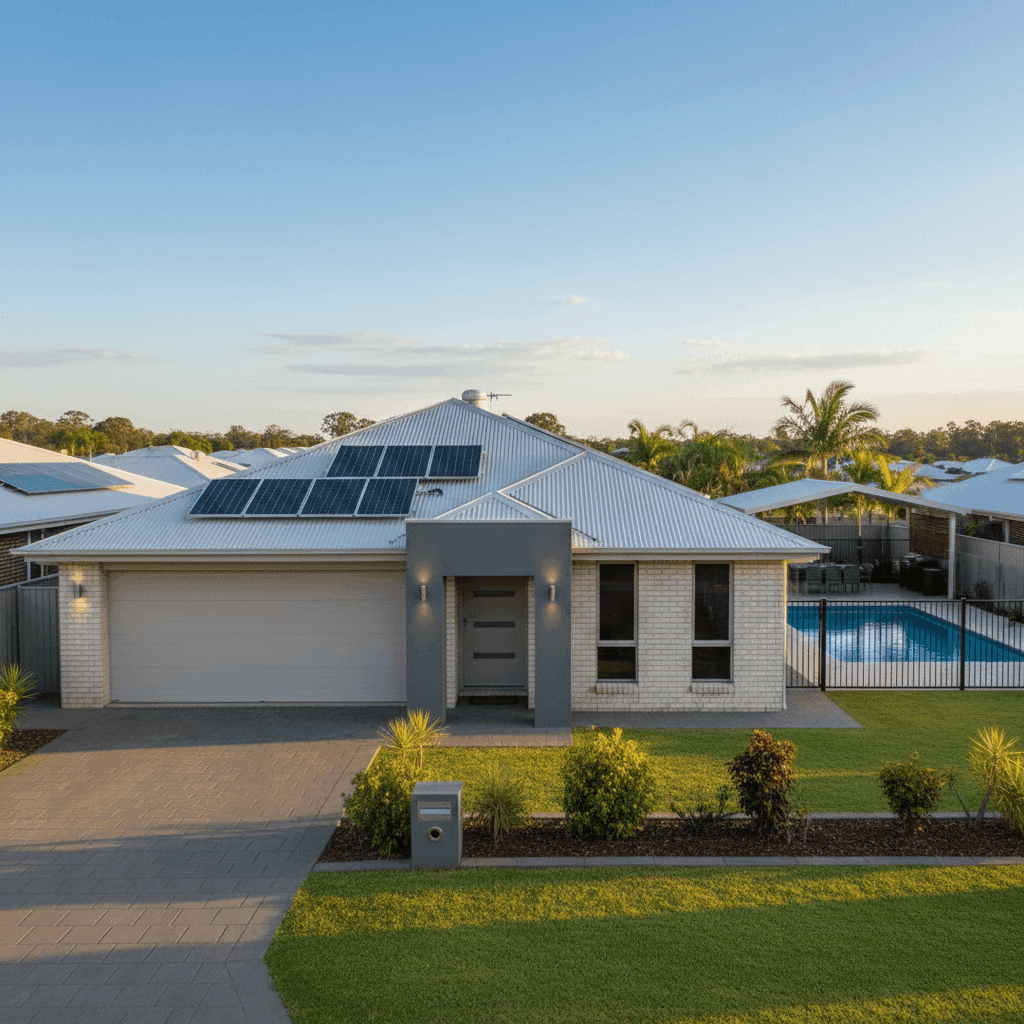
Situated in the Gladstone region of Central Queensland, Clinton is a well-established residential suburb where brick veneer homes on stumps are a familiar sight. If you own a four-bedroom, two-bathroom freestanding home here and you're wondering whether your home and contents insurance quote stacks up, you're in the right place. This article breaks down a real quote for a property in Clinton QLD 4680 — $3,404 per year — and puts it in context against local, state, and national benchmarks.
---
Is This Quote Fair?
The short answer: yes, broadly speaking — but there's room to do better.
This quote has been rated Fair (Around Average), which means it sits in the middle of the road for Clinton. At $3,404 per year (or $319 per month), it's above the suburb average of $3,097 and the suburb median of $3,153, but it falls comfortably below the 75th percentile of $3,744. In practical terms, roughly a quarter of similar properties in Clinton are paying more than this — but the majority are paying less.
That said, "fair" doesn't mean you should simply accept the price. Insurance premiums are highly sensitive to individual property characteristics, the insurer's risk appetite, and the level of cover selected. A sum insured of $857,000 on the building and $50,000 on contents is a meaningful level of protection, and the $1,000 excess on both building and contents is fairly standard.
The key takeaway: this quote isn't alarming, but it's worth shopping around to see if a comparable policy can be secured for closer to the suburb median — or even below it.
---
How Clinton Compares
Understanding where Clinton sits relative to broader markets gives valuable perspective. You can explore the full data on the Clinton suburb stats page.
| Benchmark | Annual Premium |
|---|---|
| This Quote | $3,404 |
| Clinton Suburb Average | $3,097 |
| Clinton Suburb Median | $3,153 |
| Clinton 25th Percentile | $2,322 |
| Clinton 75th Percentile | $3,744 |
| QLD State Average | $4,547 |
| QLD State Median | $3,931 |
| National Average | $2,965 |
| National Median | $2,716 |
A few things stand out here. First, Queensland homeowners pay significantly more than the national average — the QLD state average of $4,547 is over 50% higher than the national average of $2,965. This reflects the elevated risk profile of Queensland properties, which are frequently exposed to severe weather events including floods, storms, and hail.
Clinton, however, performs notably better than the state average. At $3,097 on average, Clinton homeowners are paying roughly $1,450 less per year than the typical Queenslander. This is likely due to the suburb's position outside designated cyclone risk zones, which meaningfully reduces the risk burden for insurers.
Compared to the national picture, Clinton premiums are slightly elevated — around $130–$440 above national benchmarks — which is consistent with the broader Queensland risk environment.
---
Property Features That Affect Your Premium
Every property tells its own insurance story. Here's how the specific features of this home influence what you'd expect to pay:
Brick Veneer Walls & Colorbond Roof
Brick veneer is one of the more insurer-friendly wall materials in Australia. It offers solid fire resistance and structural durability, which typically attracts more competitive premiums compared to timber or weatherboard homes. The steel Colorbond roof is similarly well-regarded — it's durable, low-maintenance, and performs well in high-wind conditions. Together, these materials suggest a property that insurers view as relatively lower risk from a construction standpoint.
Stump Foundation & Timber/Laminate Flooring
Homes on stumps are common in Queensland and were historically built to allow airflow beneath the structure and to manage flood risk. However, they can be more vulnerable to certain types of damage, including subsidence and termite ingress. Timber and laminate flooring — while attractive — can also be susceptible to water damage, which may factor into premium calculations.
Swimming Pool
Pools add to the replacement cost of a property and introduce liability considerations. They also require specific coverage inclusions to ensure the pool shell, equipment, and surrounding areas are properly protected. Homeowners should confirm their policy explicitly covers pool-related damage and liability.
Solar Panels
With solar panels installed, it's essential to verify that your policy covers the panels themselves — both for physical damage (storms, hail) and for the cost of removal and reinstallation if roof repairs are needed. Solar coverage is not always automatic, and the value of a modern system can be significant.
Built in 1995
A home approaching its 30th year may have ageing infrastructure — think plumbing, electrical systems, and roofing components. Insurers factor in the age of a property when calculating risk, and older homes may attract slightly higher premiums or more scrutiny at claim time.
214 sqm Building Size
At 214 square metres, this is a comfortably sized family home. The $857,000 sum insured translates to roughly $4,000 per square metre in rebuild cost — a figure worth reviewing periodically, as construction costs in regional Queensland have risen considerably in recent years.
---
Tips for Homeowners in Clinton
1. Review Your Sum Insured Regularly
Building costs have surged across Australia since 2020. If your sum insured hasn't been updated recently, you may be underinsured — meaning a total loss could leave you significantly out of pocket. Use a building cost calculator or speak with a quantity surveyor to validate your figure.
2. Confirm Solar Panel and Pool Coverage
Don't assume these are automatically included. Ask your insurer directly whether solar panels are covered for storm and hail damage, and whether pool equipment and the pool shell are included under your building policy. Getting this in writing protects you at claim time.
3. Consider Raising Your Excess to Lower Your Premium
A $1,000 excess is standard, but opting for a higher excess — say $2,000 or $2,500 — can reduce your annual premium meaningfully. This strategy works well if you have an emergency fund and are primarily insuring against major losses rather than minor claims.
4. Shop the Market at Renewal Time
Loyalty doesn't always pay in insurance. Insurers frequently offer better rates to new customers than to existing ones. Set a reminder to compare quotes 4–6 weeks before your renewal date each year — even if you end up staying with your current provider, you'll negotiate from a position of knowledge.
---
Compare Your Quote with CoverClub
Whether you're renewing your policy or shopping for the first time, CoverClub makes it easy to see how your quote stacks up. Our suburb and state-level data gives you real market context — not just a number — so you can make a confident, informed decision.
Get a home insurance quote today and find out if you're paying a fair price for your Clinton home.