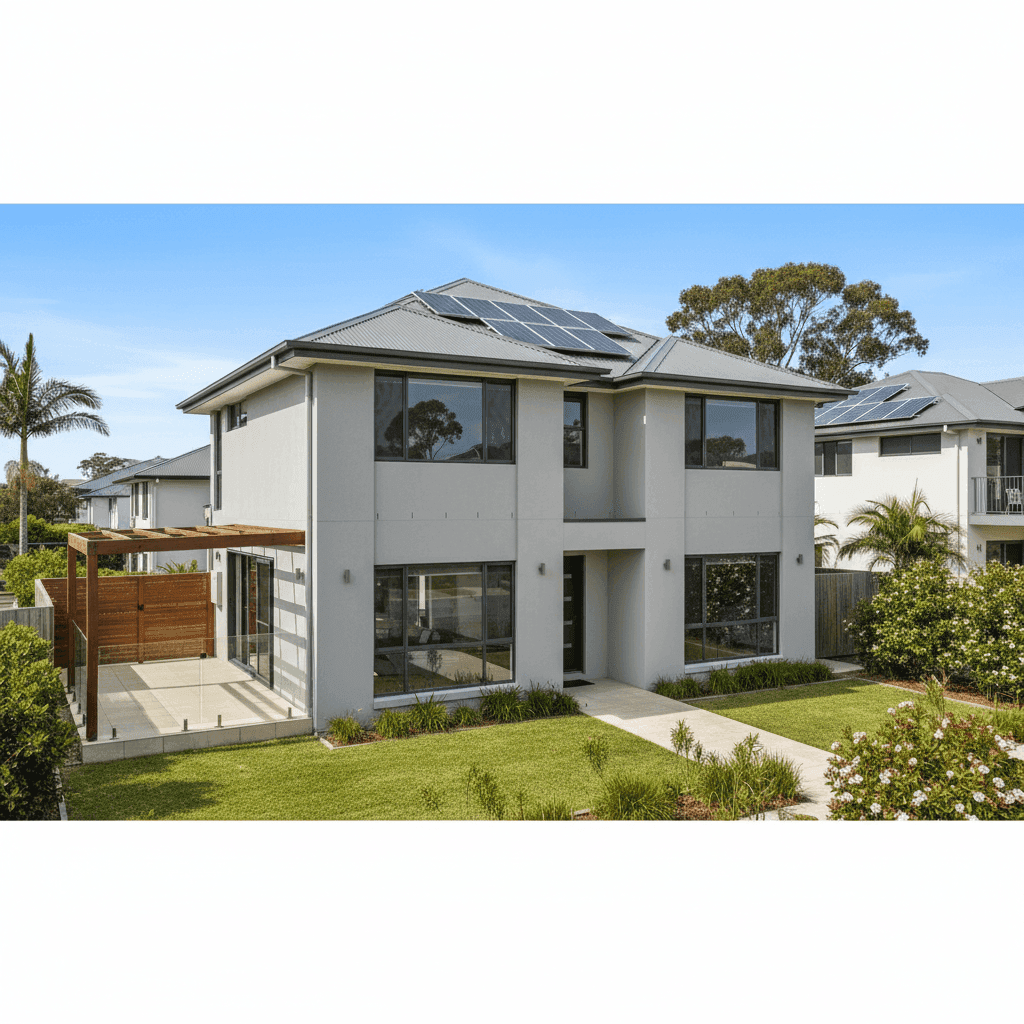
Home insurance costs in coastal New South Wales can vary enormously depending on where you live, what your home is built from, and which insurer you choose. To illustrate what homeowners might expect to pay, we've analysed a real home and contents insurance quote for a three-bedroom, free-standing home in Coffs Harbour, NSW 2450 — a popular coastal city on the Mid North Coast. Here's what the numbers reveal.
---
Is This Quote Fair?
The quote in question comes in at $1,646 per year (or roughly $161 per month) for a combined home and contents policy. The building is insured for $450,000 and contents for $10,000, with a $2,000 building excess and a $1,000 contents excess.
Our price rating for this quote is FAIR — Around Average, and the data backs that up. Based on 96 quotes collected for the Coffs Harbour 2450 postcode, the suburb's 25th percentile sits at $1,600 per year. That means this quote is just above the cheapest quarter of the market locally — a solid result without being the absolute lowest available.
To put it plainly: this homeowner isn't overpaying, but there's still room to potentially do better. Premiums in this suburb range widely, from around $1,600 at the lower end up to $3,544 at the 75th percentile — a difference of nearly $2,000 per year for broadly similar properties. That spread underscores just how much insurer pricing can diverge, and why comparing quotes is so worthwhile.
---
How Coffs Harbour Compares
Coffs Harbour is notably more affordable to insure than many other parts of New South Wales, and the figures make for interesting reading:
| Benchmark | Annual Premium |
|---|---|
| This quote | $1,646 |
| Suburb average (2450) | $2,819 |
| Suburb median (2450) | $2,079 |
| NSW average | $3,801 |
| NSW median | $3,410 |
| National average | $2,965 |
| National median | $2,716 |
| LGA average (Clarence Valley) | $6,052 |
This quote comes in 42% below the suburb average and a remarkable 57% below the NSW state average. Even against the national average of $2,965, this policy is priced well below the midpoint.
Perhaps the most striking comparison is against the broader Clarence Valley LGA average of $6,052 per year. That figure reflects the elevated risk profiles of some surrounding areas — including flood-prone and more exposed coastal zones — and serves as a reminder that location within a region matters enormously. Coffs Harbour itself, particularly for newer builds in lower-risk pockets, can attract considerably more competitive premiums.
It's worth noting that averages can be skewed by high-value properties and high-risk locations, so the median is often a more reliable benchmark. At $2,079, the suburb median is still 26% higher than this quote — suggesting this is genuinely a competitive result for the area.
---
Property Features That Affect Your Premium
Several characteristics of this property work in the homeowner's favour when it comes to pricing:
New Construction (2025) Insurers typically reward newer homes with lower premiums. A brand-new build is less likely to have ageing plumbing, outdated wiring, or structural wear — all factors that can drive up risk. A 2025 construction date is about as favourable as it gets.
Hebel External Walls Hebel (autoclaved aerated concrete) panels are increasingly popular in Australian residential construction. They offer excellent fire resistance and durability, which can positively influence underwriting assessments compared to more combustible materials like timber weatherboard.
Steel/Colorbond Roof Metal roofing is generally viewed favourably by insurers. It's resilient against ember attack, less susceptible to storm damage than some alternatives, and has a long lifespan — all of which reduce the likelihood of a claim.
Concrete Slab Foundation A slab foundation is considered low-risk from an underwriting perspective. There's no subfloor space to trap moisture or allow pest access, and slabs are structurally robust in most soil conditions.
Solar Panels This property includes solar panels, which are noted on the policy. It's important that homeowners confirm their solar system is explicitly covered under their building sum insured, as panels can be costly to replace and some policies treat them differently.
Ducted Climate Control Ducted air conditioning is a meaningful inclusion from a contents and building perspective. Homeowners should verify whether the system is covered under the building or contents component — and that the sum insured adequately accounts for its replacement value.
No Pool, Tiles Throughout The absence of a pool removes a common source of liability and maintenance-related claims. Tiled flooring throughout is also a practical, low-maintenance choice that holds up well in coastal climates.
Not in a Cyclone Risk Zone Unlike parts of Queensland and northern Western Australia, Coffs Harbour is not classified as a cyclone risk area. This is a meaningful factor — cyclone-rated construction requirements and associated premiums can add substantially to costs further north.
---
Tips for Homeowners in Coffs Harbour
1. Review your building sum insured carefully At $450,000, the building sum insured should reflect the full cost of rebuilding — not the market value of the property. With construction costs rising across Australia, it's worth getting a professional rebuild estimate to ensure you're not underinsured. Don't forget to factor in site clearance, architect fees, and the solar system.
2. Consider increasing your excess to reduce premiums This policy carries a $2,000 building excess and $1,000 contents excess. If you have a financial buffer and rarely make small claims, opting for a higher excess can meaningfully reduce your annual premium. Just make sure the excess is genuinely manageable if you do need to claim.
3. Compare quotes at renewal — every year Insurance loyalty rarely pays. Insurers regularly re-price risk, and the market is competitive. Given that premiums in this suburb range from $1,600 to $3,544 for similar properties, there's real money to be saved by shopping around annually rather than simply auto-renewing.
4. Confirm solar panel and ducted AC coverage With solar panels and ducted climate control both present, it's worth reading your Product Disclosure Statement carefully to confirm how each is treated. Some insurers include solar panels as part of the building; others require them to be separately listed. Gaps in coverage can be costly.
---
Compare Your Own Quote
Whether you're a new homeowner in Coffs Harbour or coming up to renewal, it pays to see what the broader market looks like before you commit. CoverClub makes it easy to get a home insurance quote and benchmark it against real data from your suburb and state. You can also explore detailed Coffs Harbour insurance statistics or browse NSW-wide premium data to understand how your area stacks up. A few minutes of comparison could save you hundreds of dollars a year.