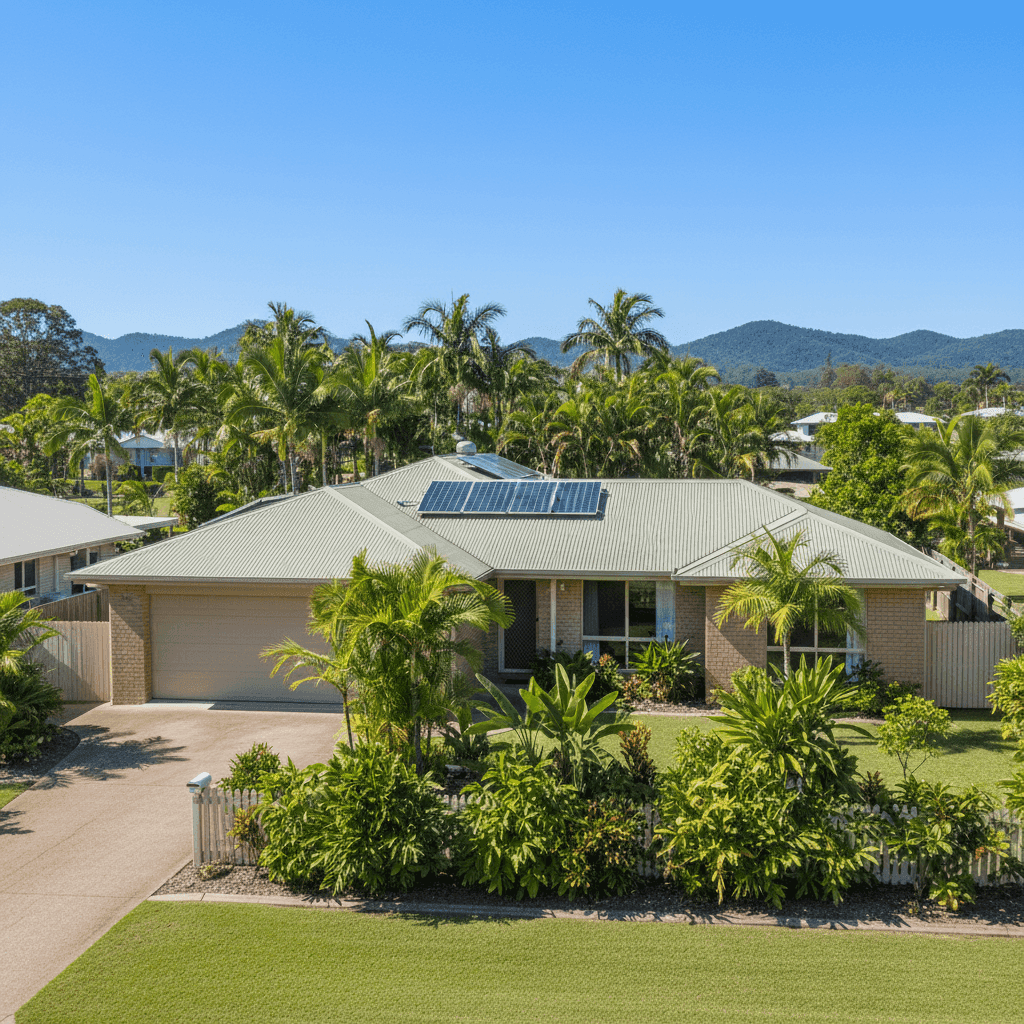
Cooktown, nestled at the tip of Far North Queensland, is one of Australia's most storied coastal towns — and one of its most exposed when it comes to natural hazard risk. If you own a free standing home here, understanding what drives your insurance premium is just as important as having cover in the first place. This analysis breaks down a real home and contents insurance quote for a 3-bedroom, 1-bathroom free standing home in Cooktown (QLD 4895), built in 1996 on a slab foundation with double brick walls and a steel Colorbond roof — and puts that premium in context against local, state, and national benchmarks.
---
Is This Quote Fair?
The quote in question comes in at $3,760 per year (or $360/month) for a combined home and contents policy, covering a building sum insured of $709,000 and $50,000 in contents, with a $1,000 excess on both components.
Our rating for this quote is FAIR — Around Average, and the data backs that up. The suburb average premium for Cooktown sits at $3,775 per year, meaning this quote lands almost exactly on the local benchmark — just $15 below the average across 59 quotes sampled in the area.
That said, "average" in Cooktown is not the same as "cheap." The suburb's median premium is $3,208/yr, which tells us that while the middle of the market is somewhat lower, a meaningful proportion of homeowners are paying significantly more — the 75th percentile sits at $4,478/yr. So while this quote isn't a bargain, it's also far from the worst outcome for a property in this postcode.
The verdict: this is a reasonable quote for the risk profile involved, but there is room to do better with the right insurer and the right approach.
---
How Cooktown Compares
To appreciate what Cooktown homeowners are up against, it helps to zoom out and look at the broader picture.
| Benchmark | Average Premium |
|---|---|
| Cooktown (4895) | $3,775/yr |
| LGA: Douglas | $4,706/yr |
| Queensland | $4,547/yr |
| National | $2,965/yr |
A few things stand out here. First, Cooktown's suburb average of $3,775/yr is actually below both the Queensland state average ($4,547/yr) and the Douglas LGA average ($4,706/yr) — a somewhat surprising result given the town's cyclone exposure. This may reflect a mix of property ages, construction types, and sum insured levels in the local sample.
Second, the gap between Cooktown and the national average of $2,965/yr is substantial — roughly $810 more per year, or about 27% above the national benchmark. That premium loading is almost entirely attributable to the elevated natural hazard risk in Far North Queensland, particularly cyclone and flood exposure.
Compared to the broader Queensland state picture, Cooktown homeowners are actually faring slightly better on average — but that's cold comfort when you're still paying nearly $1,000 more per year than the typical Australian homeowner.
---
Property Features That Affect Your Premium
Several characteristics of this particular property work in the owner's favour — and a couple don't.
Double Brick Walls Double brick construction is generally viewed favourably by insurers. It offers superior structural integrity compared to timber or clad weatherboard, and provides better resistance to wind-driven debris — a meaningful advantage in a cyclone-prone region. This likely provides some downward pressure on the premium.
Steel Colorbond Roof Colorbond roofing is another positive signal for insurers in cyclone zones. It's lightweight, purpose-engineered, and when correctly installed and fastened, performs well under high-wind conditions. Older corrugated iron or tile roofs tend to attract higher premiums in Far North Queensland.
Slab Foundation Concrete slab foundations are considered low-risk from an underwriting perspective. There's no subfloor cavity that can be compromised by flooding or pest activity, which simplifies the risk profile.
Solar Panels The presence of solar panels adds a modest layer of complexity to the risk assessment. Panels represent an additional asset that can be damaged by hail, cyclone debris, or storm events. Some insurers cover rooftop solar automatically under building cover; others treat it as an optional extension. It's worth confirming exactly how your policy handles solar panel damage and replacement.
Construction Year: 1996 A home built in 1996 predates some of the more stringent cyclone-resistant building codes introduced in Queensland after Cyclone Larry (2006) and Cyclone Yasi (2011). While double brick and Colorbond construction offer solid inherent resilience, homes built before these code updates may still attract a slight premium loading compared to newer builds.
Vinyl Flooring and Standard Fittings These are neutral factors from an insurance perspective. Vinyl is durable and relatively inexpensive to replace, which keeps contents and building replacement costs manageable. Standard-grade fittings mean the rebuild cost estimate is unlikely to be inflated by high-end fixtures.
---
Tips for Homeowners in Cooktown
1. Review Your Building Sum Insured Carefully A sum insured of $709,000 for a 130 sqm home in a remote Far North Queensland location may be appropriate — but it's worth stress-testing that figure. Construction costs in remote areas like Cooktown are significantly higher than in metropolitan centres due to freight, logistics, and labour availability. Underinsurance is a serious risk; make sure your sum insured reflects true rebuild cost, not market value.
2. Confirm Your Cyclone Cover and Excess Structure Many policies in cyclone-prone areas apply a separate, higher cyclone excess on top of the standard building excess. Read your Product Disclosure Statement (PDS) carefully to understand what applies in the event of a named cyclone. A $1,000 standard excess may look attractive, but a cyclone-specific excess of $2,500 or more could change the picture significantly.
3. Ask About Solar Panel Coverage With solar panels on the roof, clarify with your insurer whether they're automatically included under your building sum insured or whether a separate item or endorsement is required. Also check whether damage from storm or cyclone events is covered, and what the claims process looks like for panel replacement.
4. Compare Quotes Annually Insurance pricing in high-risk postcodes like Cooktown can vary dramatically between providers — sometimes by thousands of dollars for equivalent cover. The 25th percentile in this suburb is $2,733/yr, meaning some homeowners are paying more than $1,000 less per year than average. Shopping the market at renewal time is one of the most effective ways to manage your premium without sacrificing cover quality.
---
Ready to See What You Could Pay?
Whether you're renewing soon or just curious about your options, comparing quotes is the smartest first step. Get a home insurance quote through CoverClub and see how different insurers price your specific property — you might be surprised by the range. You can also explore detailed premium statistics for Cooktown and the surrounding area to benchmark any quote you receive.