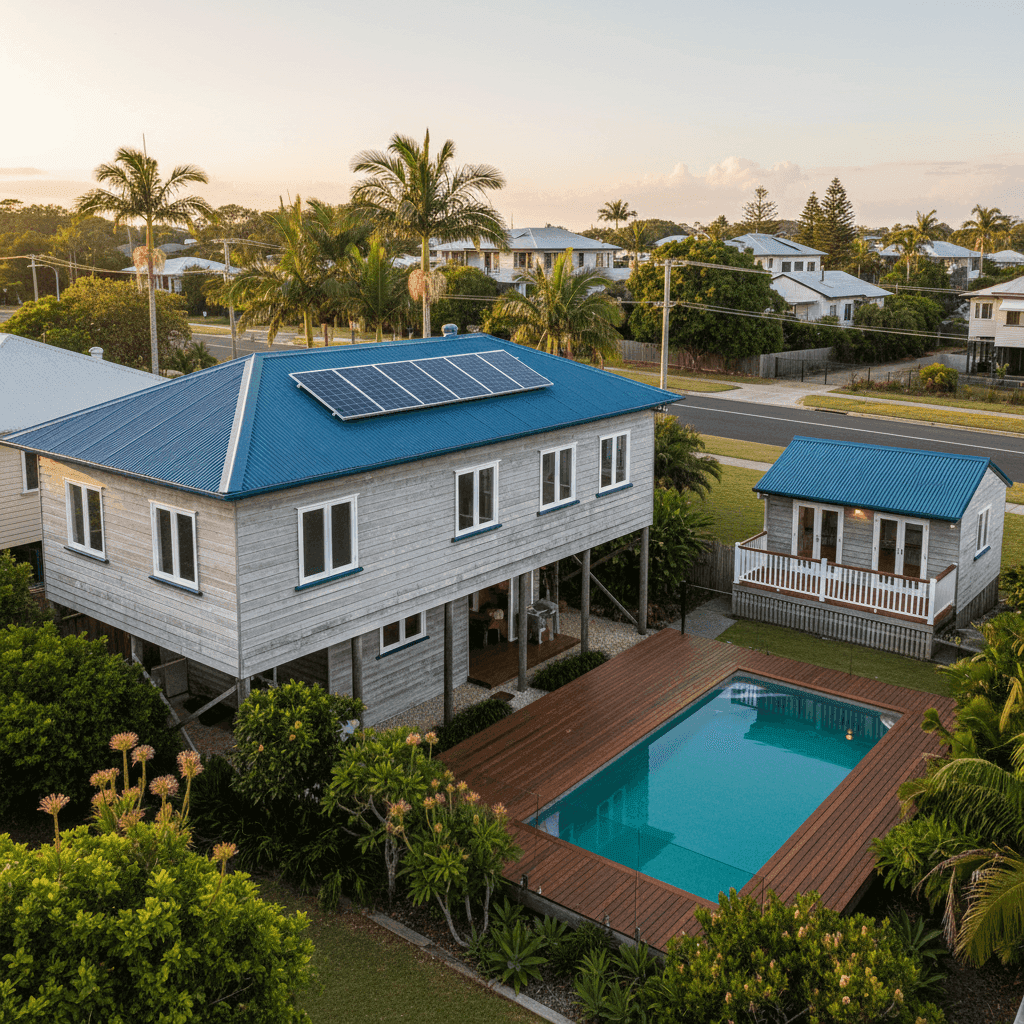
If you own a free standing home in Coolum Beach, QLD 4573, you're living in one of the Sunshine Coast's most sought-after beachside suburbs — and like many homeowners here, you're probably wondering whether your home insurance premium is competitive. This article breaks down a real home and contents insurance quote for a three-bedroom, three-bathroom property in the area, compares it against local, state, and national benchmarks, and offers practical tips to help you make the most of your cover.
---
Is This Quote Fair?
The quote in question sits at $2,263 per year (or $222/month) for combined home and contents insurance, covering a building sum insured of $619,200 and contents valued at $135,200. The building excess is $3,000 and the contents excess is $1,000.
Our pricing engine rates this quote as Fair — Around Average, and the data backs that up. At $2,263/yr, this premium sits just above the Coolum Beach suburb average of $2,164/yr and slightly above the suburb median of $2,091/yr. That means this homeowner is paying a touch more than the typical Coolum Beach policyholder — but not by a significant margin.
Importantly, the quote is well below both the QLD state average of $4,547/yr and the national average of $2,965/yr. For a property with several risk-relevant features (more on those below), landing in the "around average" band for the suburb is a reasonable outcome.
The 25th–75th percentile range for Coolum Beach spans $1,135/yr to $3,125/yr, meaning this quote sits comfortably within the middle of the pack — closer to the upper half, but far from an outlier.
---
How Coolum Beach Compares
One of the most striking takeaways from the pricing data is just how affordable Coolum Beach is relative to the broader Queensland market.
| Benchmark | Annual Premium |
|---|---|
| This Quote | $2,263 |
| Coolum Beach Suburb Average | $2,164 |
| Coolum Beach Suburb Median | $2,091 |
| Noosa LGA Average | $4,485 |
| QLD State Average | $4,547 |
| National Average | $2,965 |
| National Median | $2,716 |
The contrast with the broader Noosa LGA average of $4,485/yr is particularly notable. Despite sitting within the Noosa local government area, Coolum Beach properties tend to attract significantly lower premiums than the LGA average — likely reflecting a lower concentration of high-value or flood/cyclone-exposed properties compared to other parts of the Noosa region.
Queensland as a whole is one of the most expensive states for home insurance in Australia, largely driven by extreme weather risks in northern and coastal areas. The fact that this Coolum Beach quote comes in well under the state average suggests the property's risk profile is being assessed favourably — no cyclone rating, and a location that doesn't appear to carry the same flood or storm surge exposure as higher-risk QLD postcodes.
You can explore more suburb-level data on the Coolum Beach insurance stats page or browse QLD-wide trends for broader context.
---
Property Features That Affect Your Premium
Several characteristics of this property are worth understanding from an insurance pricing perspective.
Fibro/Asbestos External Walls This is one of the most significant premium factors for homes of this era. Built in 1988, the property features fibro asbestos cladding — a common construction material in Queensland homes from the mid-20th century through to the late 1980s. Insurers typically apply a loading to these properties due to the higher cost and complexity of repairs, which must comply with strict asbestos handling regulations. This almost certainly contributes to the premium sitting above the suburb median.
Pole Foundation Homes built on poles (also known as stilts or stumps) are common in Queensland, particularly in flood-prone or hilly coastal areas. While pole homes can actually perform well in flood events, they can be more expensive to repair after storm or wind damage, and some insurers price this into their assessments.
Steel/Colorbond Roof This is a positive from an insurance standpoint. Colorbond roofing is durable, fire-resistant, and widely regarded as lower-risk than older materials like terracotta tiles or corrugated iron. It may help offset some of the loadings applied for other features.
Swimming Pool A pool adds to the overall replacement cost of the property and is factored into the building sum insured. It also introduces a liability consideration, though this is generally covered under the home building policy.
Solar Panels Solar panels are increasingly common on Queensland rooftops and are typically covered under the building policy as a fixed fixture. They add to the replacement cost, which flows through to the sum insured and, in turn, the premium.
Granny Flat The presence of a secondary dwelling on the property adds complexity to the insurance assessment. Depending on the policy, a granny flat may be automatically included in the building cover or may require a specific declaration. It's worth confirming with your insurer that the flat is explicitly covered.
Timber/Laminate Flooring Timber floors can be costly to replace or repair — particularly in a pole home where subfloor access and moisture exposure are relevant. This is reflected in the contents and building valuation.
---
Tips for Homeowners in Coolum Beach
1. Get your sum insured right — especially with a granny flat and pool Underinsurance is one of the most common and costly mistakes Australian homeowners make. With a granny flat, pool, and solar panels all contributing to replacement costs, it's worth using a professional building estimator or your insurer's calculator to validate your $619,200 sum insured. The cost of construction has risen sharply in recent years, and what was adequate cover two years ago may no longer be sufficient.
2. Understand your asbestos obligations If your home is damaged and requires repair, any work involving fibro asbestos walls must be carried out by a licensed asbestos removalist under Queensland regulations. Make sure your insurer is fully aware of the wall construction type (as declared in this quote) and confirm that asbestos-related repair costs are not subject to exclusions or sub-limits in your policy.
3. Review your excess structure This quote carries a $3,000 building excess — which is on the higher end. A higher excess generally reduces your premium, but it also means a larger out-of-pocket cost when you claim. Consider whether that trade-off makes sense for your financial situation, particularly given the property's age and construction materials, which may make smaller claims more likely.
4. Compare at renewal, not just at sign-up Insurance loyalty rarely pays off in Australia. Premiums can shift significantly year on year, and the market in Coolum Beach has enough competition (based on 37 quotes in our dataset) to make shopping around worthwhile. Set a reminder to compare quotes at least 30 days before your renewal date.
---
Ready to Compare?
Whether you're reviewing an existing policy or shopping for cover on a new property, CoverClub makes it easy to see how your quote stacks up. Enter your address at CoverClub to get a personalised quote comparison and find out whether you're getting a fair deal — or paying more than you should be.