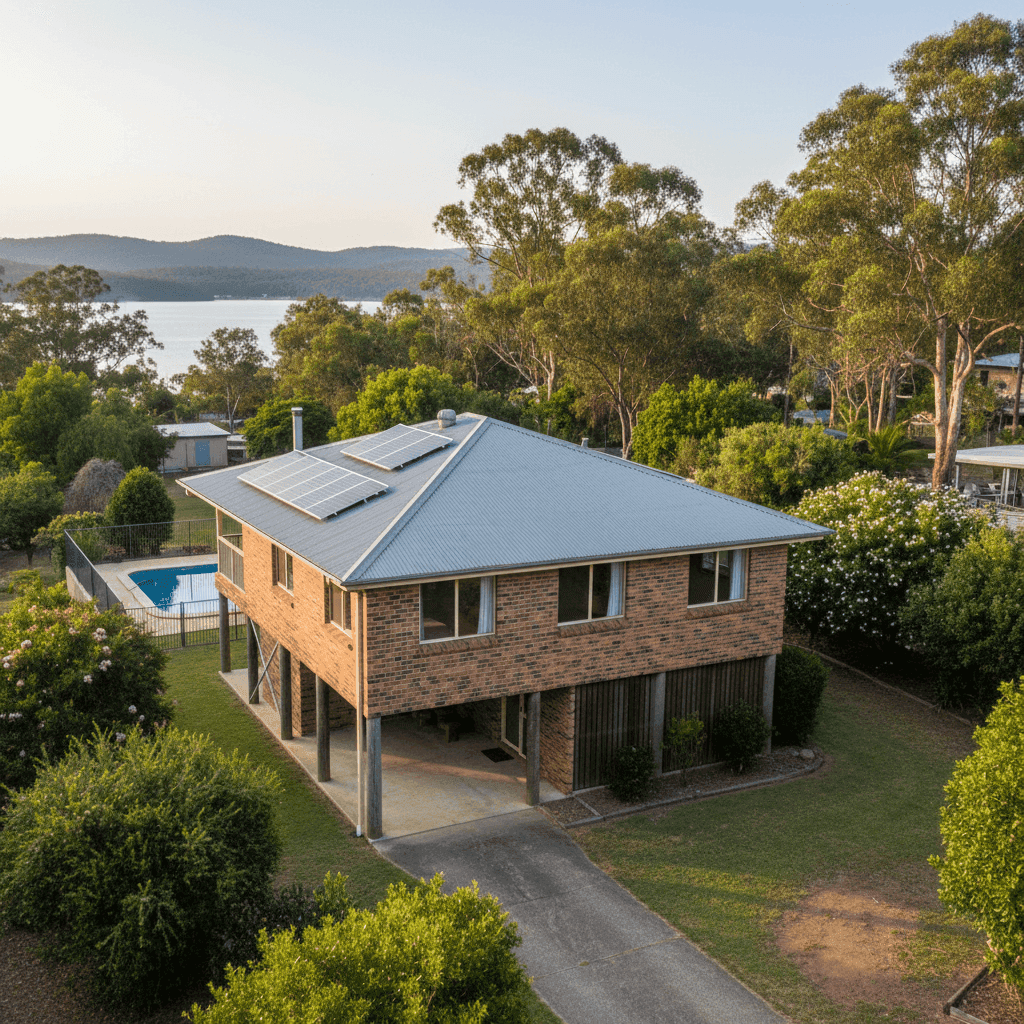
Coomba Park is a quiet lakeside village tucked along the shores of Wallis Lake on the Mid-Coast of New South Wales. It's the kind of place where weekenders become permanent residents and retirees trade the city for something slower — but that doesn't mean home insurance is something you can afford to overlook. For a four-bedroom, free-standing home in this postcode, understanding what you're paying and why is essential to making sure you're properly covered without overpaying.
---
Is This Quote Fair?
The quote in question comes in at $1,964 per year (or $181 per month) for combined home and contents cover — insuring the building for $600,000 and contents for $240,000, with a building excess of $3,000 and a contents excess of $2,000.
Our pricing analysis rates this quote as CHEAP — below average — which is genuinely good news for the homeowner. To put that in perspective:
- The NSW state average premium sits at $3,801/yr, with a median of $3,410/yr
- The national average is $2,965/yr, with a median of $2,716/yr
- The Mid-Coast LGA average is a notably high $4,463/yr
At $1,964/yr, this quote is nearly 48% below the NSW state average, 34% below the national average, and a striking 56% below the Mid-Coast LGA average. For a coastal property in regional NSW — a category that often attracts elevated premiums — this represents genuinely competitive pricing.
Of course, price alone doesn't tell the whole story. The excess levels are on the higher side (particularly the $3,000 building excess), which will have contributed to bringing the annual premium down. Homeowners should weigh up whether those excess amounts are comfortable in the event of a claim.
---
How Coomba Park Compares
While suburb-level data for Coomba Park (2428) isn't available in sufficient volume to produce a reliable local benchmark, the broader regional picture is telling. You can explore Coomba Park insurance statistics as more data becomes available, and compare against NSW-wide home insurance data or the national overview.
The Mid-Coast LGA average of $4,463/yr is notably higher than both the state and national figures, which reflects the risk profile of coastal and semi-rural properties in this region. Factors like flood proximity (Wallis Lake and surrounding waterways), distance from fire services, and the general age and style of housing stock in the area all push premiums upward for many properties in the LGA.
That makes this particular quote — at well under half the LGA average — stand out as unusually competitive. It's worth noting, however, that individual premiums vary enormously based on property-specific features, and what one insurer charges can differ dramatically from another for the same home.
---
Property Features That Affect Your Premium
Several characteristics of this property would influence how insurers assess and price the risk:
Brick Veneer Walls & Colorbond Roof Brick veneer is a well-regarded construction type in the Australian insurance market — it's considered more fire-resistant than timber weatherboard and is widely understood by insurers. Colorbond steel roofing is similarly favoured: it's durable, low-maintenance, and performs well in high-wind conditions. Together, these materials generally attract more competitive premiums than older or less resilient alternatives.
Elevated on Stumps (at Least 1 Metre) The home is elevated by at least one metre on stumps — a construction style common in coastal and flood-prone areas of NSW and Queensland. This elevation can be a meaningful risk-reduction factor in areas near waterways, as it reduces the likelihood of inundation damage to the main living areas. Insurers typically view this favourably in flood-adjacent locations like Coomba Park.
Swimming Pool A pool adds both value and liability to a property. From an insurance perspective, it increases the replacement cost of the building (contributing to the $600,000 sum insured) and may also introduce some liability considerations. Homeowners should ensure their policy covers pool-related structures and equipment.
Solar Panels Solar panels are increasingly common across Australian homes, but they're not always covered as a matter of course. It's important to confirm whether your policy includes solar panels under the building sum insured, and whether damage from storms, hail, or electrical faults is explicitly covered.
2003 Construction At just over two decades old, this home sits in a comfortable middle ground — modern enough to meet contemporary building standards, but old enough that some components (roofing, plumbing, electrical) may be approaching the age where maintenance becomes more important. Insurers generally view post-2000 construction favourably.
139 sqm Building Size At 139 square metres, this is a modestly sized four-bedroom home. Building size directly influences the cost to rebuild, and the $600,000 sum insured works out to roughly $4,317 per square metre — a figure that broadly aligns with current construction costs in regional NSW when factoring in site-specific considerations like the elevated foundation.
---
Tips for Homeowners in Coomba Park
1. Review your sum insured regularly Construction costs have risen significantly across Australia in recent years. If your building sum insured hasn't been reviewed since the policy was first taken out, there's a real risk of being underinsured. Use a building cost calculator or speak with a quantity surveyor to make sure $600,000 still reflects what it would genuinely cost to rebuild your home today.
2. Confirm solar panel and pool coverage explicitly Don't assume these features are automatically included. Read your Product Disclosure Statement (PDS) carefully, or call your insurer directly to confirm that solar panels, pool equipment, and fencing are covered — and to what limit.
3. Consider your flood and storm exposure Coomba Park's proximity to Wallis Lake and the surrounding waterways means flood and storm surge risk is a genuine consideration. Check whether your policy includes flood cover (not just storm or rainwater damage), and understand the difference — they are often treated separately by insurers.
4. Weigh up your excess carefully The $3,000 building excess on this policy is relatively high. While it helps keep the annual premium down, it means you'd need to cover the first $3,000 of any building claim yourself. If a lower excess would give you greater peace of mind, it's worth getting alternative quotes to see what the premium difference would be.
---
Compare Quotes and Make Sure You're Getting the Best Deal
Even if your current quote looks competitive, it pays to check. Insurers price risk differently, and the gap between the cheapest and most expensive quote for the same property can be substantial — as the Mid-Coast LGA data clearly shows. Get a home insurance quote at CoverClub to see how your property stacks up and make sure you're not leaving money on the table.