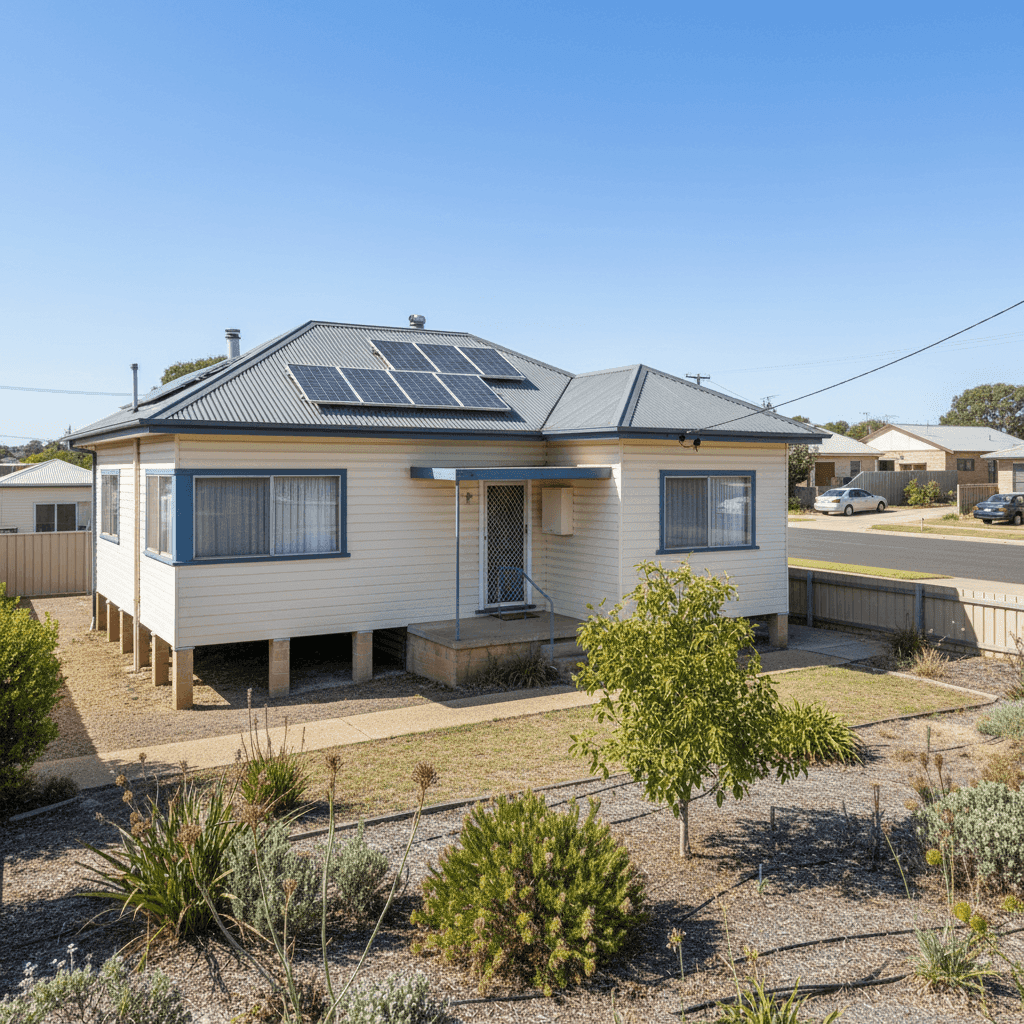
If you own a free standing home in Cootamundra, NSW 2590, you've probably wondered whether you're paying a fair price for home insurance — or quietly overpaying year after year. This article breaks down a real home and contents insurance quote for a four-bedroom, two-bathroom property in Cootamundra, comparing it against local, state, and national benchmarks so you can make a more informed decision at renewal time.
---
Is This Quote Fair?
The quote in question comes to $4,384 per year (or $413/month) for combined home and contents cover, with a building sum insured of $538,000 and contents valued at $100,000. Both the building and contents carry a $1,000 excess.
Our price rating for this quote is Expensive (Above Average) — and the data backs that up. At $4,384/yr, this premium sits above the 75th percentile for the Cootamundra suburb sample, meaning it's higher than at least three-quarters of comparable quotes we've seen in the area. The suburb's 75th percentile sits at $4,020/yr, so this quote clears even that upper threshold.
That said, context matters. The property has several characteristics — including fibro asbestos walls and a stumps foundation — that insurers typically view as higher risk, which can push premiums upward regardless of location. More on that below.
---
How Cootamundra Compares
To understand whether this quote is genuinely out of step with the market, it helps to look at the numbers side by side.
| Benchmark | Annual Premium |
|---|---|
| This Quote | $4,384 |
| Cootamundra suburb average | $2,970 |
| Cootamundra suburb median | $3,035 |
| Cootamundra 25th percentile | $1,925 |
| Cootamundra 75th percentile | $4,020 |
| LGA (Junee) average | $4,234 |
| NSW state average | $3,801 |
| NSW state median | $3,410 |
| National average | $2,965 |
| National median | $2,716 |
A few things stand out here. First, the Cootamundra suburb average of $2,970/yr is notably lower than this quote — a gap of over $1,400 annually. However, the LGA average for Junee (which encompasses Cootamundra) is $4,234/yr, suggesting that at a broader geographic level, premiums in this region trend higher than the suburb sample alone might indicate.
Compared to the NSW state average of $3,801/yr, this quote is roughly $583 more expensive. And against the national average of $2,965/yr, the gap widens to nearly $1,420. Regional NSW properties — particularly older homes with non-standard construction — do tend to attract higher premiums than the national norm, so some premium loading here is expected.
---
Property Features That Affect Your Premium
Several characteristics of this particular property are likely contributing to the above-average premium. Understanding these factors can help you have a more productive conversation with your insurer or broker.
Fibro Asbestos External Walls
This is arguably the most significant risk factor for this property. Homes built with fibro asbestos (common in Australian construction up until the late 1980s) are treated with caution by insurers. The cost and complexity of repairing or rebuilding these walls — including safe asbestos removal and disposal — can be substantially higher than standard brick or weatherboard construction. Given this home was built in 1953, fibro asbestos cladding is entirely consistent with the era.
Stumps Foundation
A stump foundation (also known as a pier and beam or post foundation) is common in older Australian homes, particularly in regional areas. While not inherently problematic, stumps can be susceptible to movement, rot, or termite damage over time, all of which can affect structural integrity and increase rebuild costs in the eyes of an insurer.
Age of Construction (1953)
At over 70 years old, this home falls into a category where insurers apply additional scrutiny. Older properties may have outdated plumbing, wiring, or roofing systems that increase the likelihood of a claim. The good news is that the steel/Colorbond roof is likely a more recent upgrade, which should work in the homeowner's favour — Colorbond is durable, fire-resistant, and widely regarded as a low-maintenance roofing material.
Solar Panels
The presence of solar panels adds a modest amount to the insured value of the property. Most insurers will cover rooftop solar as part of the building sum insured, but it's worth confirming this explicitly in your policy documents to avoid any surprises at claim time.
Building Size and Sum Insured
At 139 sqm and a building sum insured of $538,000, the cost-per-square-metre implied here is approximately $3,870/sqm. For a fibro asbestos home requiring specialist remediation during any rebuild, this figure is not unreasonable — but it's worth having your sum insured reviewed by a qualified quantity surveyor or using an online building calculator to ensure you're neither underinsured nor over-insured.
---
Tips for Homeowners in Cootamundra
If you're looking to manage your home insurance costs without compromising on coverage, here are a few practical steps worth considering.
1. Shop around at every renewal Loyalty doesn't pay in insurance. Insurers regularly offer their best rates to new customers, meaning long-term policyholders often end up paying more than they should. Use a comparison tool like CoverClub to benchmark your renewal quote against the current market before you auto-renew.
2. Review your sum insured annually Construction costs have risen significantly in recent years, and your building sum insured should reflect what it would actually cost to rebuild your home today — not what it cost five years ago. Equally, if your sum insured is set too high relative to actual rebuild costs, you may be paying more in premiums than necessary.
3. Ask about discounts for home improvements If you've made upgrades to the property — such as rewiring, re-plumbing, or installing a new roof — let your insurer know. These improvements can reduce the perceived risk profile of an older home and may result in a lower premium. Similarly, security upgrades like deadbolts, alarm systems, or security cameras can sometimes attract discounts.
4. Consider your excess carefully Both the building and contents excess on this policy sit at $1,000. Opting for a higher voluntary excess can reduce your annual premium, which may make sense if you have a solid emergency fund and are primarily insuring against major events rather than minor claims. Just make sure the excess level is genuinely affordable if you did need to claim.
---
Compare Your Options with CoverClub
Whether this quote reflects fair market pricing for your specific property or there's room to save, the only way to know for certain is to compare. At CoverClub, we make it easy to see how your current premium stacks up against real quotes for similar properties in your area. Get a quote today and find out if you could be paying less — without giving up the cover you need.