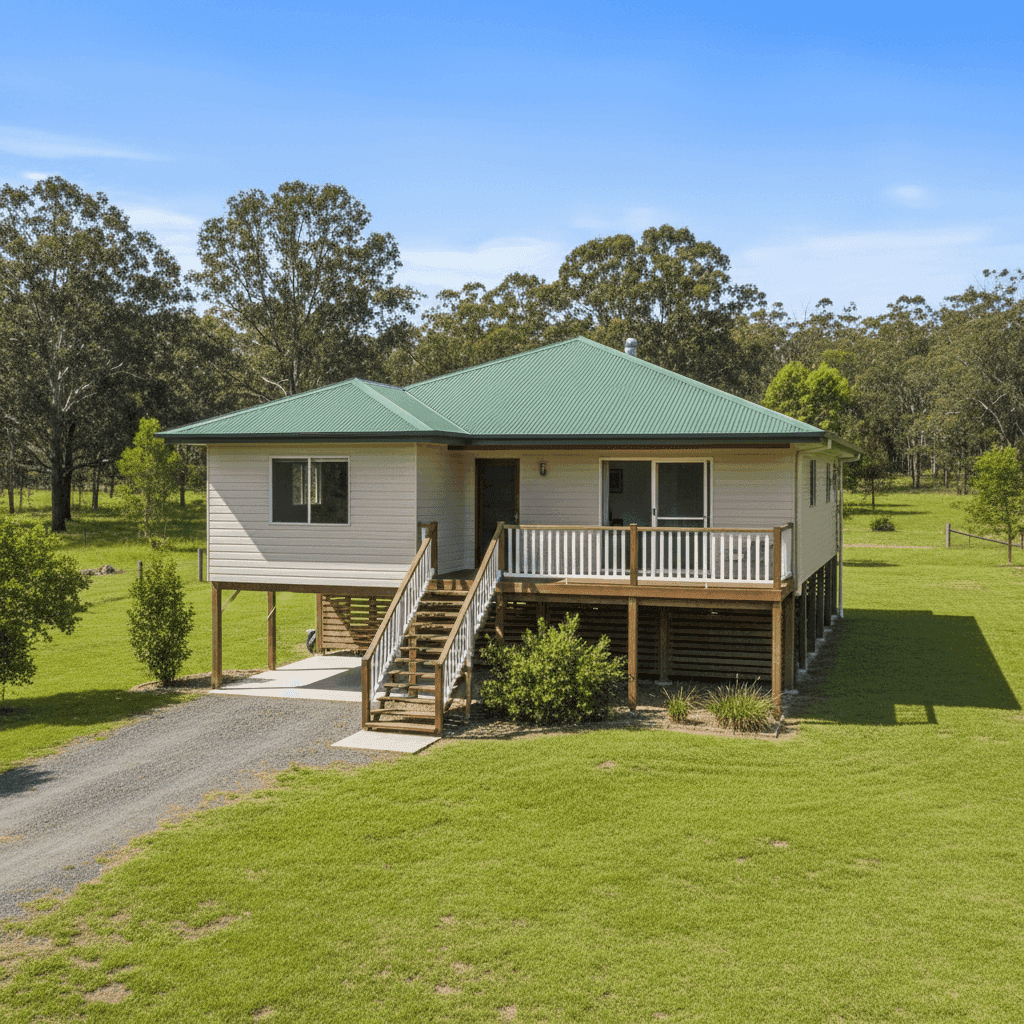
If you own a free standing home in Coutts Crossing, NSW 2460, you've probably noticed that home insurance isn't cheap — and if you've received a quote recently, you may be wondering whether what you're paying is reasonable. In this article, we break down a real home and contents insurance quote for a three-bedroom, two-bathroom property in Coutts Crossing, compare it against local, state, and national benchmarks, and offer some practical tips to help you get better value from your cover.
---
Is This Quote Fair?
The quote in question comes in at $4,915 per year (or $492/month) for a free standing home with a building sum insured of $800,000 and $50,000 in contents cover. The building excess is $3,000 and the contents excess is $1,000.
Our price rating for this quote is FAIR — Around Average.
That rating reflects where this premium sits relative to what other homeowners in the same suburb are paying. At $4,915/yr, this quote is above the suburb average of $3,986/yr and notably above the suburb median of $3,234/yr — but it still falls comfortably below the 75th percentile of $5,436/yr. In other words, roughly a quarter of comparable properties in Coutts Crossing are paying more than this quote. So while it's not the cheapest option on the market, it's far from the most expensive either.
The "fair" rating is a useful signal: you're not being gouged, but there's likely room to shop around and potentially bring your premium down — particularly if your current insurer hasn't reviewed your policy details recently.
---
How Coutts Crossing Compares
To put this quote in proper context, here's how Coutts Crossing stacks up against broader benchmarks:
| Benchmark | Average Premium | Median Premium |
|---|---|---|
| Coutts Crossing (suburb) | $3,986/yr | $3,234/yr |
| NSW (state) | $3,801/yr | $3,410/yr |
| Australia (national) | $2,965/yr | $2,716/yr |
| Richmond Valley LGA | $7,188/yr | — |
(Based on 39 quotes sampled for the Coutts Crossing area.)
A few things stand out here. First, Coutts Crossing premiums are broadly in line with the NSW state average, which sits at $3,801/yr — suggesting the suburb doesn't carry dramatically elevated risk compared to the rest of the state. However, both figures are meaningfully higher than the national average of $2,965/yr, which reflects the broader reality that rural and regional NSW properties often attract higher premiums than metropolitan homes in lower-risk states.
Perhaps the most striking figure is the Richmond Valley LGA average of $7,188/yr — nearly double the Coutts Crossing suburb average. This suggests that while Coutts Crossing sits within a higher-risk local government area, properties in this particular pocket may be somewhat better positioned than others in the LGA. That said, it's a reminder that location risk can vary significantly even within the same council boundary.
You can explore more localised data on the Coutts Crossing suburb stats page.
---
Property Features That Affect Your Premium
Every home is different, and insurers price risk based on a combination of property characteristics. Here's how the features of this particular property are likely influencing the premium:
Vinyl Cladding Exterior
Vinyl cladding is generally considered a moderate-risk external wall material. It's not as fire-resistant as brick or fibre cement, which can push premiums slightly higher. On the upside, it's resistant to moisture and rot, which matters in a region that can experience significant rainfall.
Steel / Colorbond Roof
A Colorbond steel roof is viewed favourably by most insurers. It's durable, fire-resistant, and performs well in high-wind events — all of which can help moderate your premium compared to older or more vulnerable roofing materials like tiles or corrugated iron in poor condition.
Elevated on Stumps (At Least 1 Metre)
This is one of the most significant features for a property in this region. Being elevated by at least one metre on stumps provides meaningful protection against flood inundation — a genuine risk in the Clarence Valley area, which has experienced significant flood events in recent years. Insurers often apply lower flood risk ratings to elevated homes, which can positively influence your premium. It's worth confirming with your insurer that this elevation is correctly recorded on your policy.
Timber / Laminate Flooring
Timber and laminate floors can be costly to replace or repair after a water damage event, which may be factored into your contents and building sum insured. Ensuring your building sum insured accurately reflects replacement costs — including flooring — is important to avoid being underinsured.
1990 Construction
A home built in 1990 sits in an interesting middle ground. It's old enough that some components (plumbing, electrical, structural elements) may be approaching the end of their serviceable life, which can influence risk assessments. However, it's also likely to have been built to better standards than pre-1970s homes, and may have benefited from renovations in the decades since.
---
Tips for Homeowners in Coutts Crossing
1. Document Your Elevation and Flood Mitigation Features
If your home is elevated on stumps and you're in a flood-prone area, make sure your insurer has this on record. Some insurers will reduce your flood premium component if they can confirm the property sits above defined flood levels. Ask your insurer directly whether your elevation qualifies for any rating adjustment.
2. Review Your Building Sum Insured Annually
$800,000 is a substantial sum insured, and it's important to verify it reflects the true cost of rebuilding — not the market value of the land. Construction costs have risen sharply across regional NSW in recent years. Tools like the Cordell Sum Sure calculator can help you cross-check your figure and avoid the costly trap of underinsurance.
3. Consider Raising Your Excess Strategically
This policy carries a $3,000 building excess and a $1,000 contents excess. If you have the financial buffer to absorb a higher excess in the event of a claim, opting for a higher voluntary excess can meaningfully reduce your annual premium. Just make sure the saving outweighs the additional out-of-pocket risk.
4. Compare Quotes Before Renewal
The 25th percentile for Coutts Crossing premiums sits at $2,049/yr — roughly $2,800 less than this quote. While direct comparisons aren't always apples-to-apples (cover levels vary), the spread in the market is wide enough to make shopping around worthwhile. Even saving $500–$800/yr adds up significantly over time.
---
Ready to Compare?
Whether you're renewing an existing policy or insuring a property for the first time, comparing quotes is one of the most effective ways to make sure you're not overpaying. Get a home insurance quote at CoverClub and see how your premium stacks up against the market in seconds — no lengthy forms, no obligation.