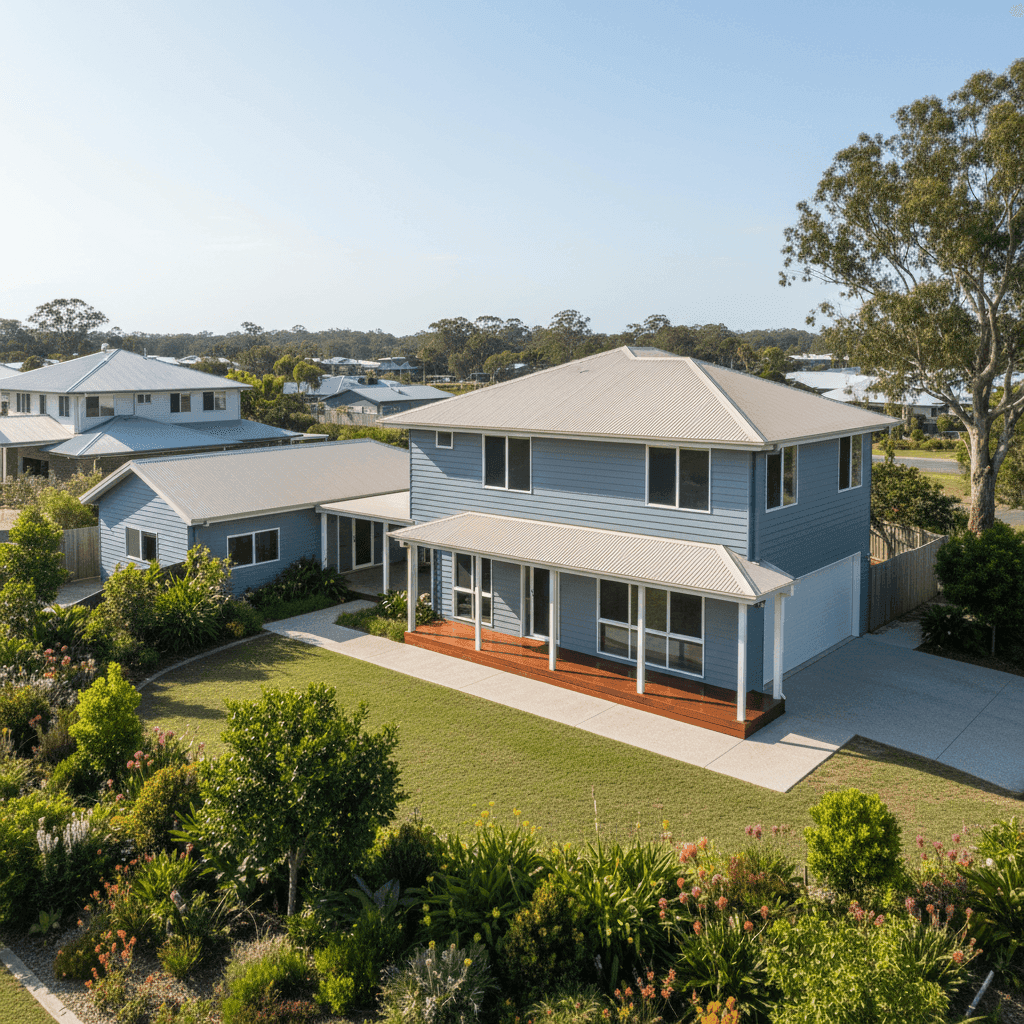
Currumbin is one of the Gold Coast's most sought-after coastal suburbs — a relaxed beachside community tucked between the surf and the hinterland, just south of Burleigh Heads. It's the kind of place where well-appointed homes command serious prices, and protecting that investment with the right home insurance is essential. This article breaks down a real home and contents insurance quote for a five-bedroom, free-standing home in Currumbin (postcode 4223), examines whether the premium stacks up, and offers practical guidance for local homeowners.
---
Is This Quote Fair?
The quote in question comes in at $5,728 per year (or $549/month) for a building sum insured of $1,200,000 and contents cover of $200,000, with a $1,000 excess on both building and contents.
Our price rating for this quote is Expensive — above average for the Currumbin area.
To put that in context: the suburb average annual premium sits at $3,610, while the median is a more modest $3,007. This quote lands well above both figures — sitting roughly 59% higher than the suburb average and nearly double the median. Even compared to the 75th percentile of local quotes ($4,474/yr), this premium is noticeably elevated.
That said, "expensive" doesn't automatically mean "wrong." A 367 sqm home with five bedrooms, five bathrooms, a granny flat, ducted climate control, and a $1.2 million building sum insured is a substantial property. Larger, higher-value homes naturally attract higher premiums, and the sum insured here is likely well above the suburb average. If the rebuild cost genuinely warrants $1.2 million in coverage, a higher premium is expected — the question is whether the rate itself is competitive.
The short answer: this quote is worth shopping around on. There may be room to find comparable cover at a lower price point.
---
How Currumbin Compares
Understanding where Currumbin sits in the broader insurance landscape helps put any individual quote in perspective.
| Benchmark | Average Premium | Median Premium |
|---|---|---|
| Currumbin (4223) | $3,610/yr | $3,007/yr |
| Gold Coast LGA | $8,161/yr | — |
| Queensland | $9,129/yr | $3,903/yr |
| National | $5,347/yr | $2,764/yr |
A few things stand out here. First, Currumbin's suburb average of $3,610 is significantly lower than both the Queensland state average of $9,129 and the Gold Coast LGA average of $8,161. This suggests that Currumbin, while a premium coastal suburb, is relatively well-regarded by insurers — likely due to its lower flood and cyclone risk profile compared to other parts of Queensland.
Second, the national average of $5,347 is actually higher than the Currumbin suburb average, which is a positive sign for local homeowners. Compared to many other parts of Australia — particularly cyclone-prone northern Queensland or flood-affected inland regions — Currumbin represents a comparatively lower-risk postcode.
You can explore the full breakdown of insurance pricing trends for this postcode at the Currumbin suburb stats page.
> Note: Our suburb data is based on a sample of 24 quotes, so averages should be treated as indicative rather than definitive.
---
Property Features That Affect Your Premium
Several characteristics of this property will influence how insurers price the risk — some favourably, others less so.
Hardiplank/Hardiflex external walls are generally viewed positively by insurers. This fibre cement cladding is fire-resistant, durable, and low-maintenance — all qualities that reduce the likelihood of a significant claim.
Steel/Colorbond roofing is another tick in the right column. Colorbond is a well-regarded roofing material in Australia, offering strong resistance to wind, fire, and corrosion. It's particularly well-suited to coastal environments like Currumbin, where salt air can degrade lesser materials over time.
Slab foundation is standard for modern construction and generally straightforward for insurers to assess. There's no elevated risk from stumps or subfloor moisture issues.
Timber and laminate flooring can be a mild risk factor — these materials are more susceptible to water damage than tiles — but it's unlikely to be a major premium driver on its own.
Construction year of 2015 is a genuine advantage. Newer homes are built to more recent Australian Standards, with better cyclone, fire, and structural resilience built in. Insurers typically reward this with more competitive pricing.
Ducted climate control adds to the replacement value of the home and may contribute modestly to the premium — this is a significant fixed asset that would need to be replaced in the event of a total loss.
The granny flat is an important factor. Secondary dwellings add complexity and replacement cost to a property, and insurers need to be aware of their existence. It's worth confirming with your insurer that the granny flat is explicitly covered under the policy, as some standard policies may not automatically include secondary structures at full value.
No pool and no solar panels simplify the risk profile slightly — both can add to premiums when present.
---
Tips for Homeowners in Currumbin
1. Make sure your granny flat is fully covered Don't assume your policy automatically covers a secondary dwelling. Review the policy wording carefully and, if necessary, ask your insurer to confirm that the granny flat — including its fixtures, fittings, and any contents — is included in your sum insured. Underinsurance is a real risk here.
2. Review your building sum insured annually With construction costs rising sharply across Australia in recent years, a sum insured that was accurate two or three years ago may no longer reflect true rebuild costs. Use a quantity surveyor or your insurer's rebuild cost calculator to reassess the figure each year. Overcovering can push premiums up unnecessarily; undercovering leaves you exposed.
3. Compare quotes — this premium has room to move At 59% above the suburb average, this quote is worth benchmarking against other providers. The property features are largely positive from an insurer's perspective, and a competitive market should be able to offer comparable cover at a lower price. Even saving $500–$1,000 per year adds up significantly over time.
4. Consider your excess strategy A $1,000 excess on both building and contents is fairly standard. However, if you're comfortable self-insuring smaller claims, opting for a higher excess (say, $2,000–$2,500) can reduce your annual premium meaningfully — sometimes by 10–20% depending on the insurer.
---
Ready to Find a Better Rate?
Whether you're renewing your policy or comparing for the first time, CoverClub makes it easy to benchmark your home insurance quote against real data from your suburb, your state, and across Australia. Get a quote today at CoverClub and find out whether you're paying a fair price — or whether there's a better deal waiting for you.