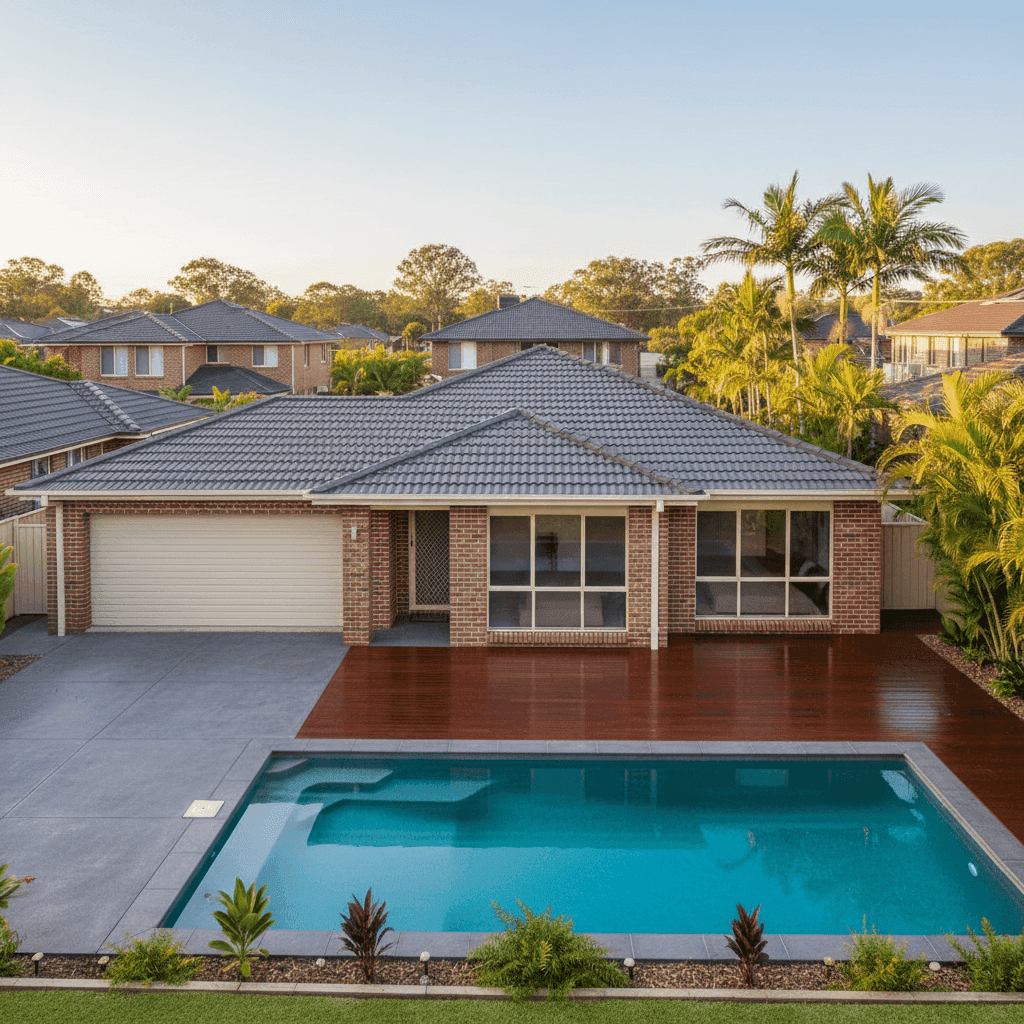
If you own a free standing home in Daisy Hill, QLD 4127, you've probably wondered whether you're paying a fair price for your building insurance. This article breaks down a real building-only quote for a 4-bedroom, 2-bathroom brick veneer home in the suburb — and puts it into context against local, state, and national benchmarks so you can make a more informed decision.
---
Is This Quote Fair?
The quote in question comes in at $2,001 per year (or $192/month) for building-only cover, with a $1,000 building excess and a sum insured of $544,000. Our price rating for this quote is FAIR — Around Average.
That rating holds up well under scrutiny. Based on a sample of 39 quotes collected for the Daisy Hill area, the suburb median premium sits at $2,428/year, meaning this quote lands comfortably below the midpoint. It also falls within the interquartile range — between the 25th percentile of $1,216/year and the 75th percentile of $3,321/year — which confirms it's a reasonable price rather than an outlier in either direction.
In short: this isn't the cheapest policy available in the suburb, but it's not overpriced either. For a 1985-built home with a pool and a solid brick veneer construction, landing near the median is a respectable outcome.
---
How Daisy Hill Compares
To appreciate just how competitive this quote is, it helps to zoom out and look at the broader picture.
| Benchmark | Average Premium | Median Premium |
|---|---|---|
| Daisy Hill (suburb) | $3,919/yr | $2,428/yr |
| Queensland (state) | $9,129/yr | $3,903/yr |
| Australia (national) | $5,347/yr | $2,764/yr |
| Brisbane LGA | $16,277/yr | — |
The figures above paint a striking picture. Queensland's average premium of $9,129/year is well above the national average of $5,347/year, largely driven by the state's elevated exposure to severe weather events — cyclones in the north, flooding across the southeast, and intense storm seasons throughout. You can explore the full Queensland insurance stats here.
What stands out about Daisy Hill specifically is how much more affordable it is compared to the broader Brisbane LGA average of $16,277/year. That figure is heavily skewed by high-risk flood and storm-prone pockets across the greater Brisbane region, so Daisy Hill's relatively modest premiums reflect its comparatively lower risk profile. Browse the Daisy Hill suburb stats for a deeper look at local pricing trends.
At a national level, the median of $2,764/year means this $2,001 quote also sits below the midpoint for Australia as a whole — a solid result for any homeowner. See how other suburbs and states compare nationally.
---
Property Features That Affect Your Premium
Every home is different, and insurers price policies based on a combination of construction quality, age, features, and location risk. Here's how the key characteristics of this property likely influence the premium:
Brick Veneer Walls & Tiled Roof
Brick veneer is one of the most common — and insurer-friendly — wall materials in Australia. It offers solid fire resistance and structural durability, which typically attracts more competitive premiums compared to lightweight cladding or weatherboard. A tiled roof similarly signals longevity and weather resistance, provided it's well maintained. Together, these two features are likely contributing to a more favourable rate.
Slab Foundation
A concrete slab foundation is generally viewed positively by insurers. It reduces the risk of subsidence and pest-related structural damage compared to raised timber stumps, and is well suited to Queensland's climate.
1985 Construction Year
Homes built in the mid-1980s sit in an interesting middle ground. They're old enough that some components — roofing, plumbing, electrical — may be approaching the end of their serviceable life, which can nudge premiums upward. However, 1985 builds in Queensland were typically constructed to reasonable standards, and a well-maintained property of this era shouldn't attract a significant loading.
Swimming Pool
The presence of a pool adds to the overall replacement cost of the property and introduces additional liability considerations. This will have contributed modestly to the sum insured of $544,000 and may factor into the premium calculation depending on the insurer's methodology.
Timber & Laminate Flooring
Timber and laminate floors can be more costly to repair or replace than tiles following a water or flood event, which may influence how certain insurers assess internal fixtures. It's worth ensuring your sum insured adequately accounts for the cost of replacing these materials at today's prices.
No Solar Panels or Ducted Climate Control
The absence of solar panels and ducted air conditioning keeps the replacement cost calculation simpler and removes some potential points of claim. These omissions may contribute to a cleaner risk profile in the eyes of underwriters.
---
Tips for Homeowners in Daisy Hill
1. Review Your Sum Insured Annually
Building costs in Queensland have risen sharply in recent years due to labour shortages and material price increases. The $544,000 sum insured on this policy should be revisited each year to ensure it reflects current rebuild costs — not what it would have cost five years ago. Underinsurance is one of the most common and costly mistakes homeowners make.
2. Maintain Your Roof and Gutters
Southeast Queensland experiences intense storm seasons, and a tiled roof in good condition is your first line of defence. Cracked or displaced tiles and blocked gutters are among the most common causes of preventable water ingress claims. A seasonal inspection before summer storms arrive is time well spent.
3. Consider Your Excess Carefully
This policy carries a $1,000 building excess. Opting for a higher excess — say, $2,000 or $2,500 — can meaningfully reduce your annual premium if you're in a financial position to self-insure smaller claims. Conversely, if cash flow is a concern, a lower excess provides more predictable out-of-pocket costs when you do need to claim.
4. Don't Auto-Renew Without Comparing
The suburb average of $3,919/year shows there's significant variation in what insurers charge for similar properties in Daisy Hill. If you've been with the same insurer for several years, chances are you're not on the best available rate. Shopping around at renewal time — even just comparing two or three quotes — can save hundreds of dollars annually.
---
Ready to Compare?
Whether you're renewing your current policy or insuring a new property, comparing quotes is the simplest way to make sure you're not overpaying. [Get a home insurance quote at CoverClub](https://coverclub.com.au/?focus=address) and see how your premium stacks up against real data from your suburb and across Australia. It only takes a few minutes and could save you a significant amount each year.