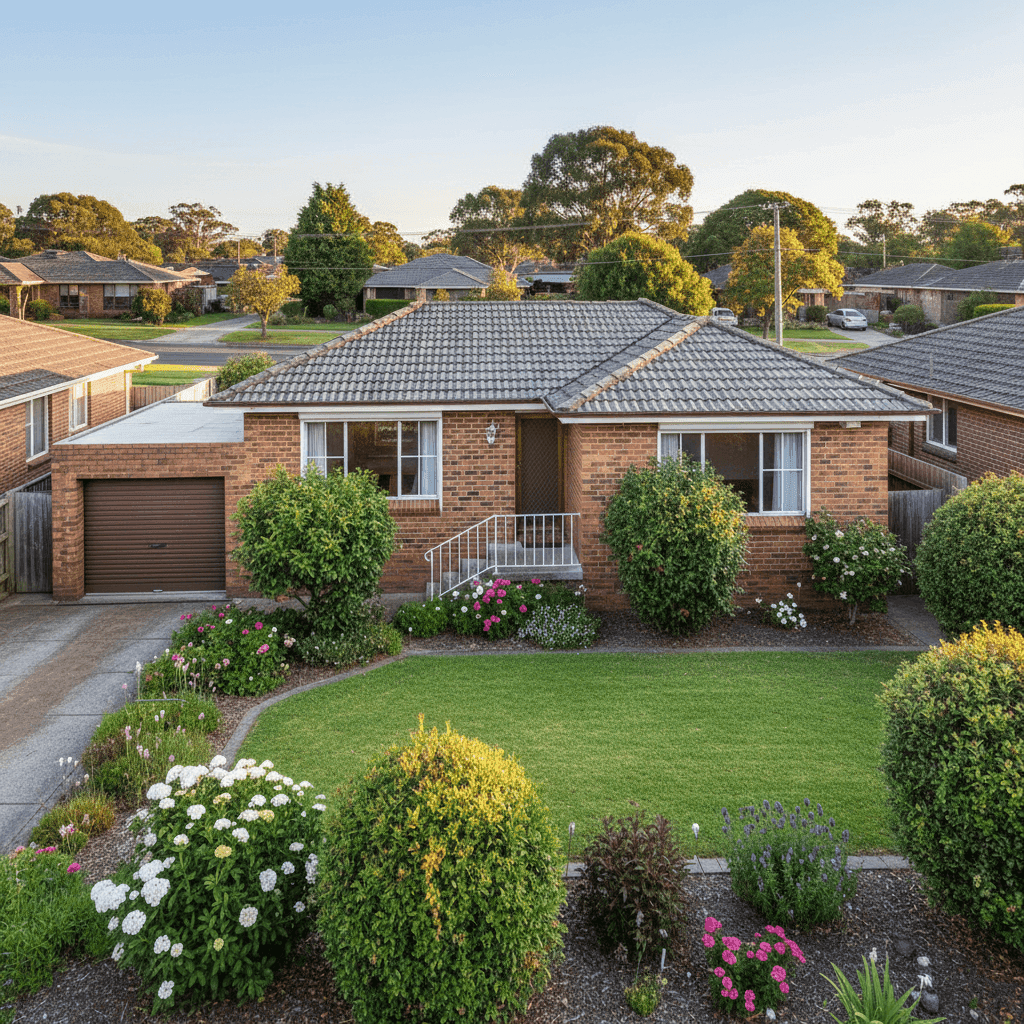
If you own a free standing home in Dandenong North, VIC 3175, you've probably wondered whether you're paying a fair price for building insurance — or whether there's room to do better. This article breaks down a real building-only insurance quote for a three-bedroom, two-bathroom brick veneer home in the suburb, and puts it in context against local, state, and national benchmarks. Whether you're reviewing your current policy or shopping around for the first time, the numbers below should give you a clearer picture of what to expect.
---
Is This Quote Fair?
The quote in question comes in at $1,175 per year (or about $122 per month) for building-only cover on a 214 sqm free standing home, with a sum insured of $510,000 and a building excess of $3,000.
Our price rating for this quote is FAIR — Around Average, and the data backs that up. The suburb average premium for Dandenong North sits at $1,272 per year, and the median is $1,243 per year, based on a sample of 31 quotes. At $1,175, this quote lands below both the average and the median — placing it comfortably in the lower half of what local homeowners are paying.
To put it more precisely: the 25th percentile for the suburb is $1,020 per year, and the 75th percentile is $1,446 per year. This quote falls between those two markers, closer to the cheaper end of the middle range. It's not the lowest price available in the area, but it's meaningfully below what many comparable properties are being quoted.
For most homeowners, a quote sitting below the suburb average and median — without sacrificing appropriate cover — is a reasonable outcome. That said, "fair" doesn't mean you can't do better.
---
How Dandenong North Compares
One of the most striking aspects of this quote is just how affordable Dandenong North is relative to the broader market. Consider the following:
| Benchmark | Average Premium | Median Premium |
|---|---|---|
| Dandenong North (suburb) | $1,272/yr | $1,243/yr |
| Casey LGA | $2,142/yr | — |
| Victoria (state) | $3,000/yr | $2,718/yr |
| Australia (national) | $5,347/yr | $2,764/yr |
The suburb average of $1,272 is less than half the Victorian state average of $3,000, and a fraction of the national average of $5,347. Even the Casey LGA average of $2,142 is significantly higher than what Dandenong North homeowners are typically quoted.
This tells an important story: Dandenong North is a relatively low-risk suburb from an insurer's perspective. It sits outside cyclone-prone zones, doesn't face the elevated bushfire risk that drives up premiums in many regional Victorian areas, and benefits from established suburban infrastructure. For homeowners in the area, this translates to genuine savings compared to peers elsewhere in the state.
You can explore full pricing data for the suburb at the Dandenong North insurance stats page, compare it against Victoria-wide averages, or see how it stacks up against the national picture.
---
Property Features That Affect Your Premium
Several characteristics of this particular home influence where the premium lands — and understanding them helps you anticipate how insurers assess risk.
Brick veneer construction is generally viewed favourably by insurers. It offers solid fire resistance and structural durability compared to weatherboard or lightweight cladding. For a home built in 1975, brick veneer has also had decades to prove its resilience, which can work in the homeowner's favour at assessment time.
Tiled roofing is another positive factor. Concrete or terracotta tiles are among the more durable roofing materials available, with strong resistance to fire and moderate weather events. They do require periodic maintenance — cracked or displaced tiles can become a liability over time — but a well-maintained tiled roof is generally seen as lower risk than corrugated iron or older roofing materials.
A slab foundation is standard for homes of this era and construction type in Victoria. It's structurally sound and doesn't carry the same risks as older pier-and-beam foundations, which can be more susceptible to subsidence or termite damage.
Standard fittings quality keeps the sum insured at a reasonable level. Homes with high-end finishes — custom cabinetry, imported stone benchtops, premium flooring — typically carry higher rebuild costs, which pushes up both the sum insured and the premium. A standard-quality fit-out keeps things proportionate.
The absence of a pool, solar panels, and ducted climate control also simplifies the risk profile. Each of those features can add to the cost of a claim and, in turn, to the annual premium.
---
Tips for Homeowners in Dandenong North
1. Review your sum insured regularly. A $510,000 sum insured on a 214 sqm home is a reasonable starting point, but building costs change over time. With construction costs rising across Victoria in recent years, it's worth checking your sum insured annually to ensure it reflects the actual cost of rebuilding — not just the market value of the property.
2. Consider your excess carefully. This quote carries a $3,000 building excess. A higher excess typically reduces your annual premium, but it also means more out-of-pocket expense if you need to make a claim. Think about what you could comfortably cover in an emergency, and set your excess accordingly.
3. Don't set and forget. Even if your current quote is fair, the insurance market changes. Insurers reprice regularly, and a policy that was competitive last year may no longer be the best option. Making a habit of comparing quotes at renewal time — even just to confirm you're still well-priced — is one of the simplest ways to avoid overpaying.
4. Maintain your roof and gutters. For a tiled roof on a 1975-built home, ongoing maintenance matters. Blocked gutters, cracked tiles, and deteriorating pointing can lead to water ingress, which is one of the more common sources of home insurance claims. Staying on top of routine upkeep not only protects your home — it can also support your claim if the need arises.
---
Compare Quotes for Your Dandenong North Home
Whether this quote reflects your own situation or you're simply curious about what's available in the market, the best way to know if you're getting a good deal is to compare. At CoverClub, you can quickly see quotes from multiple insurers side by side, with suburb-level context to help you understand where any given price sits relative to your neighbours.