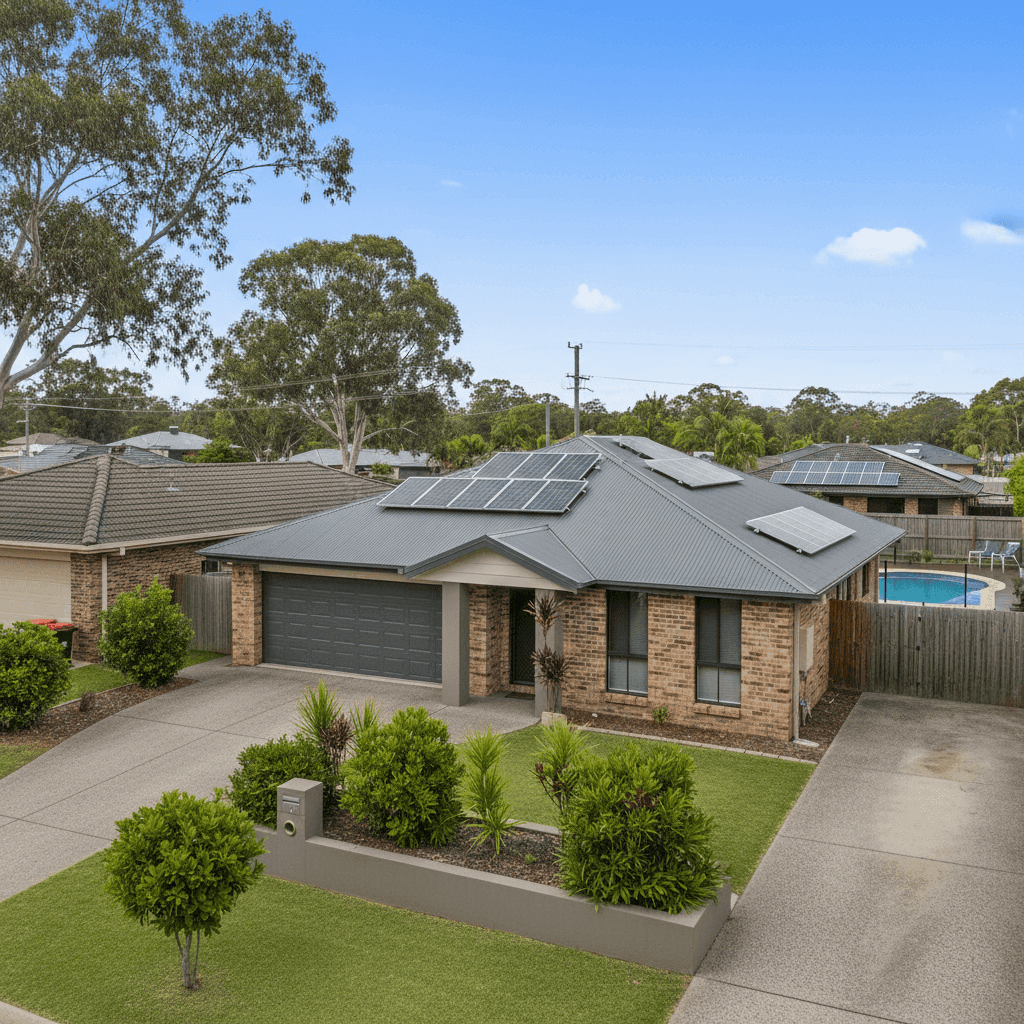
If you own a free standing home in Eagleby, QLD 4207, you're probably no stranger to the sting of home insurance premiums. Sitting in the Logan corridor south of Brisbane, Eagleby is a well-established suburb with a mix of older brick homes and more recent builds — and its insurance costs reflect a range of risk factors that are worth understanding. This article breaks down a real building-only insurance quote for a four-bedroom, three-bathroom home in the area, compares it against local, state, and national benchmarks, and offers practical tips to help you get better value on your cover.
---
Is This Quote Fair?
The quote in question comes in at $6,137 per year (or $588/month) for building-only cover on a 325 sqm free standing home, with a $1,000 building excess and a sum insured of $750,000.
Our price rating for this quote is EXPENSIVE — above average.
To put that in context: the average building insurance premium across Eagleby sits at $3,780 per year, while the suburb median is a notably lower $2,804. That means this particular quote is roughly 62% above the suburb average and more than double the median. Even compared to the 75th percentile for the suburb ($3,626/yr), this quote exceeds what most Eagleby homeowners are paying.
So what's driving the higher cost? A combination of factors — the property's age, size, construction type, and added features like a pool and solar panels — all push the premium upward. We'll unpack each of these below.
That said, it's worth noting this quote is not out of step with the broader Queensland insurance landscape, where premiums can vary enormously depending on flood mapping, storm history, and council zoning.
---
How Eagleby Compares
Understanding where Eagleby sits relative to broader benchmarks helps frame whether a quote is genuinely out of line or simply reflects the local risk environment.
| Benchmark | Average Premium | Median Premium |
|---|---|---|
| Eagleby (QLD 4207) | $3,780/yr | $2,804/yr |
| Gold Coast LGA | $8,161/yr | — |
| Queensland | $9,129/yr | $3,903/yr |
| National | $5,347/yr | $2,764/yr |
A few things stand out here. First, the Gold Coast LGA average of $8,161 is a reminder that Eagleby — while technically part of the Logan City Council area — sits in a broader region where insurance costs are elevated. Second, Queensland's state average of $9,129 is the highest in the country, largely driven by cyclone-prone northern regions and flood-affected inland areas. Eagleby itself is not a designated cyclone risk area, which is a meaningful saving.
Compared to the national average of $5,347, this quote is above average — but not dramatically so. The national median of $2,764 is closer to what simpler, lower-risk properties attract.
You can explore more local data on the Eagleby insurance stats page, compare it to the Queensland overview, or check out national home insurance benchmarks.
---
Property Features That Affect Your Premium
Several characteristics of this property have a direct bearing on the premium quoted. Here's how each one plays a role:
Age of Construction (1985)
Homes built in the mid-1980s are now approaching 40 years old. Insurers factor in the age of a property because older homes may have ageing plumbing, electrical systems, and structural components that are more costly to repair or replace. A 1985 build is not ancient by any means, but it does attract more scrutiny than a property built in the last decade.
Brick Veneer Walls & Colorbond Roof
Brick veneer is generally viewed favourably by insurers — it's durable and fire-resistant. A steel Colorbond roof is similarly robust and performs well in storm conditions. These construction types typically attract more competitive premiums compared to timber-framed or fibrous cement homes, so this property is well-positioned on that front.
Slab Foundation
A concrete slab foundation is standard for Queensland homes of this era and is generally considered low-risk from an insurance perspective. It eliminates concerns around subfloor flooding or pest damage that can affect raised timber stumped homes.
Large Building Size (325 sqm)
At 325 square metres, this is a substantial home. The sum insured of $750,000 reflects the cost to rebuild a property of this size with standard fittings. Larger homes simply cost more to rebuild, and that's reflected directly in the premium.
Swimming Pool
Pools add to the replacement cost of a property and introduce liability considerations. Most insurers factor pool coverage into building premiums, which contributes to a higher base cost.
Solar Panels
A rooftop solar system is an asset worth thousands of dollars, and its inclusion in the building sum insured adds to the overall replacement value. Insurers also consider the installation risk — panels attached to the roof can be damaged in hailstorms or high winds, and repairs can be costly.
Ducted Climate Control
Ducted air conditioning systems are expensive to replace and are typically included within the building sum insured. A full ducted system in a 325 sqm home could represent $15,000–$30,000 in replacement value, which nudges the premium higher.
---
Tips for Homeowners in Eagleby
If you're looking to reduce your home insurance costs without sacrificing meaningful cover, here are four practical steps worth considering:
- Shop around and compare multiple quotes. The gap between the cheapest and most expensive quotes for the same property in Eagleby can be substantial. Based on suburb data, there's a wide spread between the 25th percentile ($2,131/yr) and the 75th percentile ($3,626/yr) — meaning the insurer you choose matters enormously. Use a comparison platform like CoverClub to see multiple quotes side by side.
- Review your sum insured carefully. Over-insuring is common, especially on older homes. Make sure your building sum insured reflects the actual cost to rebuild — not the market value of the property. A quantity surveyor or your insurer's rebuild cost calculator can help you land on a more accurate figure.
- Consider a higher excess. If you're willing to carry more of the risk yourself in the event of a minor claim, increasing your excess from $1,000 to $2,500 or higher can meaningfully reduce your annual premium. This strategy works well for homeowners with a solid financial buffer.
- Ask about discounts for safety features. Some insurers offer premium reductions for homes with monitored security systems, deadbolts, or smoke alarms. It's worth asking each insurer what discounts are available — these aren't always advertised upfront.
---
Compare Your Quote Today
Whether the quote above sounds familiar or you're just starting to shop around, the best way to know if you're getting fair value is to compare. CoverClub makes it easy to see how your premium stacks up against real quotes from across Eagleby and beyond. Get a home insurance quote today and find out if you could be paying less for the same level of protection.