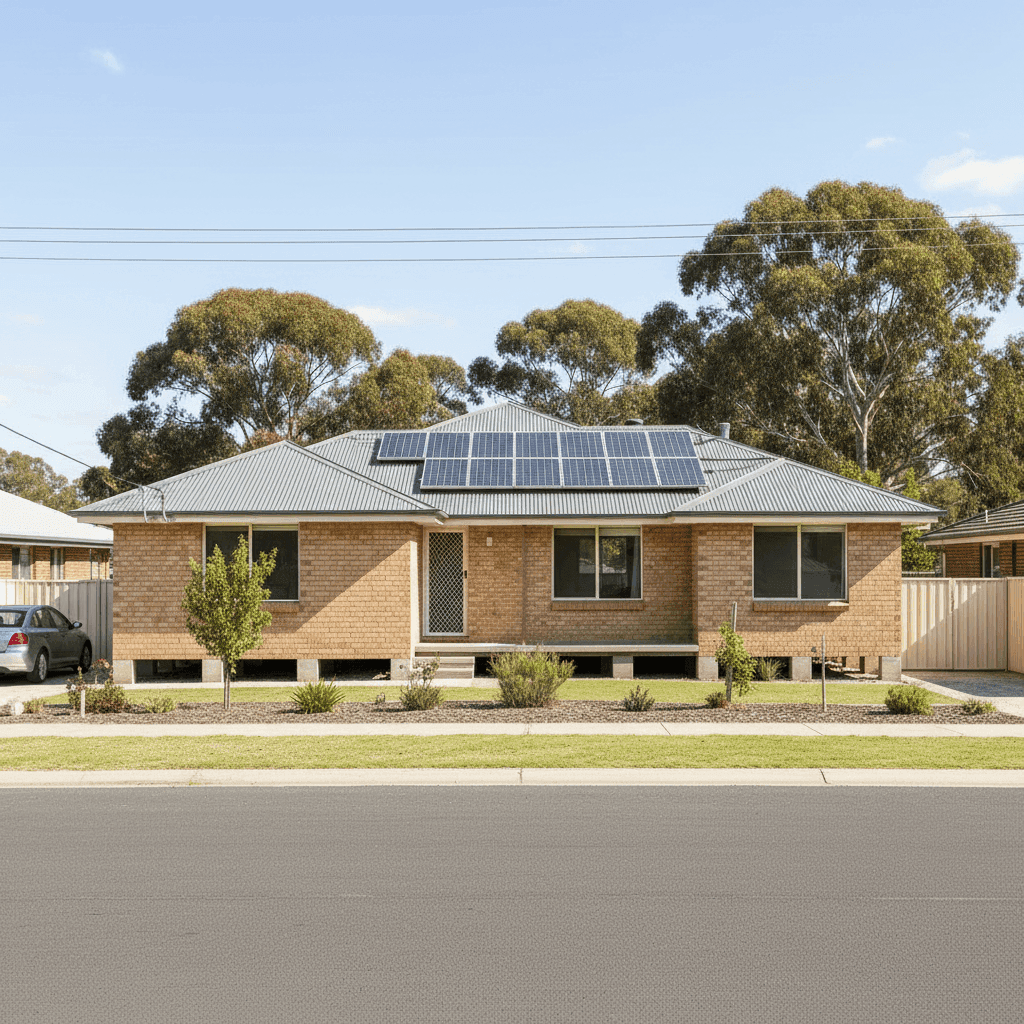
If you own a free standing home in East Branxton, NSW 2335, you're probably wondering whether your home insurance premium is reasonable — or whether you're paying more than you should. This article breaks down a real home and contents insurance quote for a three-bedroom, two-bathroom brick veneer home in the area, and puts it into context against suburb, state, and national benchmarks.
---
Is This Quote Fair?
The quote in question comes in at $2,032 per year (or roughly $204 per month) for combined home and contents cover, with a building sum insured of $648,000 and contents valued at $50,000. The building excess is $3,000 and the contents excess sits at $1,000.
Our price rating for this quote? Cheap — below average. That's genuinely good news for the homeowner.
To put it plainly: this premium is well below what most comparable properties in East Branxton are paying. The suburb average sits at $2,887 per year, and the median is $2,488 per year. Even the 25th percentile — meaning only one in four quotes comes in cheaper — is $2,263 per year. This quote, at $2,032, undercuts even that lower benchmark, placing it among the most competitive prices available in the area.
Compared to the broader NSW state average of $3,801 per year, this quote is nearly 47% cheaper. That's a significant saving, particularly given the level of cover on offer.
---
How East Branxton Compares
Understanding where East Branxton sits in the wider insurance landscape helps homeowners make more informed decisions.
| Benchmark | Average Premium |
|---|---|
| East Branxton (suburb average) | $2,887/yr |
| East Branxton (suburb median) | $2,488/yr |
| NSW state average | $3,801/yr |
| NSW state median | $3,410/yr |
| National average | $2,965/yr |
| National median | $2,716/yr |
You can explore the full breakdown of East Branxton insurance statistics here, or compare against all NSW suburbs and the national picture.
One figure that stands out is the Maitland LGA average of $13,875 per year. This is unusually high and likely reflects a small number of outlier properties — perhaps acreage, heritage homes, or high-value dwellings — skewing the LGA average upward. It's a good reminder that averages can be misleading, and that suburb-level data is often a more reliable guide for typical residential properties.
East Branxton itself compares favourably against both the state and national medians, suggesting the area carries a relatively moderate risk profile in the eyes of insurers. With no cyclone risk designation and sitting inland in the Hunter Valley, the suburb avoids some of the more extreme weather premiums seen in coastal or far-north Queensland areas.
---
Property Features That Affect Your Premium
Every home is different, and insurers assess a range of property characteristics when calculating your premium. Here's how the features of this particular property are likely influencing the quote:
Brick Veneer Construction Brick veneer is one of the more insurer-friendly wall materials in Australia. It offers solid fire resistance and durability, which typically translates to lower premiums compared to weatherboard or lightweight cladding alternatives.
Steel / Colorbond Roof A Colorbond steel roof is viewed positively by most insurers. It's durable, low-maintenance, and performs well in high-wind conditions. Compared to older tile or fibrous cement roofing, it generally attracts a more competitive rate.
Stump Foundation The home sits on stumps, which is common for properties of this era (built in 1985) in regional NSW. While stumps can be a consideration for some insurers — particularly around subsidence or pest risk — they don't typically carry a significant premium loading for standard residential properties in this region.
Timber and Laminate Flooring Timber and laminate floors can be a factor in contents and building claims, particularly in flood or water damage scenarios. However, for a property in East Branxton without a noted flood designation, this is unlikely to be a major pricing driver.
Solar Panels This property has solar panels installed. Insurers treat solar panels as part of the building sum insured, so it's important to ensure the $648,000 building cover adequately accounts for the replacement cost of the system. Most standard home insurance policies cover solar panels as a fixed fixture, but it's worth confirming this with your insurer.
No Pool, No Ducted Climate Control The absence of a swimming pool removes a common liability and maintenance risk that can nudge premiums upward. Similarly, no ducted climate control system means fewer mechanical components to insure within the building sum.
Building Size: 214 sqm At 214 square metres, this is a mid-sized family home. The $648,000 sum insured works out to roughly $3,028 per square metre — a reasonable rebuild cost estimate for a brick veneer home in regional NSW, though homeowners should periodically reassess this figure to account for rising construction costs.
---
Tips for Homeowners in East Branxton
1. Review your sum insured annually Construction costs in Australia have risen sharply in recent years. A building sum insured set a few years ago may no longer reflect the true cost of rebuilding. Use a building cost calculator or speak to a local builder to sense-check your coverage before renewal.
2. Confirm solar panels are explicitly covered Ask your insurer to confirm that your solar panel system is included under your building cover — and check whether the policy covers damage from storms, hail, or electrical faults. Some policies have specific exclusions or sub-limits for solar installations.
3. Consider your excess levels carefully This quote carries a $3,000 building excess. While a higher excess typically lowers your premium, it also means you'll need to fund that amount out of pocket before a claim pays out. Make sure your excess is genuinely affordable in the event of a significant loss.
4. Don't set-and-forget your contents value At $50,000, the contents sum insured is relatively modest. If you've made significant purchases — new appliances, furniture, electronics — since you last updated your policy, it may be worth revisiting whether this figure still reflects the true replacement value of your belongings.
---
Compare Quotes and Save
Whether you're renewing your current policy or shopping around for the first time, it pays to compare. The quote analysed here is already competitively priced, but the market is always moving. Get a home insurance quote at CoverClub to see how your property stacks up and make sure you're getting the best value cover available for your East Branxton home.