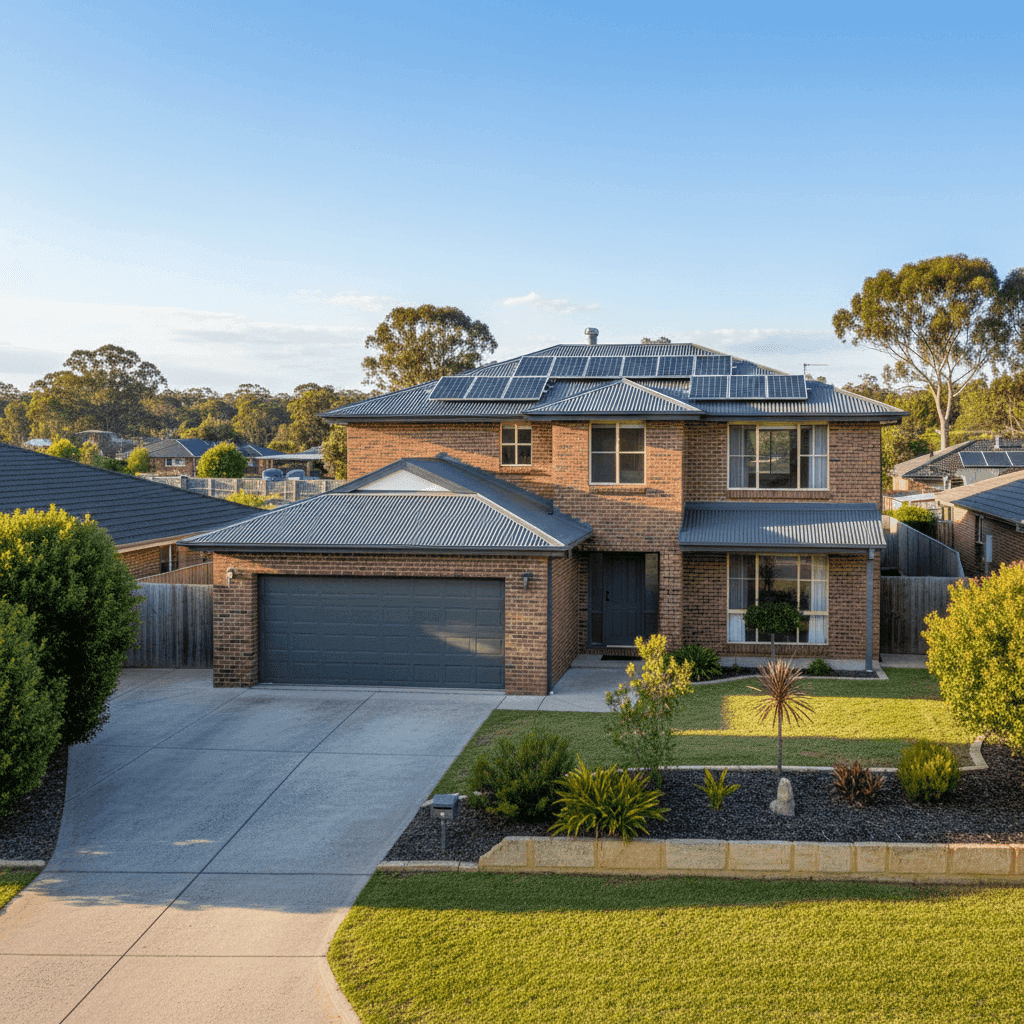
If you own a free standing home in East Kurrajong, NSW 2758, you've probably wondered whether you're paying a fair price for your home and contents insurance — or whether there's a better deal out there. This article breaks down a real quote for a four-bedroom, two-bathroom brick veneer home in the suburb, and puts it in context against local, state, and national benchmarks so you can make a more informed decision.
---
Is This Quote Fair?
The annual premium for this property came in at $4,178 per year (or around $400 per month), covering both building and contents. The building is insured for $1,026,000, with contents covered to $80,000. The building excess sits at $2,000 and the contents excess at $1,000.
Our price rating for this quote is FAIR — Around Average.
That label reflects where the premium sits relative to comparable quotes in the area. It's not a bargain, but it's not an outlier either. For a property of this size and specification — 286 sqm of living space with ducted climate control, solar panels, and timber/laminate flooring — a premium in this range is broadly in line with what insurers are pricing for the risk profile.
One thing worth noting: the sum insured on the building ($1,026,000) is substantial, and rightly so for a home of this footprint. Under-insuring a property is one of the most common and costly mistakes homeowners make, so it's reassuring to see a figure that reflects genuine rebuild costs rather than an artificially low number chosen to reduce premiums.
---
How East Kurrajong Compares
To understand whether $4,178 represents good value, it helps to zoom out and look at what others are paying. Here's how this quote stacks up across different comparison points:
| Benchmark | Premium |
|---|---|
| This quote | $4,178/yr |
| East Kurrajong suburb average | $4,800/yr |
| East Kurrajong suburb median | $5,282/yr |
| East Kurrajong 25th percentile | $3,733/yr |
| East Kurrajong 75th percentile | $5,770/yr |
| NSW state average | $9,528/yr |
| NSW state median | $3,770/yr |
| National average | $5,347/yr |
| National median | $2,764/yr |
| Lithgow LGA average | $11,842/yr |
A few things stand out here. First, this quote is below the suburb average and median, which is a positive sign. Within East Kurrajong specifically, it sits between the 25th and 75th percentile — meaning it's cheaper than the majority of quotes collected in the area, but not at rock-bottom pricing.
Second, the Lithgow LGA average of $11,842 is strikingly high, which likely reflects the diverse range of properties and risk profiles across the broader local government area — including more exposed rural and semi-rural properties. East Kurrajong, as a suburb, appears to attract more competitive pricing than the LGA average would suggest.
Third, the NSW state average of $9,528 is heavily skewed by high-risk and high-value areas across the state. The state median of $3,770 is actually below this quote, which is a useful reminder that averages can be misleading when the distribution is uneven.
For a deeper look at how premiums are trending in the postcode, visit the East Kurrajong insurance stats page. You can also explore NSW-wide insurance data or national home insurance statistics for broader context.
---
Property Features That Affect Your Premium
Every property tells a story to an insurer, and this one has several features that shape how risk — and therefore price — is calculated.
Brick veneer construction is generally viewed favourably by insurers. It offers solid fire resistance and structural durability compared to weatherboard or lightweight cladding, which can translate to lower premiums or at least fewer loading penalties.
Steel/Colorbond roofing is another positive. Colorbond is low-maintenance, resistant to fire and high winds, and less prone to the kind of storm damage that can send claims costs soaring. For a property in the foothills west of Sydney, this matters.
Slab foundation is standard for homes of this era and construction type, and generally presents minimal risk concerns for insurers in non-reactive soil areas.
Solar panels are an interesting factor. While they add value to the property, they also represent an additional insurable asset — and some insurers treat them as an increased liability if they're not explicitly covered. It's worth confirming with your insurer that your solar system is included in the building sum insured.
Ducted climate control is another feature that adds to rebuild cost estimates and can influence the sum insured calculation. It's a common inclusion in homes of this size and vintage, but homeowners should ensure it's accounted for in their policy.
The home was built in 1998, placing it in a generation of construction that's past the worst of older wiring and plumbing risks, but old enough that some components may be approaching the end of their serviceable life. Insurers may factor this into their risk assessment, particularly for water damage and electrical claims.
---
Tips for Homeowners in East Kurrajong
1. Review your sum insured annually Building costs have risen significantly in recent years due to labour shortages and material price increases. A sum insured that was adequate two years ago may no longer reflect the true cost of rebuilding your home. Use a building cost calculator or speak with a quantity surveyor to validate your figure.
2. Confirm solar panels are covered As mentioned above, solar panel coverage isn't always automatic. Check your policy documents to confirm whether your system is included under the building definition, and whether it covers both physical damage and any liability arising from the panels.
3. Consider your excess strategically This policy carries a $2,000 building excess and $1,000 contents excess. Opting for a higher excess is a common way to reduce premiums, but make sure you could comfortably cover the excess amount if you needed to make a claim. A lower premium isn't worth much if an excess you can't afford prevents you from claiming.
4. Compare at renewal time The insurance market is competitive, and loyalty doesn't always pay. Premiums can shift significantly from year to year, and a quote that was competitive 12 months ago may no longer be the best available. Use a comparison platform like CoverClub to benchmark your renewal quote before accepting it.
---
Ready to Compare?
Whether you're reviewing an existing policy or shopping for the first time, comparing quotes is the single most effective way to ensure you're not overpaying. Get a home and contents insurance quote at CoverClub and see how your premium stacks up against the market — it takes just a few minutes and could save you hundreds of dollars a year.