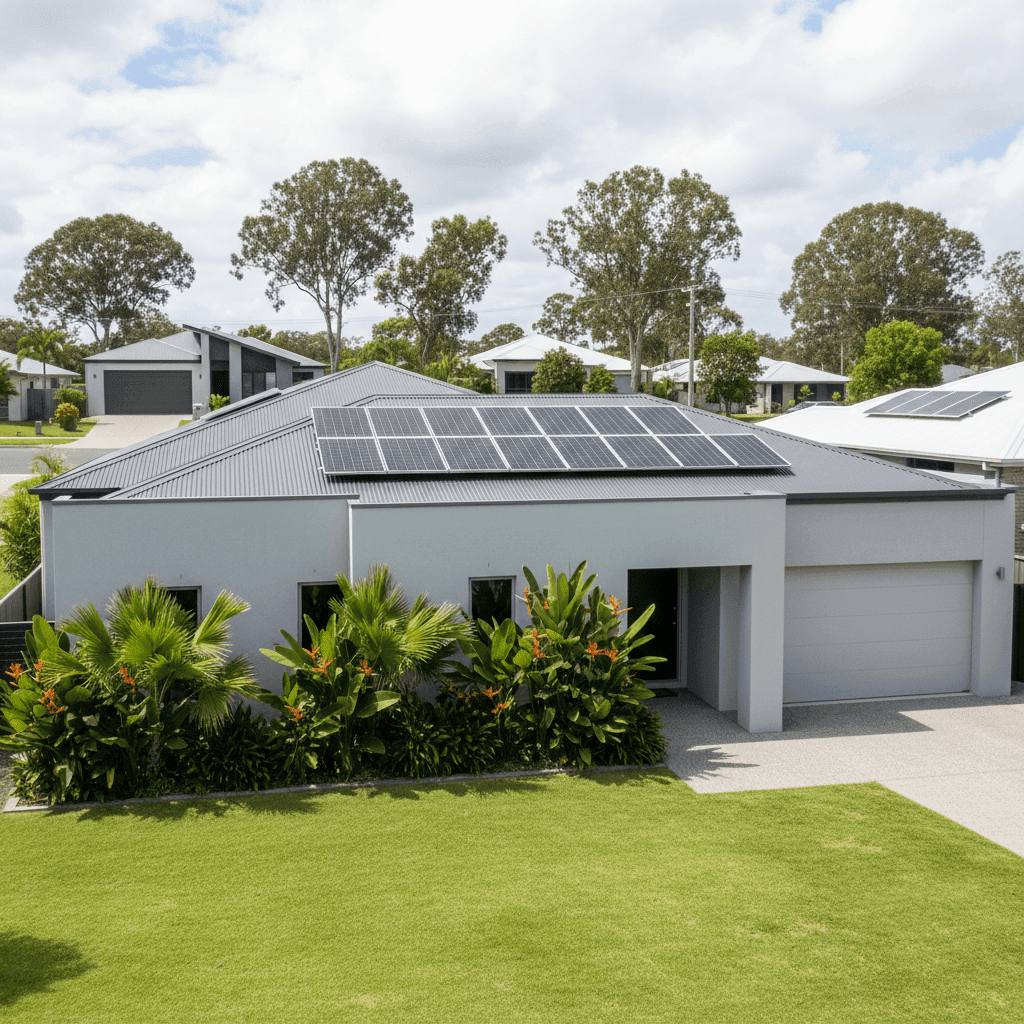
If you own a free standing home in Edmonton, QLD 4869, you already know that insurance costs in Far North Queensland can be anything but predictable. Sitting just south of Cairns, Edmonton sits squarely in a cyclone-prone region — which means insurers price policies here with a very different risk lens compared to most of Australia. In this article, we break down a recent building insurance quote for a 3-bedroom, 2-bathroom home in the suburb and put the numbers in context so you can judge whether your own premium stacks up.
---
Is This Quote Fair?
The quote in question came in at $3,031 per year (or about $290 per month) for building-only cover on a 139 sqm concrete-walled, Colorbond-roofed home built in 2013, with a sum insured of $357,000 and a $1,000 building excess.
Our price rating for this quote? Cheap — below average.
That's genuinely good news for the homeowner. Based on 17 quotes collected for Edmonton (4869), the suburb average sits at $4,406 per year and the median at $3,968 per year. This quote comes in well below both benchmarks — even below the 25th percentile of $3,281, it's competitive enough to be considered a strong result for the area.
To put it plainly: three-quarters of Edmonton homeowners in our dataset are paying more than this. That's a meaningful saving, especially in a region where premiums can spike dramatically based on relatively small differences in property features or insurer appetite.
---
How Edmonton Compares
Edmonton doesn't exist in a vacuum, so let's zoom out and look at the broader picture.
| Benchmark | Premium |
|---|---|
| This quote | $3,031 / yr |
| Edmonton suburb average | $4,406 / yr |
| Edmonton suburb median | $3,968 / yr |
| QLD state average | $9,129 / yr |
| QLD state median | $3,903 / yr |
| Cairns LGA average | $12,404 / yr |
| National average | $5,347 / yr |
| National median | $2,764 / yr |
A few things jump out here. The Cairns LGA average of $12,404 is extraordinarily high — one of the most expensive in the country — which reflects the intense cyclone exposure across the region. Edmonton, as part of the Cairns LGA, shares that risk profile, yet the suburb-level data tells a more nuanced story: the local median of $3,968 is actually very close to the QLD state median of $3,903, suggesting that Edmonton's mix of property types and construction standards is helping to keep premiums more moderate than the broader LGA average might imply.
Compared to the national average of $5,347, this quote is roughly 43% cheaper. And while the national median of $2,764 is lower, that figure is heavily influenced by lower-risk southern states where cyclone loading simply doesn't apply.
The takeaway: for a cyclone-risk suburb in Far North Queensland, a premium under $3,100 for building cover is a genuinely competitive outcome.
---
Property Features That Affect Your Premium
Several characteristics of this particular property work in the homeowner's favour — and a few are worth understanding in detail.
Concrete external walls are highly regarded by insurers in cyclone zones. Unlike timber or lightweight cladding, concrete construction offers superior wind resistance, which directly reduces the risk of catastrophic structural damage during a severe tropical cyclone. This is one of the most impactful factors in keeping premiums lower in Far North Queensland.
Steel/Colorbond roofing is another positive. Colorbond steel is a popular choice in Queensland for good reason — it's durable, relatively lightweight, and when properly fixed, performs well in high-wind events. Insurers generally view it favourably compared to older or heavier roofing materials that may be more susceptible to uplift.
Slab foundation construction adds further resilience. Slab homes tend to have fewer vulnerabilities at the base compared to raised or stump foundations, which can be more exposed during flood or storm surge events.
Tile flooring throughout is a practical choice in the tropics — resistant to moisture and easier to repair or replace than carpet or timber if water does enter the home.
Solar panels are present on this property. While solar panels themselves don't dramatically increase premiums, it's worth confirming with your insurer that they are explicitly covered under your building policy — particularly for storm or cyclone damage. Some policies cover them automatically as a fixture; others may require a specific endorsement.
The 2013 construction year is also a plus. Homes built after Queensland's updated building codes (introduced following the damage assessments from Cyclone Larry in 2006 and Cyclone Yasi in 2011) are generally constructed to higher wind-resistance standards, which insurers recognise in their pricing.
---
Tips for Homeowners in Edmonton
1. Don't assume your sum insured is still accurate. Building costs in Queensland have risen significantly over the past few years due to labour shortages and material price increases. A sum insured of $357,000 for 139 sqm works out to roughly $2,568 per sqm — which is reasonable, but worth reviewing annually. Being underinsured in a cyclone event could leave you significantly out of pocket at claim time.
2. Ask your insurer specifically about cyclone excess. Many policies in cyclone-prone areas apply a separate cyclone excess on top of the standard building excess. This can be a flat dollar amount or a percentage of the sum insured — sometimes 1–2%, which on a $357,000 policy could mean $3,570–$7,140 out of pocket before the insurer pays anything. Always read the Product Disclosure Statement carefully.
3. Confirm your solar panels are covered. As noted above, solar panels are a fixture worth protecting. Check whether your policy covers them for storm, cyclone, and accidental damage — and whether there's a sub-limit that applies. If your system is newer or higher-value, you may want to ensure the coverage reflects its replacement cost.
4. Compare quotes at renewal, every year. The Far North Queensland insurance market can shift significantly between years as insurers adjust their risk appetite for the region. A competitive quote today doesn't guarantee the same outcome at renewal. Using a comparison tool like CoverClub takes the legwork out of shopping around and helps you benchmark your premium against what others in Edmonton are actually paying.
---
Ready to See What You Could Be Paying?
Whether you're a current Edmonton homeowner wondering if your renewal quote is fair, or you're purchasing a property in the area and want to understand what to budget for insurance, CoverClub makes it easy to compare. Enter your address and get an instant comparison — no obligation, no jargon. You can also explore the full Edmonton suburb insurance data to see how premiums in your postcode stack up.