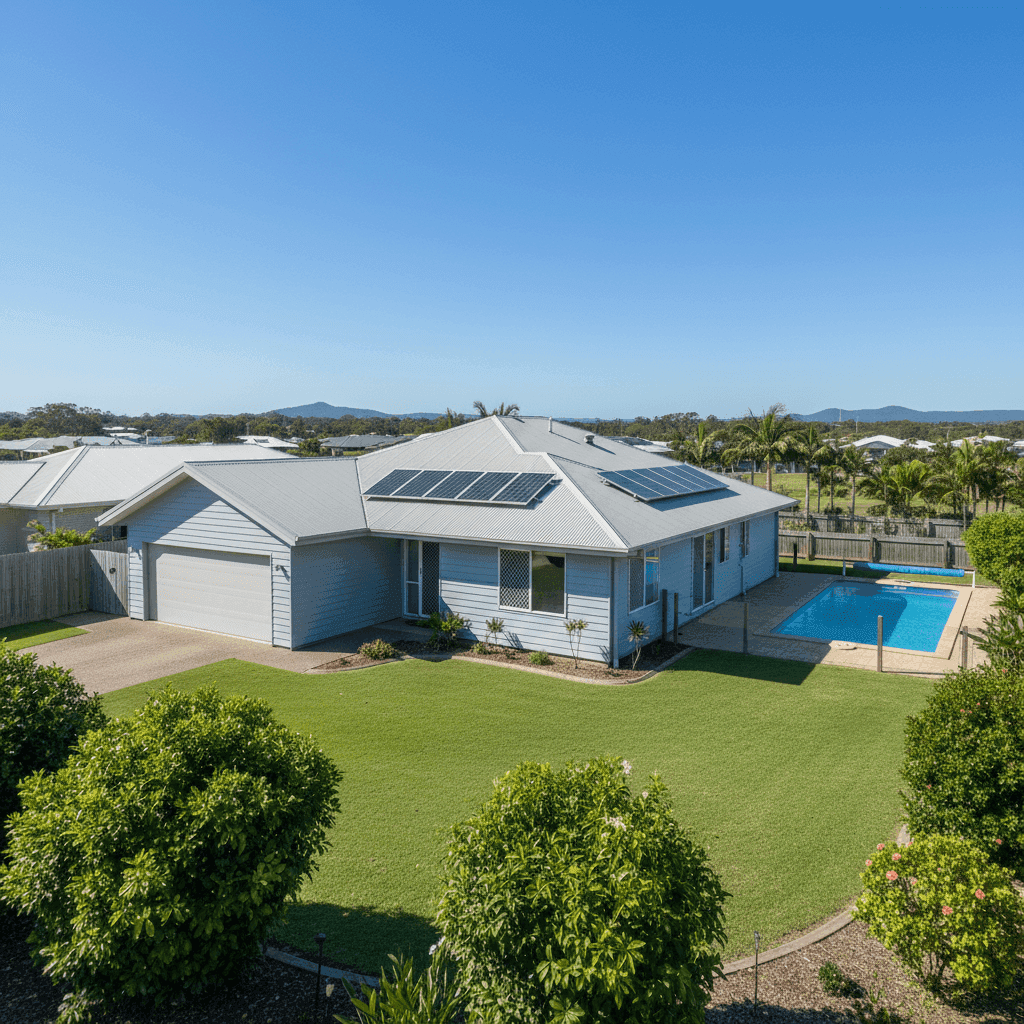
If you own a free standing home in Elliott Heads, QLD 4670, you've probably wondered whether you're paying a fair price for home insurance — or quietly overpaying year after year. This article breaks down a real home and contents insurance quote for a three-bedroom, two-bathroom property in this coastal Queensland suburb, comparing it against local, state, and national benchmarks to help you understand what's reasonable.
---
Is This Quote Fair?
The annual premium on this quote comes in at $2,485 per year (or $233/month), covering both building (sum insured: $725,000) and contents ($30,000). The building excess is $2,000 and the contents excess is $1,000.
Our price rating for this quote? Cheap — below average. That's good news for the homeowner.
To put it in context, the suburb average for Elliott Heads sits at $3,971/year, with a median of $3,742/year. This quote comes in well below both figures — roughly 37% cheaper than the suburb average and about 34% below the suburb median. Even compared to the 25th percentile of quotes in the area ($2,967/year), this premium is still notably lower, placing it among the most competitively priced policies seen in the postcode.
For a brand-new home built in 2024 with a solid sum insured of $725,000, this represents strong value. Newer homes often attract more favourable premiums because insurers view them as lower risk — modern building standards, fresh materials, and no legacy maintenance concerns all work in the homeowner's favour.
---
How Elliott Heads Compares
Home insurance pricing in Queensland is notoriously variable, and the numbers here illustrate that clearly.
| Benchmark | Annual Premium |
|---|---|
| This Quote | $2,485 |
| Elliott Heads Suburb Average | $3,971 |
| Elliott Heads Suburb Median | $3,742 |
| QLD State Average | $9,129 |
| QLD State Median | $3,903 |
| National Average | $5,347 |
| National Median | $2,764 |
(Based on 24 quotes sampled in the Elliott Heads area)
The Queensland state average of $9,129/year is dramatically higher than what most Elliott Heads residents are paying — a reflection of the extreme premiums seen in high-risk cyclone and flood zones elsewhere in the state (think far north Queensland and flood-prone inland areas). Elliott Heads, while a coastal suburb near Bundaberg, is not classified as a cyclone risk area, which goes a long way towards keeping premiums more manageable.
Compared to the national average of $5,347/year, this quote is roughly 54% cheaper — a meaningful difference. Even against the national median of $2,764/year, this premium holds up well, sitting only slightly below that midpoint.
---
Property Features That Affect Your Premium
Several characteristics of this property have a direct bearing on how insurers calculate the premium. Here's what stands out:
Newly Built (2024)
A construction year of 2024 is a significant advantage. New builds comply with the latest Australian building codes, which means stronger structural integrity, better fire resistance, and more resilient materials throughout. Insurers typically reward this with lower premiums compared to older homes that may have ageing wiring, plumbing, or roofing.
Weatherboard Timber Walls
Weatherboard wood is a classic Australian construction material, but it does carry a slightly higher fire risk than brick or rendered masonry. That said, when paired with modern construction standards and treated timber, the risk is well managed. Homeowners should ensure their policy covers the full replacement cost of timber cladding, which can be expensive to source and install.
Steel / Colorbond Roof
Colorbond roofing is one of the most insurer-friendly roof types in Australia. It's durable, lightweight, resistant to bushfire ember attack, and holds up well in high-wind events. This is likely contributing positively to the premium calculation.
Slab Foundation
A concrete slab foundation is considered low-risk by most insurers — there's no subfloor cavity to contend with, and slabs are generally resistant to subsidence and pest damage. This is a straightforward tick in the "favourable" column.
Pool, Solar Panels & Ducted Climate Control
The presence of a swimming pool adds liability exposure and some additional replacement value, which can nudge premiums upward slightly. Solar panels are increasingly common and most policies now include them under building cover, though it's worth confirming this explicitly with your insurer. Ducted climate control is a high-value fixture that should be accounted for in the building sum insured — at $725,000, there's good reason to believe this has been factored in appropriately for a 153 sqm home.
No Cyclone Risk Classification
This is a major factor. Properties in cyclone-declared zones in Queensland can see premiums two to three times higher than comparable homes outside those zones. Elliott Heads falling outside a cyclone risk area keeps this policy firmly in affordable territory.
---
Tips for Homeowners in Elliott Heads
1. Review your sum insured annually Construction costs have risen sharply in recent years. A $725,000 building sum insured may be appropriate today, but it's worth recalculating every year — particularly for a new build where you have accurate cost data. Underinsurance is one of the most common and costly mistakes homeowners make.
2. Confirm solar panels and pool equipment are covered Not all policies automatically extend cover to solar panel systems or pool equipment as standard. Check your Product Disclosure Statement (PDS) carefully to confirm these are included — and at what value. Some insurers cap solar coverage at a set dollar amount.
3. Consider increasing your contents cover At $30,000, the contents sum insured is on the lower end for a three-bedroom, two-bathroom home with standard fittings. A rough rule of thumb is to walk through each room and estimate the replacement cost of everything in it. Many homeowners are surprised to find their contents are worth considerably more than they assumed.
4. Don't set and forget — compare at renewal Even if your current premium is competitive, insurers regularly adjust their pricing models. What's cheap today may not be cheap at your next renewal. Making it a habit to compare quotes annually ensures you're always getting fair value.
---
Ready to Compare Your Own Quote?
Whether you're a new homeowner in Elliott Heads or simply due for a renewal check, CoverClub makes it easy to see how your premium stacks up. Get a home insurance quote now and compare your options side by side — it takes just a few minutes and could save you hundreds of dollars a year. You can also explore detailed insurance pricing data for Elliott Heads to see exactly where your premium sits in the local market.