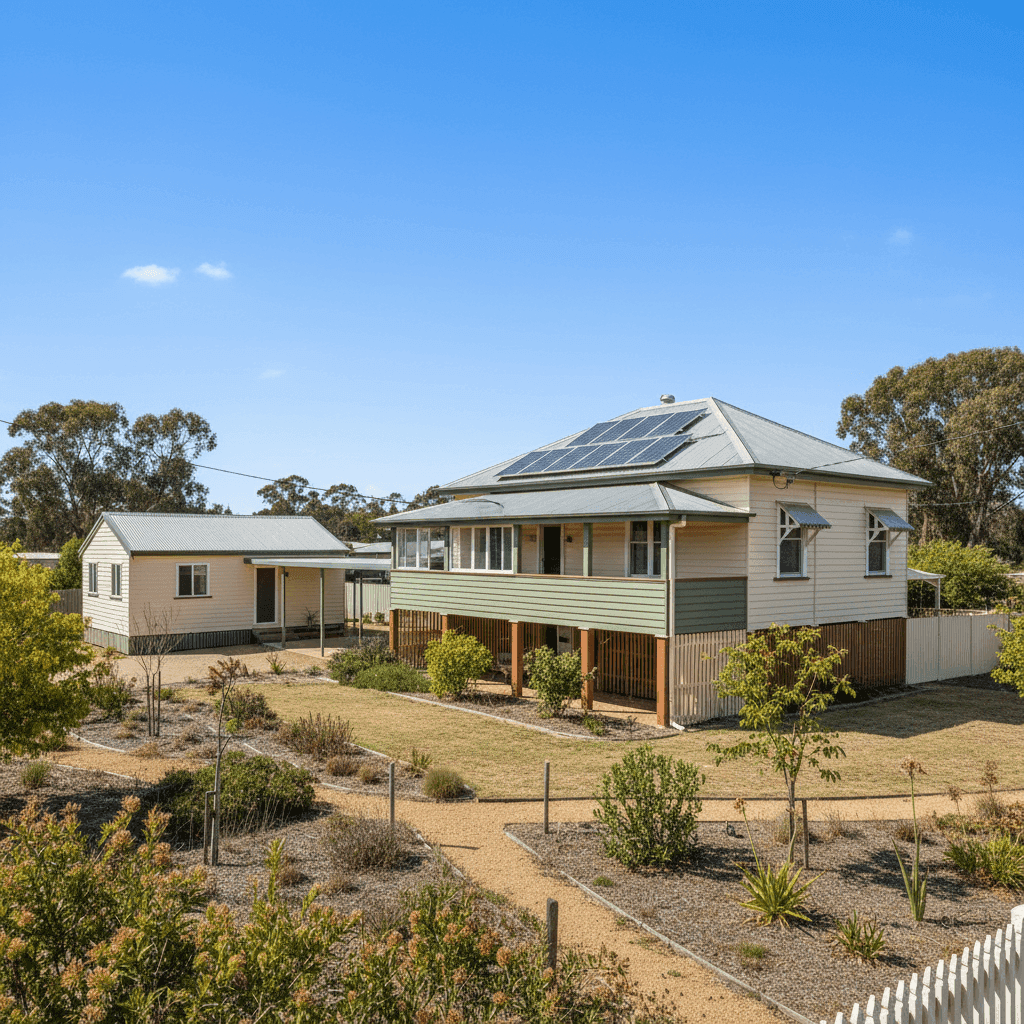
Gilgandra is a quiet rural township in the Orana region of New South Wales, sitting roughly halfway between Dubbo and Coonamble. It's the kind of place where properties tend to be generous in size and character — and this 4-bedroom, 2-bathroom free standing home on stumps is a good example. Built in 2002, featuring weatherboard timber walls, a Colorbond steel roof, solar panels, ducted climate control, and a granny flat on a 214 sqm footprint, it's a well-appointed rural property with several features that insurers pay close attention to when calculating premiums.
This article breaks down a recent home and contents insurance quote for this property — $3,959 per year (or $388/month) — and puts it in context against local, state, and national benchmarks to help you understand whether you're getting a fair deal.
---
Is This Quote Fair?
The short answer: yes, broadly speaking. This quote has been rated Fair (Around Average), which means it sits comfortably within the normal range for this type of property in this location — but it's not the cheapest option available, nor is it the most expensive.
The quote covers:
- Building sum insured: $935,000
- Contents value: $50,000
- Building excess: $2,000
- Contents excess: $1,000
A $935,000 building sum insured is substantial, and it's worth noting this figure reflects the cost to rebuild, not the market value of the property. For a 214 sqm home with a granny flat, quality fittings, solar panels, and ducted air conditioning in regional NSW, that rebuild figure is realistic — and it directly influences the premium.
The contents cover at $50,000 is relatively modest, which helps keep the overall premium from climbing higher.
---
How Gilgandra Compares
Understanding where your premium sits relative to others in the area can be genuinely useful when shopping around. Here's how this quote stacks up:
| Benchmark | Premium |
|---|---|
| This quote | $3,959/yr |
| Gilgandra suburb average | $3,880/yr |
| Gilgandra suburb median | $3,241/yr |
| Gilgandra 25th percentile | $1,954/yr |
| Gilgandra 75th percentile | $4,019/yr |
| NSW state average | $3,801/yr |
| NSW state median | $3,410/yr |
| National average | $2,965/yr |
| National median | $2,716/yr |
| LGA (Warren) average | $7,256/yr |
(Based on 37 quotes sampled in the Gilgandra 2827 area. View full [Gilgandra suburb insurance stats](https://coverclub.com.au/stats/NSW/2827/gilgandra).)
A few things stand out here. This quote sits just above the suburb average of $3,880 and below the 75th percentile of $4,019 — meaning roughly three-quarters of comparable quotes in the area are cheaper, but the top quarter are similar or more expensive. That's consistent with a "Fair" rating.
Compared to the NSW state average of $3,801, this quote is only marginally higher — a difference of about $158 per year, which is negligible given the size and features of this property.
What's particularly striking is the comparison to the LGA (Warren) average of $7,256/yr. This quote comes in at nearly half that figure, which suggests the property's specific characteristics — including its construction year, roof type, and elevated foundation — may actually be working in its favour relative to other properties across the broader Warren local government area.
Against the national average of $2,965, this quote is around $994 higher — but that's not unusual for a rural NSW property with a high building sum insured and additional structures like a granny flat.
---
Property Features That Affect Your Premium
Several characteristics of this home have a meaningful impact on what insurers charge. Here's what's most relevant:
Weatherboard timber walls are one of the most significant factors. Timber is more susceptible to fire and pest damage than brick veneer or full brick, and it can be more expensive to repair or replace. Insurers typically apply a loading to weatherboard homes as a result.
Steel/Colorbond roofing is generally viewed favourably by insurers. It's durable, low-maintenance, and performs well in hail events compared to terracotta or concrete tiles. This likely helps moderate the premium somewhat.
Elevated on stumps (at least 1m) is a double-edged sword. On one hand, elevation can reduce flood risk by keeping the floor above potential inundation levels. On the other hand, stumped homes can be more vulnerable to wind uplift and may cost more to repair after storm events. Insurers weigh both sides.
Solar panels add replacement value to the property and must be factored into the building sum insured. They're increasingly common in regional NSW and most insurers now include them as part of standard building cover — but they do contribute to a higher rebuild cost.
Ducted climate control is a significant fixture that adds to rebuild costs. Like solar panels, it's reflected in the building sum insured rather than directly in the rate, but it's a reason why that $935,000 figure is justified.
The granny flat is an important consideration. Additional dwellings on the same property increase the total rebuild cost and add complexity to a claim. It's essential that your policy explicitly covers the granny flat as part of the building — not all policies do this automatically, so always confirm with your insurer.
No pool, no cyclone risk zone — both of these work in the property's favour. Pools add liability exposure and can increase premiums, while cyclone-rated areas attract significant loadings in some parts of Australia. Neither applies here.
---
Tips for Homeowners in Gilgandra
1. Review your building sum insured regularly Rebuild costs in regional NSW have risen significantly in recent years due to labour shortages and material price increases. A sum insured of $935,000 may be appropriate now, but it's worth reassessing annually — or after any renovations, including upgrades to the granny flat or solar system. Underinsurance is one of the most common and costly mistakes homeowners make.
2. Confirm your granny flat is explicitly covered Don't assume your policy automatically covers the secondary dwelling. Ask your insurer directly whether the granny flat is included under the building definition in your policy documents. Some policies treat it as a separate structure with its own sub-limit.
3. Consider raising your excess to reduce your premium This quote carries a $2,000 building excess and $1,000 contents excess. If you have the financial buffer to absorb a higher out-of-pocket cost in the event of a claim, opting for a higher excess can meaningfully reduce your annual premium. Run the numbers with your insurer to see what the trade-off looks like.
4. Shop around at renewal time The spread of quotes in Gilgandra is wide — from $1,954 at the 25th percentile to $4,019 at the 75th percentile. That's a potential saving of over $2,000 per year for the same property, depending on which insurer you choose and what cover they offer. Loyalty doesn't always pay in insurance; comparing quotes annually is one of the simplest ways to avoid overpaying.
---
Compare Your Home Insurance Quote
Whether you're renewing your existing policy or buying cover for the first time, it pays to see what's available. CoverClub makes it easy to compare home and contents insurance quotes tailored to your property in Gilgandra and across regional NSW. Get a quote today and see how your premium stacks up — you might be surprised by what's out there.