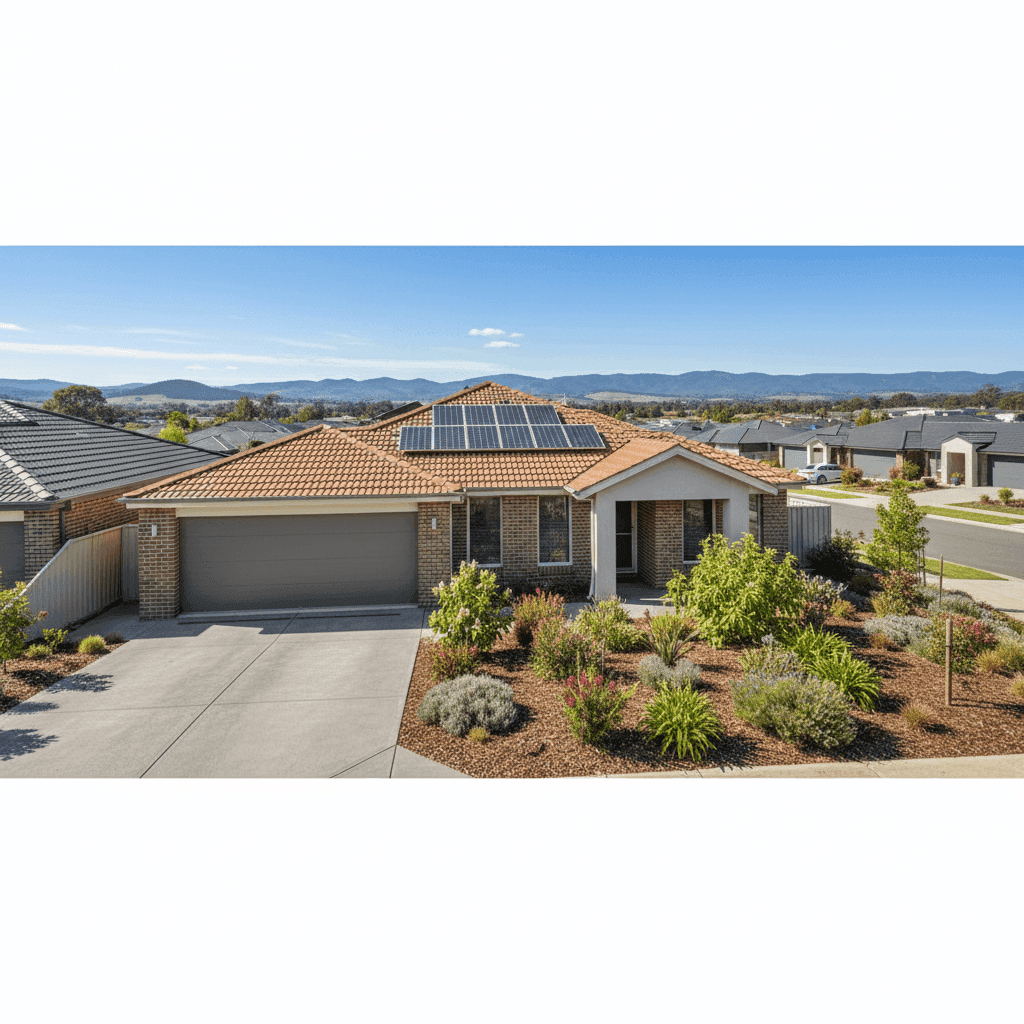
Gisborne is one of Victoria's most appealing regional townships — close enough to Melbourne for commuters, yet surrounded by the rolling hills and open spaces of the Macedon Ranges. It's a location that attracts families looking for space and lifestyle, which means larger homes, higher build values, and — as this quote illustrates — premiums that can reflect that elevated risk profile. This article breaks down a real home and contents insurance quote for a four-bedroom, free-standing brick veneer home in Gisborne (postcode 3437), and puts the numbers into context so you can make a more informed decision about your own cover.
---
Is This Quote Fair?
The annual premium on this quote comes in at $4,184 per year (or $369/month), which our pricing analysis rates as Expensive — above average for the area.
To understand why, it helps to look at what's being insured. The building is covered for $1,433,000, which is a substantial sum insured — appropriate for a 268 sqm home with above-average fittings, but a figure that will naturally push premiums higher. Contents are insured for $160,000, adding further to the base cost. The building excess is set at $2,000 and the contents excess at $1,000.
That said, "expensive" is a relative term, and it's worth unpacking exactly what it's relative to. Based on a sample of 40 quotes from the Gisborne area, the suburb average sits at $2,061/year and the median at $2,026/year. At $4,184, this quote is roughly double the local median — a meaningful gap that warrants scrutiny.
However, many of those 40 comparison quotes may be for smaller homes, lower sums insured, or contents-only policies. A 268 sqm home with above-average fittings and a $1.43 million building sum insured is not a typical suburban property. When you factor in the size, the quality of inclusions, and the solar panels and ducted climate control that add replacement value, the premium begins to make more sense — even if it still sits on the higher end.
---
How Gisborne Compares
Putting this quote into a broader geographic context is useful for any homeowner trying to benchmark their costs.
| Benchmark | Average Premium |
|---|---|
| Gisborne (3437) suburb average | $2,061/yr |
| Gisborne (3437) suburb median | $2,026/yr |
| Moorabool LGA average | $2,640/yr |
| Victoria state average | $3,000/yr |
| Victoria state median | $2,718/yr |
| National average | $5,347/yr |
| National median | $2,764/yr |
You can explore the full breakdown of Gisborne suburb insurance statistics, or compare against Victoria-wide data and national averages.
At $4,184, this quote sits well above the Gisborne suburb average but below the national average of $5,347/year. Compared to the Moorabool LGA average of $2,640/year, it's notably higher — though again, the high sum insured is likely the primary driver. The 75th percentile for Gisborne quotes is $2,650/year, meaning this premium is above even the most expensive quarter of local quotes, which underscores the outsized impact of insuring a high-value property.
---
Property Features That Affect Your Premium
Several characteristics of this property have a direct bearing on what insurers charge:
Brick veneer construction and tiled roof are generally viewed favourably by insurers. Brick veneer offers solid fire resistance and structural durability, while tiled roofs are considered more resilient than corrugated iron in many risk assessments. These features can help moderate premiums compared to timber-clad or Colorbond-roofed homes of similar size.
Slab foundation is standard for homes of this era and construction type, and doesn't typically attract a loading from insurers — though it does mean the home has limited underfloor space, which can affect claims related to moisture or pest ingress.
Built in 1985, the home is approaching 40 years old. Older homes can attract higher premiums due to the increased likelihood of wear-related issues — ageing plumbing, electrical wiring, and roofing materials that may be closer to end-of-life. Insurers factor this into their risk modelling.
Solar panels add real replacement value and are an increasingly common inclusion in modern home insurance policies. If the panels are not explicitly listed in your policy schedule, it's worth confirming whether they're covered under the building or as a separate item.
Ducted climate control is another high-value inclusion. Ducted systems can cost tens of thousands of dollars to replace, and their presence in the home contributes meaningfully to the overall sum insured — and therefore the premium.
Above-average fittings quality — think stone benchtops, quality cabinetry, premium tapware, and higher-grade flooring — means the cost to rebuild or repair the home to its original standard is significantly higher than a standard-spec property of the same size. Insurers price accordingly.
---
Tips for Homeowners in Gisborne
1. Review your sum insured carefully A $1,433,000 building sum insured is substantial. It's worth getting an independent building replacement cost estimate (not market value) to ensure you're not over-insured. Equally, under-insuring can leave you seriously out of pocket after a major claim — so accuracy matters in both directions.
2. Check your solar panel coverage explicitly Ask your insurer whether solar panels are covered under the building section, and whether storm damage, inverter failure, or panel degradation are included. Coverage varies significantly between policies.
3. Consider your excess settings This quote carries a $2,000 building excess and $1,000 contents excess. Opting for a higher voluntary excess can reduce your annual premium — a useful lever if you're looking to bring costs down without reducing your sum insured.
4. Shop around at renewal time Insurance loyalty rarely pays. The spread between the 25th percentile ($1,377/yr) and 75th percentile ($2,650/yr) in Gisborne alone shows how much premiums can vary for similar properties. Compare quotes at CoverClub to see whether a better deal is available for your specific property profile.
---
Compare Your Home Insurance Today
Whether you're reviewing an existing policy or shopping for the first time, understanding how your premium stacks up is the first step to getting better value. CoverClub makes it easy to compare home and contents insurance quotes for properties across Gisborne and the wider Macedon Ranges region. Get a quote today and see what you could be paying.