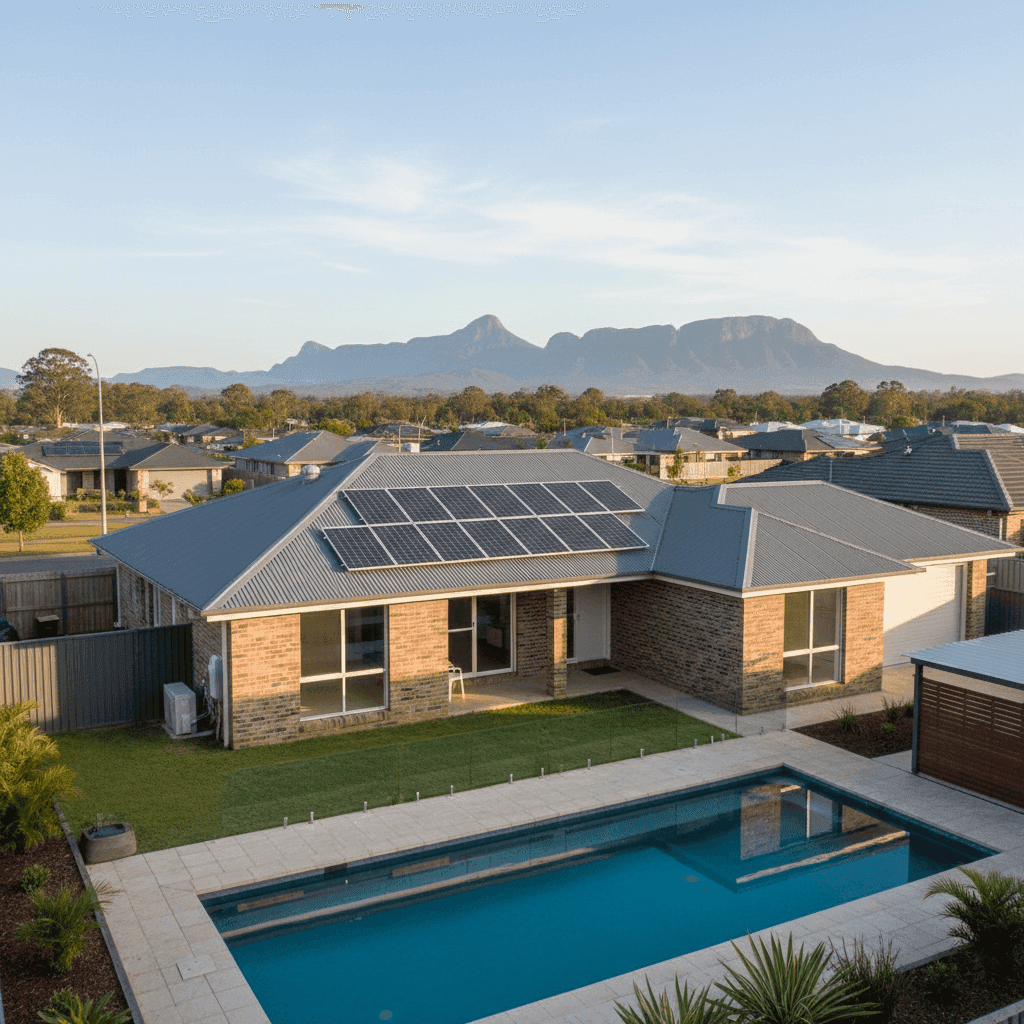
Nestled at the foot of the iconic Glasshouse Mountains in South East Queensland, Glass House Mountains (postcode 4518) is a sought-after semi-rural suburb offering a relaxed lifestyle within reach of the Sunshine Coast. For owners of a larger free standing home in this area, understanding what drives your home insurance premium — and whether you're getting a fair deal — is well worth the effort. This article breaks down a recent Home and Contents insurance quote for a five-bedroom property in the suburb, and puts it in context against local, state-wide, and national benchmarks.
---
Is This Quote Fair?
The quote in question comes in at $4,083 per year (or $384/month) for combined Home and Contents cover, with a building sum insured of $1,000,000 and contents valued at $200,000. Both the building and contents excess are set at $1,000 each.
Our price rating for this quote is FAIR — Around Average, and the data backs that up. The suburb average premium for Glass House Mountains sits at $4,016/year, meaning this quote lands just $67 above what most comparable properties in the area are paying. That's a difference of less than 2%, which is well within normal variation territory.
It's worth noting that the suburb median premium is $3,312/year — noticeably lower than this quote. The gap between the mean and median suggests there are a handful of higher-cost properties pulling the average up, which is common in areas with a mix of modest homes and larger, more valuable dwellings. A five-bedroom home with a pool, solar panels, and a $1,000,000 building sum insured sits comfortably in the upper tier of the local market, so a premium above the median is to be expected.
The 25th–75th percentile range for the suburb spans $2,219 to $5,828/year, and this quote falls neatly in the middle of that band — further confirmation that it's a reasonable price for the level of cover provided.
---
How Glass House Mountains Compares
To properly evaluate this quote, it helps to zoom out and look at the broader picture. Here's how Glass House Mountains stacks up:
| Benchmark | Average Premium | Median Premium |
|---|---|---|
| Glass House Mountains (4518) | $4,016/yr | $3,312/yr |
| Sunshine Coast LGA | $4,608/yr | — |
| Queensland | $4,547/yr | $3,931/yr |
| National | $2,965/yr | $2,716/yr |
A few things stand out here. First, Glass House Mountains is actually slightly cheaper on average than both the broader Queensland state average ($4,547/yr) and the Sunshine Coast LGA average ($4,608/yr). This is a meaningful difference — homeowners in this suburb are paying roughly 12–13% less than the Queensland average, which may reflect lower flood exposure or fewer extreme weather events compared to coastal Sunshine Coast suburbs.
Second, Queensland premiums are significantly higher than the national average of $2,965/yr. This is a well-established pattern across Australia — Queensland's exposure to severe weather events, including storms, hail, and flooding, consistently pushes premiums above what homeowners in southern states pay. If you've moved to Queensland from interstate, sticker shock on your first renewal notice is common.
You can explore the full breakdown of local premiums on the Glass House Mountains suburb stats page, which is updated regularly with real quote data.
---
Property Features That Affect Your Premium
Several characteristics of this particular property have a meaningful influence on the final premium. Understanding them can help you make sense of your quote — and potentially identify areas to address.
Size and bedrooms: At 214 sqm with five bedrooms and three bathrooms, this is a larger-than-average home. Bigger homes cost more to rebuild, which is reflected in the $1,000,000 building sum insured. Rebuild costs in regional Queensland have risen sharply in recent years, so ensuring your sum insured keeps pace with current construction costs is critical.
Brick veneer walls and Colorbond roof: Brick veneer construction is generally viewed favourably by insurers — it offers solid fire resistance and structural integrity. A steel Colorbond roof is also a positive signal: it's durable, low-maintenance, and performs well in high-wind conditions. Together, these features help keep the premium from being higher than it might otherwise be.
Slab foundation: A concrete slab is a standard and insurer-friendly foundation type. It avoids the subfloor moisture and pest access issues that can affect raised timber floors, and is generally associated with lower risk.
Timber and laminate flooring: While aesthetically popular, timber and laminate flooring can be more costly to replace following water damage events compared to tile. This is worth keeping in mind when assessing your contents and building cover levels.
Swimming pool: A pool adds both value and risk to a property. It increases the potential cost of a claim (pool surrounds, fencing, equipment) and can affect liability considerations. Make sure your policy explicitly covers pool-related damage.
Solar panels: Solar systems are increasingly common in Queensland and are generally covered under building insurance, but coverage terms vary between insurers. Confirm that your panels, inverter, and associated wiring are included in your building sum insured — and check whether storm or hail damage is covered, as this is a common exclusion in some policies.
---
Tips for Homeowners in Glass House Mountains
1. Review your building sum insured annually. Construction costs in South East Queensland have climbed considerably since 2020. A sum insured that was appropriate when you took out your policy may no longer reflect the true cost of rebuilding your home. Use a building cost estimator or speak with a local builder to get a realistic figure.
2. Check your solar panel coverage explicitly. Don't assume your solar system is automatically covered. Ask your insurer to confirm what's included — panels, inverter, mounting hardware, and wiring — and under what circumstances. Storm and hail damage should be covered, but always verify.
3. Understand your storm and water damage terms. While Glass House Mountains is not classified as a cyclone risk area, the region does experience severe summer storms and heavy rainfall. Review your policy's definitions of 'storm', 'flood', and 'rainwater runoff' carefully — these distinctions can significantly affect whether a claim is paid.
4. Compare quotes before renewing. Loyalty doesn't always pay in the insurance market. Insurers frequently offer better rates to new customers than to existing ones. Use a comparison platform like CoverClub to benchmark your renewal quote against the market before automatically accepting it.
---
Ready to Compare?
Whether you're buying a new policy or approaching your annual renewal, it pays to shop around. CoverClub makes it easy to compare home and contents insurance quotes tailored to your property and location. Get a quote today and see how your premium stacks up against real data from Glass House Mountains and across Queensland.