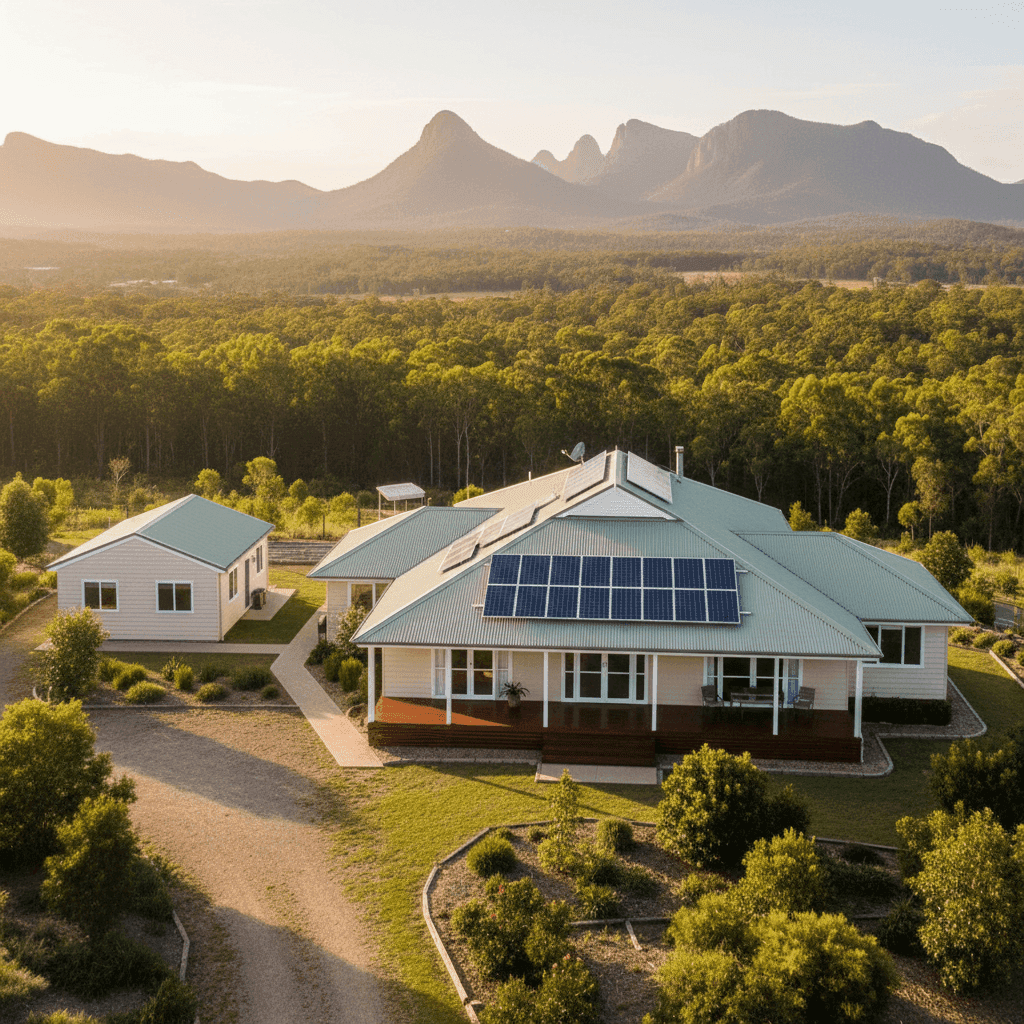
If you own a home in Glass House Mountains, QLD 4518, you already know the appeal — lush hinterland scenery, a relaxed lifestyle, and that unmistakable sense of space that's harder to find closer to the coast. But owning property here also means navigating the realities of home insurance in a region where premiums can vary widely. This article breaks down a real building insurance quote for a four-bedroom free-standing home in Glass House Mountains, comparing it against local, state, and national benchmarks to help you understand whether you're paying a fair price.
---
Is This Quote Fair?
The quote in question is $3,398 per year (or $319/month) for building-only cover on a free-standing home with a sum insured of $817,000 and a building excess of $5,000.
Our price rating for this quote is FAIR — Around Average, and the data backs that up. Based on 52 quotes collected for the Glass House Mountains area, the suburb average sits at $4,016/yr and the median at $3,312/yr. At $3,398, this quote lands just above the suburb median — meaning roughly half of comparable properties in the area are paying less, and half are paying more. That's a reasonable position to be in.
It's worth noting that the suburb's premium range is quite wide. The 25th percentile is $2,219/yr, while the 75th percentile jumps to $5,828/yr. This spread reflects the diversity of properties in the area — different ages, construction types, sizes, and risk profiles all push premiums in different directions. A quote sitting near the median is a solid outcome, but it also signals there may be room to do better with the right insurer.
---
How Glass House Mountains Compares
To put this quote in broader context, it helps to look beyond the suburb.
| Benchmark | Average Premium | Median Premium |
|---|---|---|
| Glass House Mountains (4518) | $4,016/yr | $3,312/yr |
| Queensland (State) | $4,547/yr | $3,931/yr |
| National | $2,965/yr | $2,716/yr |
| Sunshine Coast LGA | $7,249/yr | — |
A few things stand out here. First, Queensland premiums are significantly higher than the national average — QLD homeowners pay roughly 53% more on average than the national norm. This is largely driven by the state's exposure to extreme weather events, including flooding, severe storms, and hail.
Second, Glass House Mountains actually compares favourably to both the state average and — perhaps more strikingly — the broader Sunshine Coast LGA average of $7,249/yr. The LGA figure is heavily influenced by coastal and low-lying suburbs with elevated flood and storm surge risk. Being in the hinterland, Glass House Mountains sits in a more favourable risk position than many of its coastal neighbours.
At $3,398/yr, this quote comes in $1,149 below the QLD state average and $3,851 below the Sunshine Coast LGA average — a meaningful difference that reflects the relatively lower risk profile of this particular location.
---
Property Features That Affect Your Premium
Several characteristics of this property influence the premium, some working in the owner's favour and others adding complexity.
Weatherboard timber walls are one of the more significant factors. Timber-framed and weatherboard homes are generally considered higher risk by insurers compared to brick veneer or double-brick construction, primarily due to greater susceptibility to fire. This can push premiums upward, particularly in bushland-adjacent areas like Glass House Mountains.
The 1986 construction year also plays a role. Homes built in the mid-1980s are old enough that insurers may factor in the age of plumbing, electrical systems, and structural components. Older homes can carry higher replacement costs and a greater likelihood of claims related to wear and ageing infrastructure.
The steel/Colorbond roof is a positive. Colorbond is a popular roofing material in Queensland for good reason — it's durable, lightweight, and performs well in high-wind and hail events. Insurers generally view it favourably compared to older tile or fibrous cement roofing.
Solar panels add a modest layer of complexity. They increase the replacement value of the home and may require specific consideration in the policy wording. Homeowners should confirm that their solar system is explicitly covered under the building sum insured.
The granny flat is an important inclusion. Secondary dwellings on the same title can significantly affect the sum insured and the scope of cover. At $817,000, the building sum insured needs to reflect the full replacement cost of both the main dwelling and the granny flat — underinsurance here could be costly.
Slab foundation and timber/laminate flooring are relatively neutral factors, though the flooring type may be relevant if storm water or pipe burst events are a concern.
---
Tips for Homeowners in Glass House Mountains
1. Review your sum insured carefully — especially with a granny flat With a secondary dwelling on the property, it's easy to underestimate the total replacement cost. Use a building cost calculator or consult a quantity surveyor to make sure $817,000 genuinely covers both structures, including site clearance and professional fees.
2. Ask about timber construction loadings Some insurers apply a loading (surcharge) to weatherboard or timber-framed homes. It's worth asking your insurer directly whether a construction loading applies and, if so, whether switching to a different insurer with a more favourable view of timber homes could reduce your premium.
3. Confirm your solar panels are covered Not all building policies automatically cover rooftop solar systems to their full replacement value. Check the policy schedule and Product Disclosure Statement (PDS) to confirm coverage, and update your sum insured if the system has been upgraded or expanded.
4. Consider your excess trade-off This quote carries a $5,000 building excess — on the higher end. A higher excess typically reduces your premium, but it also means more out-of-pocket cost when you do claim. Review whether this excess level suits your financial situation, and compare quotes with lower excess options to see the premium difference.
---
Ready to Compare?
Whether you're looking to benchmark your current policy or shopping for cover for the first time, comparing quotes is the best way to make sure you're not overpaying. Get a home insurance quote at CoverClub and see how your premium stacks up against other homeowners in Glass House Mountains and across Queensland. It takes just a few minutes and could save you hundreds.