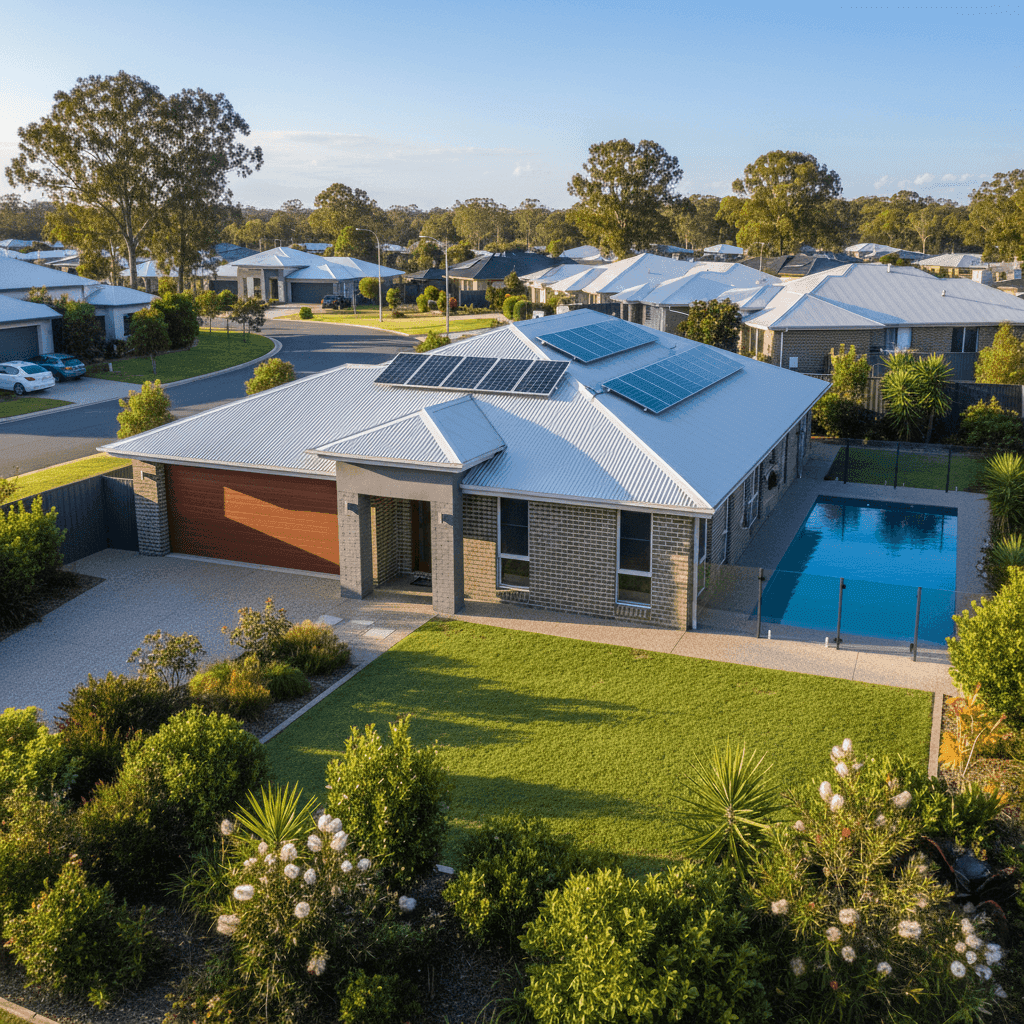
If you own a free standing home in Gleneagle, QLD 4285, you're likely paying close attention to what home insurance is costing you — and whether you're getting a fair deal. Situated in the Logan region south of Brisbane, Gleneagle is a leafy, semi-rural suburb that attracts families looking for space and lifestyle. But with larger homes, pools, and solar panels becoming the norm, insurance premiums can vary widely. This article breaks down a real quote for a five-bedroom, two-bathroom home in the area and puts it in context with suburb, state, and national data.
---
Is This Quote Fair?
The quote in question is $3,097 per year (or $290/month) for combined home and contents insurance, covering a building sum insured of $824,000 and contents valued at $90,000. Both the building and contents excess sit at $2,000.
Our price rating for this quote is FAIR — Around Average.
That verdict holds up when you look at the numbers. The suburb average premium for Gleneagle sits at $2,636/yr, and the median is $2,752/yr, meaning this quote lands above the midpoint for the area. However, it falls comfortably within the suburb's interquartile range — the 25th percentile is $2,109/yr and the 75th percentile is $3,170/yr — so it's not an outlier by any measure. At $3,097, this quote is sitting just inside the upper quarter of what locals are paying, which is reasonable given the property's size and features.
In short: you're not being gouged, but there may be room to sharpen the price if you shop around.
---
How Gleneagle Compares
To really understand whether this quote makes sense, it helps to zoom out and look at the broader picture. Here's how Gleneagle stacks up:
| Benchmark | Premium |
|---|---|
| This quote | $3,097/yr |
| Gleneagle suburb average | $2,636/yr |
| Gleneagle suburb median | $2,752/yr |
| LGA (Logan) average | $4,617/yr |
| QLD state average | $9,129/yr |
| QLD state median | $3,903/yr |
| National average | $5,347/yr |
| National median | $2,764/yr |
(Based on 29 quotes sampled for the Gleneagle area)
A few things stand out here. First, the QLD state average of $9,129/yr is dramatically higher than this quote — but that figure is heavily skewed by high-risk areas like Far North Queensland, where cyclone-prone properties attract enormous premiums. The state median of $3,903/yr is a more useful reference point, and this quote comes in well below it.
Compared to the national average of $5,347/yr, this quote looks very competitive. Even against the national median of $2,764/yr, the gap is modest — and understandable given the property's size and the inclusions (pool, solar panels) that add complexity to the risk profile.
The Logan LGA average of $4,617/yr is also notably higher than this quote, suggesting that Gleneagle's relatively low-risk profile within the broader Logan area is working in the homeowner's favour.
You can explore more local data on the Gleneagle suburb insurance stats page, compare it against Queensland-wide trends, or see how it measures up against national benchmarks.
---
Property Features That Affect Your Premium
Several characteristics of this property have a direct bearing on the premium calculated.
Size and sum insured: At 277 sqm with five bedrooms and a building sum insured of $824,000, this is a substantial home. Larger homes cost more to rebuild, and insurers price accordingly. The sum insured here reflects current construction costs and is an important figure to keep accurate — under-insuring can leave you seriously out of pocket after a claim.
Brick veneer construction: Brick veneer external walls are generally viewed favourably by insurers. They offer solid fire resistance and structural durability compared to lightweight cladding, which can contribute to a more competitive premium.
Colorbond steel roof: Steel roofing is durable and low-maintenance, and performs well in storms. Insurers typically consider it a lower-risk roofing material than tiles (which can crack) or older materials like asbestos sheeting.
Concrete slab foundation: A slab foundation is a stable, well-regarded base that doesn't carry the same risks as older stumped or suspended timber foundations, particularly in terms of subsidence or pest damage.
Swimming pool: Pools add value to a property but also add liability risk and replacement cost, both of which can nudge premiums upward. Insurers will factor in the cost of repairing or replacing the pool structure as part of the building sum insured.
Solar panels: Solar systems are increasingly common in Queensland, but they do add to the insured value of the home. Panels can be damaged by hail, storms, or fire, and replacement costs can be significant. It's worth confirming with your insurer that your solar system is explicitly covered under your policy.
Timber and laminate flooring: While stylish, timber and laminate floors can be more costly to repair or replace after water damage compared to tiles. This is a subtle factor but one that can influence contents and building claims.
No cyclone risk: Gleneagle falls outside designated cyclone risk zones, which is a meaningful premium advantage for Queensland homeowners. Cyclone-rated policies in northern parts of the state can cost multiples of what's quoted here.
---
Tips for Homeowners in Gleneagle
1. Review your sum insured annually Construction costs have risen considerably in recent years. A building sum insured that was accurate two or three years ago may no longer reflect what it would actually cost to rebuild your home today. Use a building cost calculator or speak with a quantity surveyor to ensure you're not underinsured.
2. Confirm your solar panels and pool are fully covered Not all policies automatically include solar panels or pool structures in the building cover. Read your Product Disclosure Statement (PDS) carefully and ask your insurer directly. Some policies require you to list these as specific items.
3. Consider your excess level strategically This quote carries a $2,000 excess on both building and contents. A higher excess generally reduces your premium, but make sure you can comfortably afford to pay it in the event of a claim. If cash flow is a concern, a lower excess with a slightly higher premium may be the smarter choice.
4. Shop around at renewal time Loyalty doesn't always pay in the insurance industry. Insurers often offer better rates to new customers than to existing ones. Use a comparison platform like CoverClub at renewal time to see whether you can get equivalent cover for less — even a saving of a few hundred dollars a year adds up over time.
---
Compare Your Own Quote
Whether you're reviewing an existing policy or shopping for cover on a new property, it pays to see what the market is offering. Get a home insurance quote through CoverClub and compare options from multiple insurers side by side — so you can make a confident, informed decision about protecting one of your most valuable assets.