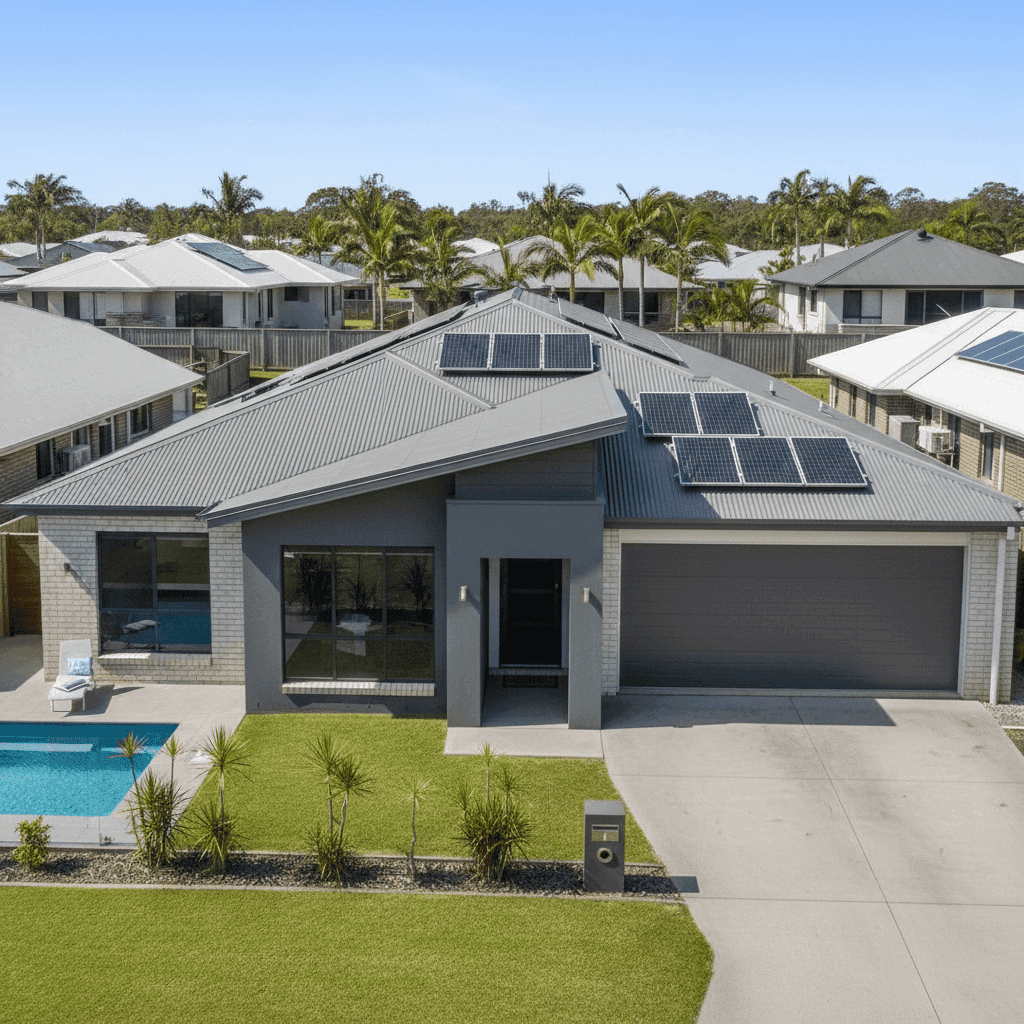
If you own a free standing home in Glenella, QLD 4740, you're probably well aware that insuring a property in the Mackay region comes with its own set of considerations — not least of which is the area's exposure to cyclone risk. This article breaks down a real home and contents insurance quote for a four-bedroom, two-bathroom brick veneer home in Glenella, compares it against local, state, and national benchmarks, and offers practical tips to help you get the best value on your cover.
---
Is This Quote Fair?
The annual premium for this property came in at $4,014 per year (or $385/month), covering both building (sum insured: $809,000) and contents ($50,000). Our price rating for this quote is FAIR — Around Average.
That rating holds up well under scrutiny. Based on 32 quotes collected for Glenella and surrounds, the suburb average sits at $4,438/year and the median at $4,465/year. This quote lands noticeably below both figures, which is a positive sign. It also falls within the interquartile range — between the 25th percentile of $3,570/year and the 75th percentile of $5,128/year — meaning it's genuinely competitive without being an outlier in either direction.
In short, while this isn't the cheapest quote available in the suburb, it's a reasonable price for the level of cover provided. Homeowners paying above $5,128/year for a comparable property in Glenella should seriously consider shopping around.
---
How Glenella Compares
Understanding how your premium stacks up at different geographic levels can reveal a lot about local risk factors and insurer pricing strategies.
| Benchmark | Average Premium | Median Premium |
|---|---|---|
| Glenella (4740) | $4,438/yr | $4,465/yr |
| Mackay LGA | $8,458/yr | — |
| Queensland | $9,129/yr | $3,903/yr |
| National | $5,347/yr | $2,764/yr |
A few things stand out here. The Queensland state average of $9,129/year is strikingly high — but it's heavily influenced by extreme premiums in high-risk coastal and cyclone-prone areas across the state. The state median of $3,903/year is far more representative of what most Queenslanders actually pay, and this quote sits just above that figure.
The Mackay LGA average of $8,458/year is also notably elevated, which reflects the broader cyclone and weather risk across the region. Glenella's suburb-level figures are considerably lower than the LGA average, which may suggest that this particular pocket of Mackay attracts more competitive pricing from insurers — or that the mix of properties quoted skews toward newer, better-constructed homes.
Compared to the national average of $5,347/year, this quote is below par, which is a good outcome for the homeowner. However, the national median of $2,764/year serves as a reminder that Australians in lower-risk areas — think southern states with minimal cyclone or flood exposure — can pay significantly less for equivalent cover.
---
Property Features That Affect Your Premium
Several characteristics of this property have a direct bearing on what insurers charge. Here's how each one plays into the pricing:
Cyclone risk area: This is arguably the single biggest driver of premiums in Glenella. Properties in North Queensland cyclone zones attract loading from virtually every major insurer, reflecting the elevated risk of wind and storm damage. Even well-built homes aren't immune to this surcharge.
Brick veneer construction with Colorbond roof: Brick veneer walls are generally viewed favourably by insurers — they're more fire-resistant than timber weatherboard and hold up reasonably well in high winds. A steel Colorbond roof is also a practical choice in cyclone-prone regions, as it's designed to meet Australian wind-load standards. Together, these materials likely help moderate the premium compared to older or less resilient construction types.
Slab foundation and tiled flooring: A concrete slab foundation is considered low-risk from an insurer's perspective — there's no underfloor cavity for moisture or pests, and it performs well in flood-adjacent scenarios. Tiled flooring similarly reduces the risk of water damage claims compared to timber or carpet.
Built in 2010: A home constructed in 2010 benefits from building codes that were already incorporating improved cyclone resilience standards, particularly in Queensland. This is a meaningful factor — homes built before the mid-1990s code updates can attract significantly higher premiums.
Swimming pool: Pools add modest complexity to a policy, as they represent a liability and replacement cost consideration. Most insurers factor this into the building sum insured rather than applying a standalone surcharge.
Solar panels: Solar systems are increasingly common and most insurers now include them as part of the building cover. It's worth confirming with your insurer that your panels are explicitly covered under the policy, particularly for storm or hail damage.
Above-average fittings quality: Higher-quality fixtures, fittings, and finishes push up the replacement cost of the home, which is reflected in the $809,000 building sum insured. This is appropriate — underinsuring a well-appointed home is a common and costly mistake.
---
Tips for Homeowners in Glenella
1. Review your building sum insured annually Construction costs in Queensland have risen significantly in recent years. A sum insured of $809,000 for a 214 sqm home with above-average fittings seems reasonable, but it's worth validating this figure each year using a building cost calculator. Being underinsured at claim time can leave you significantly out of pocket.
2. Ask about cyclone-specific policy conditions Some insurers impose specific requirements for cyclone cover — such as securing outdoor furniture, closing shutters, or providing notice before a named cyclone. Failing to meet these conditions can affect your claim. Read the Product Disclosure Statement carefully and know your obligations before storm season.
3. Consider increasing your excess to lower your premium This policy carries a $2,000 building excess and $1,000 contents excess. If you have the financial buffer to absorb a higher excess in the event of a claim, increasing these figures can meaningfully reduce your annual premium. This strategy works best for homeowners who are unlikely to make small or frequent claims.
4. Compare quotes at renewal — every year Insurers regularly reprice their books, and loyalty doesn't always pay. Given that premiums in the Mackay LGA can vary enormously (from under $3,500 to well over $5,000 for comparable properties in Glenella alone), comparing quotes at each renewal is one of the most effective ways to avoid overpaying.
---
Ready to Compare Home Insurance in Glenella?
Whether you're reviewing an existing policy or shopping for cover on a new property, CoverClub makes it easy to see how your quote stacks up. Get a home insurance quote today and compare real prices for homes in Glenella and across Queensland — so you can be confident you're getting fair value, not just a familiar brand name.