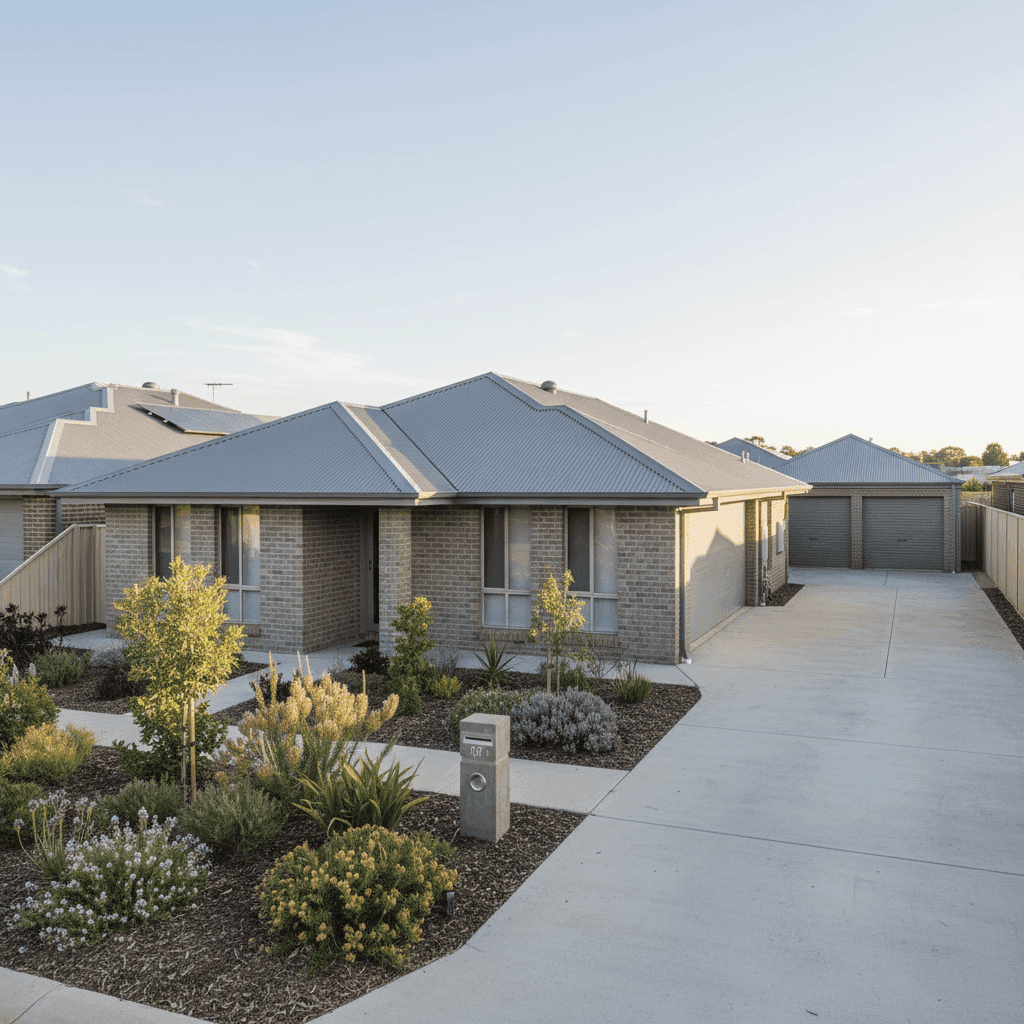
If you own a free standing home in Glenfield, WA 6532, you're likely aware that home insurance costs in regional Western Australia can vary quite significantly. This article breaks down a real home and contents insurance quote for a four-bedroom, two-bathroom brick veneer property in Glenfield — and puts that number into context against local, state-wide, and national benchmarks. Whether you're renewing your policy or shopping around for the first time, this analysis will help you understand what's driving your premium and where you stand.
---
Is This Quote Fair?
The annual premium in question comes in at $3,687 per year (or around $346 per month), covering both building and contents with a sum insured of $750,000 on the building and $130,000 on contents. Both the building and contents excess are set at $1,000.
Our pricing engine rates this quote as Fair — Around Average, and the data backs that up. Within the Glenfield suburb, the average premium sits at $4,267 per year and the median is slightly higher at $4,425 per year. That means this quote is tracking about 14% below the suburb average and meaningfully below the median — a solid result for a property of this size and specification.
The 25th percentile for Glenfield quotes is $3,539 per year, which represents the cheaper end of the market locally. At $3,687, this quote sits just above that threshold — meaning roughly a quarter of comparable properties in the area are insured for less, but the majority are paying more. For a four-bedroom home with above-average fittings, a granny flat, and ducted climate control, landing near the lower quartile is a reasonable outcome.
---
How Glenfield Compares
To fully appreciate where this quote sits, it helps to zoom out and look at the broader picture.
| Benchmark | Average Premium | Median Premium |
|---|---|---|
| Glenfield (suburb) | $4,267/yr | $4,425/yr |
| Western Australia (state) | $2,811/yr | $2,127/yr |
| Australia (national) | $5,347/yr | $2,764/yr |
| Shark Bay LGA | $5,859/yr | — |
A few things stand out here. First, Glenfield premiums are notably higher than the WA state average of $2,811/yr — roughly 52% above it. This reflects the elevated risk profile of regional coastal areas in WA, where factors like distance from fire services, weather exposure, and property replacement costs all push premiums upward.
Second, when compared to the national average of $5,347/yr, the Glenfield suburb average actually looks quite reasonable — and this particular quote at $3,687 looks even better. Nationally, home insurance costs have surged in recent years due to climate-related claims, supply chain pressures on building materials, and rising labour costs.
Perhaps most striking is the Shark Bay LGA average of $5,859/yr — significantly above both the suburb and national figures. This suggests that while Glenfield itself is manageable in cost terms, the broader LGA carries a higher risk weighting that some insurers price in more aggressively than others. Shopping around within this LGA is particularly worthwhile.
You can explore detailed premium statistics for Glenfield and the surrounding area to see how quotes trend over time.
---
Property Features That Affect Your Premium
Several characteristics of this property have a direct bearing on its insurance cost — some working in the owner's favour, others adding complexity.
Brick veneer construction with a Colorbond roof is generally well-regarded by insurers. Brick veneer offers solid fire resistance and structural durability, while steel Colorbond roofing is low-maintenance, resistant to corrosion, and performs well in high-wind conditions. Together, these materials typically attract more competitive premiums compared to timber-framed or older fibre cement homes.
Slab foundation is another positive signal for insurers — it's considered stable and less susceptible to subsidence or pest damage than suspended timber floors.
Above-average fittings will push the sum insured higher, as quality fixtures, appliances, and finishes cost more to replace. The $750,000 building sum insured reflects this, and it's important that figure accurately represents full rebuild cost — not market value.
The granny flat is a meaningful inclusion. Secondary dwellings add to the total rebuild cost and must be properly accounted for in the sum insured. Underinsuring a property with a granny flat is a common mistake that can leave owners significantly out of pocket after a major claim.
Ducted climate control adds to both building value and contents complexity. Ducted systems are expensive to replace and should be explicitly covered under the policy.
No pool, no solar panels, and no cyclone risk all simplify the risk profile. The absence of a cyclone risk classification is particularly relevant in WA, where properties in cyclone-prone zones can attract substantial premium loadings.
The property was built in 1976, which means it's approaching 50 years old. Older homes can carry higher risk of electrical faults, plumbing issues, and compliance gaps with modern building codes — factors some insurers weigh when pricing.
---
Tips for Homeowners in Glenfield
1. Verify your sum insured covers the granny flat Many homeowners set their building sum insured based on the main dwelling only. If your granny flat isn't factored into that $750,000 figure, you could be underinsured. Use a building cost calculator or consult a quantity surveyor to confirm your total rebuild value.
2. Review your contents estimate annually Contents values tend to creep up over time as you acquire new appliances, furniture, and personal items. With $130,000 in contents cover, it's worth doing a room-by-room check each year — especially if you've made upgrades to your ducted system, kitchen, or living areas.
3. Ask about bundling discounts Holding both home and contents with the same insurer (as is the case here) often attracts a discount. But it's still worth comparing split policies to make sure the bundled rate is genuinely competitive.
4. Consider your excess strategically Both the building and contents excess are set at $1,000. Increasing your excess is one of the most straightforward ways to reduce your annual premium. If you have a solid emergency fund and are unlikely to make small claims, a higher excess could save you money each year.
---
Compare Quotes and Find a Better Deal
Even a "fair" quote is worth challenging. Insurance markets shift constantly, and the difference between insurers can be substantial — particularly in regional WA where risk assessments vary widely. Get a home insurance quote through CoverClub to see how your current premium stacks up against the broader market. It takes just a few minutes and could save you hundreds of dollars a year.