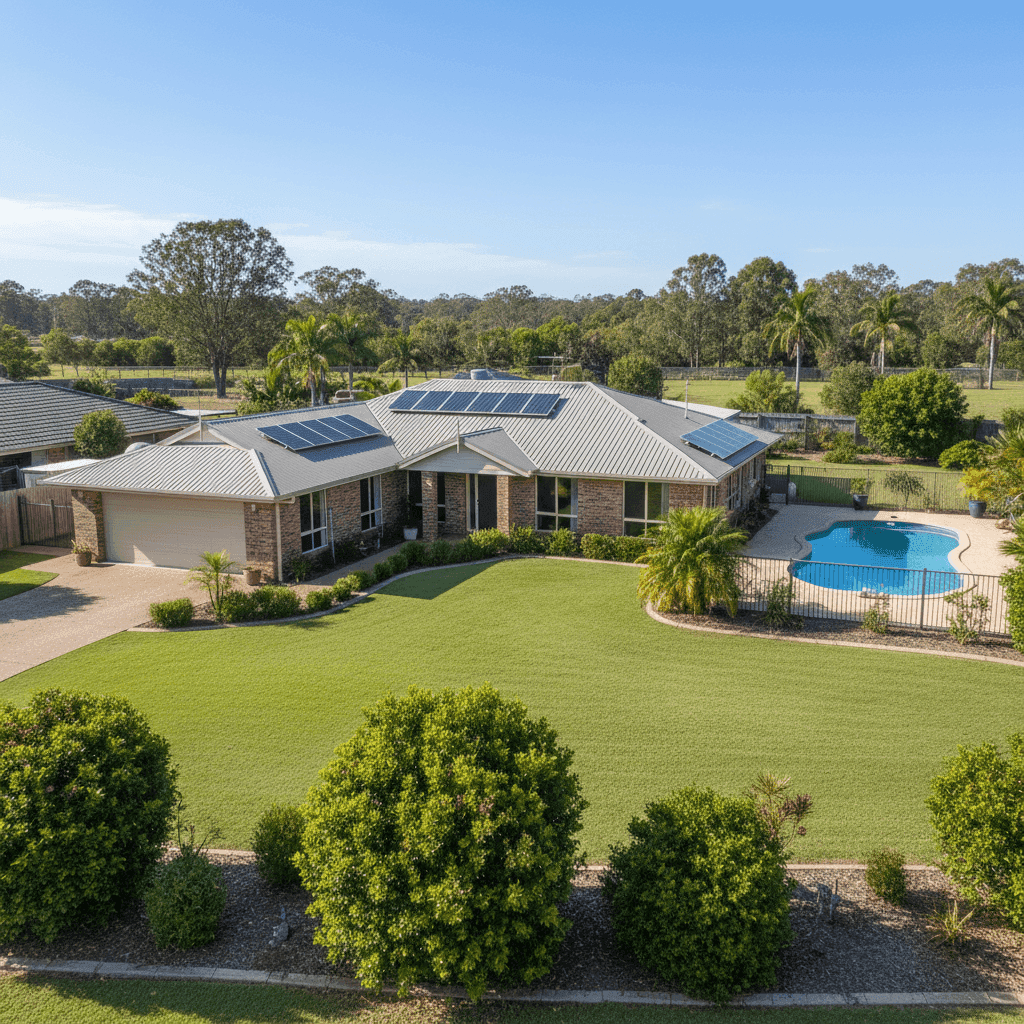
If you own a free standing home in Gooburrum, QLD 4670, you've likely noticed that home insurance premiums in Queensland can vary enormously depending on your property's characteristics and location. This article breaks down a real home and contents insurance quote for a large, seven-bedroom brick veneer home in Gooburrum, comparing it against local, state, and national benchmarks to help you understand whether you're getting a fair deal.
---
Is This Quote Fair?
The annual premium for this property came in at $2,896 per year (or roughly $271 per month), covering both building (sum insured: $1,284,000) and contents ($50,000). The price rating for this quote is FAIR — Around Average.
What does "fair" actually mean in practice? It means this premium sits in the middle of the road — not a standout bargain, but certainly not an overpriced outlier either. Given the size and age of this property (built in 1985, at 406 sqm), a "fair" rating is a reasonable outcome. Larger homes with higher building sums insured naturally attract higher premiums, so the fact that this quote lands near the average is a positive sign.
It's worth noting that the building excess on this policy is $5,000 and the contents excess is $2,000. Higher excesses are one of the most effective ways to bring a premium down — if you're comfortable absorbing more of the cost in a claim, a higher excess can be a smart trade-off.
---
How Gooburrum Compares
Understanding where your premium sits relative to others is key to evaluating value. Here's how this quote stacks up:
| Benchmark | Premium |
|---|---|
| This Quote | $2,896/yr |
| Gooburrum Suburb Average | $3,528/yr |
| Gooburrum Suburb Median | $3,318/yr |
| Gooburrum 25th Percentile | $2,770/yr |
| Gooburrum 75th Percentile | $4,299/yr |
| QLD State Average | $4,547/yr |
| QLD State Median | $3,931/yr |
| National Average | $2,965/yr |
| National Median | $2,716/yr |
A few things stand out here. This quote of $2,896 is noticeably below both the Gooburrum suburb average ($3,528) and the Queensland state average ($4,547) — saving over $600 compared to the typical local premium and more than $1,650 compared to the Queensland average. That's a meaningful difference.
Compared to national averages, the quote sits just slightly above the $2,965 national average and above the $2,716 national median — which makes sense given the property's scale and Queensland's historically elevated insurance market.
Drilling into the Gooburrum suburb statistics, the quote falls comfortably between the 25th percentile ($2,770) and the median ($3,318), suggesting it's a competitive result for this postcode. Across Queensland more broadly, premiums are significantly higher than the national norm — a reflection of the state's exposure to weather events, flooding, and storm damage — making this quote look even more favourable in context.
---
Property Features That Affect Your Premium
Several characteristics of this property play a direct role in how insurers calculate the premium.
Brick Veneer Walls & Colorbond Roof Brick veneer is generally viewed favourably by insurers — it's durable, fire-resistant, and holds up well against storm damage. A steel Colorbond roof is similarly well-regarded for its longevity and resistance to corrosion and impact. Together, these construction materials typically attract more competitive premiums than timber-framed or older tile-roofed homes.
Slab Foundation A concrete slab foundation is a solid base that reduces certain subsidence and pest-related risks compared to raised or timber subfloor constructions. Insurers tend to price slab homes more favourably in this regard.
Age of Construction (1985) A home built in 1985 is now approaching 40 years old. While the construction materials remain sound, ageing homes can carry higher risk for insurers due to older electrical wiring, plumbing, and roofing systems. It's worth ensuring your sum insured reflects the current cost to rebuild — not just the market value.
Swimming Pool The presence of a pool adds liability considerations to the policy. Pools increase the risk of accidental injury on the property, which can influence both the premium and the terms of cover. Make sure your policy explicitly covers pool-related liability.
Solar Panels Solar panels are increasingly common on Australian homes, but they do add complexity for insurers. They're typically covered under building insurance, but it's important to confirm that your sum insured accounts for the replacement cost of the panels themselves. Some policies may have specific conditions around solar systems.
Property Size (406 sqm) At 406 sqm, this is a substantial home. Larger floor areas directly increase the cost to rebuild, which is reflected in the $1,284,000 building sum insured. Ensuring this figure is accurate is critical — underinsurance is one of the most common and costly mistakes homeowners make.
Standard Fittings Standard-quality fittings mean the rebuild cost is calculated without the premium uplift associated with high-end fixtures and finishes. This keeps the sum insured — and therefore the premium — more manageable.
---
Tips for Homeowners in Gooburrum
1. Review Your Sum Insured Regularly Building costs have risen sharply across Australia in recent years. A sum insured set even two or three years ago may no longer reflect the true cost to rebuild your home. Use a building cost calculator or speak with a quantity surveyor to ensure you're adequately covered — particularly for a large home like this one.
2. Confirm Solar Panel and Pool Coverage Both solar panels and swimming pools can be sources of confusion in insurance policies. Before renewing, check the fine print to confirm your solar system is covered for both damage and liability, and that your pool is included under your public liability cover.
3. Compare Quotes at Renewal Time The Gooburrum sample data shows a wide spread of premiums — from $2,770 at the 25th percentile to $4,299 at the 75th. That's a $1,529 gap, which means shopping around at renewal can make a real difference. Don't auto-renew without checking what else is available.
4. Consider Your Excess Strategy This policy carries a $5,000 building excess and a $2,000 contents excess. While higher excesses reduce your premium, make sure you have the liquidity to cover that amount in the event of a claim. If $5,000 would be a financial stretch, it may be worth adjusting your excess and accepting a slightly higher premium for greater peace of mind.
---
Ready to Compare?
Whether you're renewing your existing policy or shopping for cover on a new purchase, it pays to compare. Get a home insurance quote at CoverClub and see how your premium stacks up against real data from your suburb and across Australia. With transparent pricing benchmarks and easy comparison tools, CoverClub makes it simple to find cover that's right for your home — and your budget.