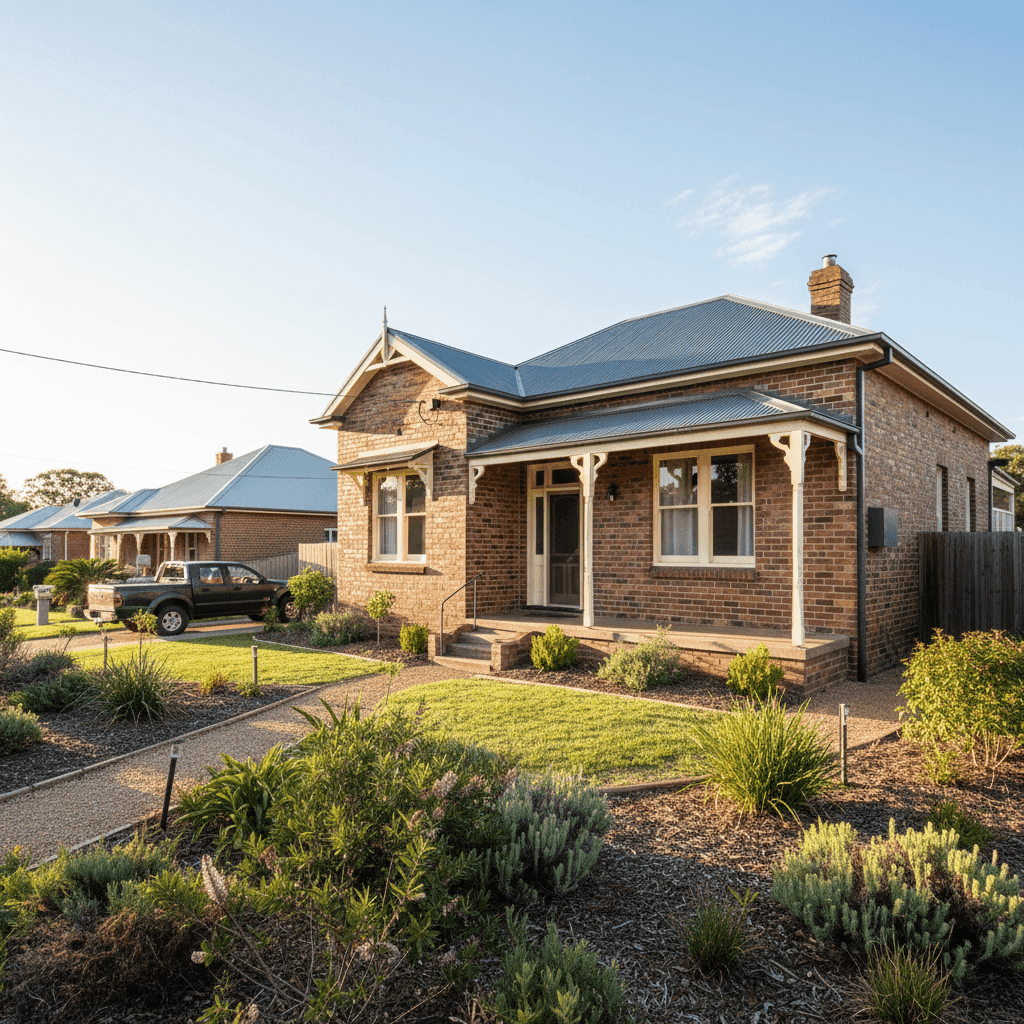
If you own a free standing home in Goulburn, NSW 2580, you've probably wondered whether you're paying a fair price for home insurance — or leaving money on the table. Goulburn is one of New South Wales' oldest inland cities, known for its cool climate, heritage streetscapes, and solid older-style housing stock. In this article, we analyse a real home and contents insurance quote for a 2-bedroom, double brick property in the area, and put it into context against local, state, and national benchmarks.
---
Is This Quote Fair?
The quote in question comes in at $2,745 per year (or $263/month) for a combined home and contents policy, with a building sum insured of $695,000 and contents covered at $50,000. Both the building and contents excess are set at $1,000.
Our price rating for this quote is FAIR — Around Average.
That assessment holds up well under scrutiny. The suburb average for Goulburn (2580) sits at $3,072/year, meaning this quote is roughly $327 cheaper than average for the area — a meaningful saving of around 11%. It also comes in below the suburb median of $2,872/year, placing it comfortably in the lower half of the local pricing range.
While it's not a rock-bottom price (the suburb's 25th percentile is $1,659/year, suggesting some homeowners are paying significantly less), it's well clear of the upper end, where premiums stretch to $3,889/year at the 75th percentile. For a property of this age, size, and construction type, landing below both the average and median is a solid result.
---
How Goulburn Compares
To properly appreciate this quote, it helps to zoom out and look at the broader pricing landscape. You can explore the full data on our Goulburn suburb stats page, but here's a quick summary:
| Benchmark | Premium |
|---|---|
| This Quote | $2,745/yr |
| Goulburn Suburb Average | $3,072/yr |
| Goulburn Suburb Median | $2,872/yr |
| Wingecarribee LGA Average | $3,312/yr |
| NSW State Average | $9,528/yr |
| NSW State Median | $3,770/yr |
| National Average | $5,347/yr |
| National Median | $2,764/yr |
(Based on 29 quotes sampled in the Goulburn 2580 area)
A few things stand out here. First, the NSW state average of $9,528/year is extraordinarily high — this is heavily skewed by expensive coastal and flood-prone postcodes across the state, so it's not a useful benchmark for an inland property like this one. The NSW median of $3,770/year is a more honest reflection of what many NSW homeowners pay, and this quote beats it by over $1,000.
Comparing against national figures, the story is similarly encouraging. The national average of $5,347/year is again distorted by high-risk areas (think cyclone-prone Queensland and flood-affected regions), but even the national median of $2,764/year is only marginally below this quote. That puts this Goulburn property roughly in line with the middle of the road nationally — a reasonable position for a well-built home in a low-risk inland location.
---
Property Features That Affect Your Premium
Several characteristics of this property influence the premium, both positively and negatively. Understanding them can help you make smarter decisions when reviewing or renewing your cover.
Double Brick Construction
Double brick is one of the most insurer-friendly wall types in Australia. It's fire-resistant, structurally robust, and less susceptible to storm damage than timber or lightweight cladding. Insurers generally view double brick homes favourably, and it likely contributes to the relatively competitive pricing here.
Steel/Colorbond Roof
A Colorbond steel roof is another tick in the right column. It's durable, low-maintenance, and performs well in hail and high-wind events. Compared to terracotta or concrete tiles (which can crack and dislodge), steel roofing tends to attract lower premiums.
Age of Construction (1930)
This is where things get more nuanced. A home built in 1930 is nearly a century old, and while double brick construction means the shell is likely still sound, the age of the property raises questions for insurers around electrical wiring, plumbing, and sub-floor structures. Older homes can be more expensive to repair or rebuild to modern standards, which partly explains why the building sum insured of $695,000 is substantial for a 105 sqm home.
Stump Foundation
The property sits on stumps, which is common for homes of this era in regional NSW. Stump foundations can be a risk factor if the stumps are original timber and showing signs of deterioration. Insurers may factor this in, though a well-maintained stump foundation is generally not a dealbreaker.
Timber/Laminate Flooring and Above-Average Fittings
Above-average fittings quality signals higher rebuild costs — think quality joinery, fixtures, and finishes that cost more to replace. This is reflected in the higher building sum insured and contributes to a premium that's above the suburb's 25th percentile. The timber flooring also adds replacement value to the contents and building calculations.
Ducted Climate Control
The presence of ducted climate control adds to the insured value of the home's fixed assets. These systems can cost $10,000–$25,000+ to replace, and their inclusion in the building sum insured is appropriate.
---
Tips for Homeowners in Goulburn
Whether you're reviewing an existing policy or shopping for the first time, here are four practical steps worth taking:
- Check your building sum insured regularly. Construction costs have risen sharply in recent years. A 105 sqm home with above-average fittings and a heritage build style could easily cost $600,000–$800,000+ to fully rebuild today. Review your sum insured annually to avoid being underinsured — and consider using a quantity surveyor for a formal assessment.
- Document your contents thoroughly. With $50,000 in contents cover, it's worth creating a home inventory — photos, receipts, and serial numbers for valuables. This makes claims faster and reduces disputes over item values. Store the inventory somewhere off-site or in the cloud.
- Ask about discounts for security and safety features. If your home has deadbolts, monitored alarms, or smoke detectors, let your insurer know. Many providers offer discounts for homes with these features that aren't always automatically applied.
- Compare quotes before renewal. The spread of premiums in Goulburn is wide — from $1,659/year at the 25th percentile to $3,889/year at the 75th percentile. That's a $2,230 gap for broadly similar properties. Shopping around at renewal time is one of the simplest ways to keep your premium competitive. Get a quote at CoverClub to see how your current policy stacks up.
---
Compare Your Home Insurance Today
Whether you're a long-time Goulburn resident or new to the area, it pays to know what the market looks like. CoverClub makes it easy to compare home and contents insurance quotes side by side, so you can see exactly where your premium sits relative to your neighbours. Start your comparison at CoverClub — it takes just a few minutes and could save you hundreds of dollars a year.