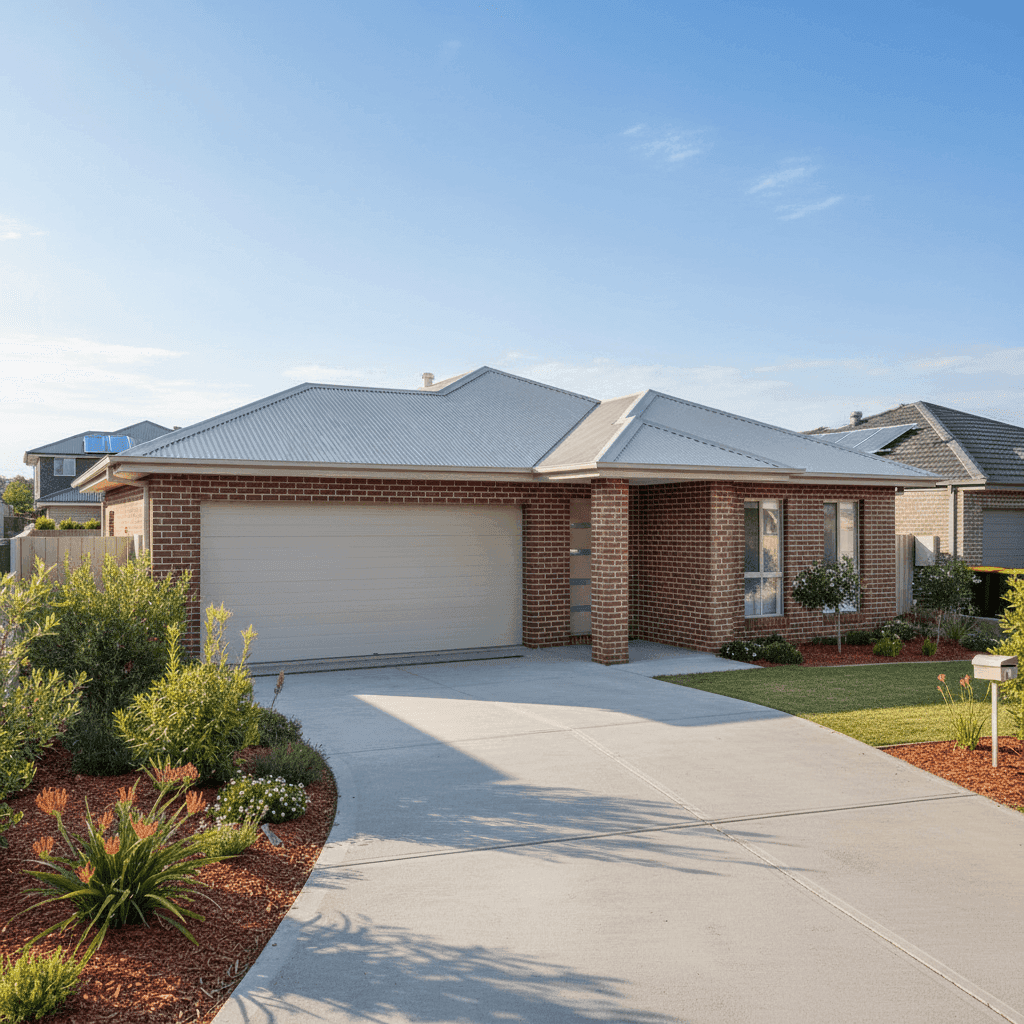
If you own a free standing home in Grovedale, VIC 3216, you're probably wondering whether you're paying a fair price for home insurance — or quietly overpaying year after year. This article breaks down a real home and contents insurance quote for a three-bedroom brick veneer home in the suburb, and puts it in context against local, state-wide, and national data.
---
Is This Quote Fair?
The quote in question comes to $1,305 per year (or about $125 per month) for combined home and contents cover. The building is insured for $448,000, with $125,000 worth of contents cover. Both the building and contents excess sit at $1,000.
Our analysis rates this quote as FAIR — around average for the area. That's not a bad result. It means the premium isn't unusually expensive, but there may still be room to do better depending on the insurer and the specific policy details.
To put the number in perspective: the suburb average for Grovedale sits at $1,413 per year, with a median of $1,468. This quote comes in roughly $108 below the suburb average and $163 below the median — a meaningful saving over time. It also sits comfortably within the middle range of quotes, between the 25th percentile ($1,159/yr) and the 75th percentile ($1,712/yr), based on a sample of 28 quotes collected for the area.
So while this isn't the cheapest quote available in Grovedale, it's a solid, competitive price that reflects the property's characteristics reasonably well.
---
How Grovedale Compares
One of the most striking things about Grovedale's insurance data is just how affordable it is relative to broader benchmarks.
The Victorian state average for home insurance sits at approximately $3,000 per year, with a median of $2,718. That means Grovedale homeowners are paying, on average, less than half what Victorian homeowners pay statewide. Even the priciest quotes in the suburb's 75th percentile ($1,712/yr) are well below the state median.
Zoom out further to the national picture, and the contrast is even more dramatic. The national average premium is $5,347 per year, heavily influenced by high-risk regions in Queensland and Western Australia where cyclones, floods, and bushfires drive premiums sky-high. Grovedale's quotes are a fraction of that figure.
Even within the Greater Geelong LGA, where the average premium runs at $1,754 per year, Grovedale sits below the local government area average. This suggests the suburb benefits from relatively lower risk characteristics compared to some other parts of the Geelong region.
| Benchmark | Annual Premium |
|---|---|
| This Quote | $1,305 |
| Grovedale Suburb Average | $1,413 |
| Grovedale Suburb Median | $1,468 |
| Greater Geelong LGA Average | $1,754 |
| VIC State Average | $3,000 |
| National Average | $5,347 |
---
Property Features That Affect Your Premium
Insurers don't just price a postcode — they price a property. Several characteristics of this particular home work in its favour when it comes to premium calculations.
Brick veneer construction is generally viewed favourably by insurers. While not as robust as full double-brick, brick veneer offers good fire resistance and structural durability, making it a lower-risk build type compared to weatherboard or lightweight cladding.
Steel/Colorbond roofing is another positive. Colorbond is a popular and well-regarded roofing material in Australia, known for its longevity, resistance to corrosion, and ability to handle a wide range of weather conditions. It's less susceptible to storm damage than older tile roofs and tends to attract lower premiums as a result.
The concrete slab foundation adds further stability. Slab homes are considered structurally sound and are less prone to the subsidence or moisture issues that can affect homes on older timber stumps or pier foundations.
Vinyl flooring is a practical choice that's easy to replace and resistant to water damage — a factor that can matter in contents and building claims alike.
The property is also not located in a cyclone risk area, which is a significant premium driver in northern parts of Australia. Grovedale's location in coastal Victoria means this risk simply doesn't apply here.
The one feature that adds a little to the premium is ducted climate control. Ducted systems are more expensive to repair or replace than split-system units, so insurers factor this into their building sum insured calculations. It's worth ensuring your building sum insured adequately accounts for the cost of replacing the ducted system if needed.
At 139 square metres, this is a modestly sized home, which also helps keep the building replacement cost — and therefore the premium — in a reasonable range.
---
Tips for Homeowners in Grovedale
Whether you're reviewing your existing policy or shopping for the first time, here are a few practical steps worth taking.
1. Check your building sum insured annually. Construction costs have risen significantly in recent years. A sum insured of $448,000 for a 139 sqm brick veneer home may be appropriate today, but it's worth recalculating each year using an independent building cost estimator to make sure you're not underinsured.
2. Don't overlook your contents value. $125,000 in contents cover is a reasonable figure for a three-bedroom home, but many Australians underestimate the replacement cost of their belongings. Walk through each room and consider what it would actually cost to replace everything from scratch — furniture, appliances, clothing, electronics, and more.
3. Compare quotes before renewing. Loyalty doesn't always pay in insurance. Insurers frequently offer better pricing to new customers than to long-standing ones. Even if your current quote is fair, it's worth running a comparison at renewal time to make sure you're not missing out on a better deal.
4. Review your excess settings. Both the building and contents excess on this policy are set at $1,000. Choosing a higher excess can reduce your annual premium, which makes sense if you have the financial buffer to cover a larger out-of-pocket cost in the event of a claim. Just make sure the trade-off works for your situation.
---
Ready to Compare?
Whether this quote is your current policy or you're exploring your options, the best way to know if you're getting a good deal is to compare. Get a home insurance quote at CoverClub and see how your premium stacks up against real data from your suburb and beyond. It takes just a few minutes and could save you hundreds.