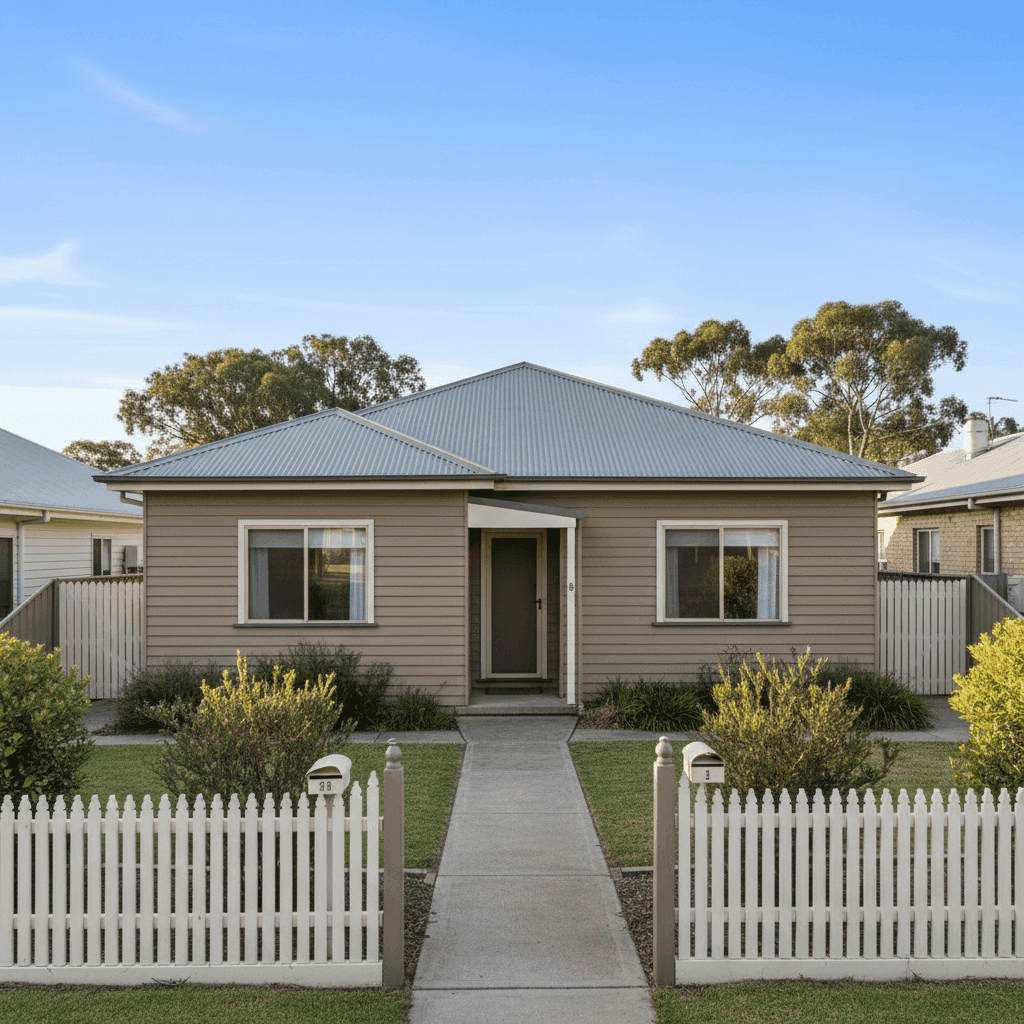
If you own a free standing home in Gunnedah, NSW 2380, you've probably noticed that home insurance can feel like a moving target — prices vary wildly depending on your property's age, construction, and location. To help cut through the noise, we've analysed a real home and contents insurance quote for a three-bedroom weatherboard property in Gunnedah and compared it against suburb, state, and national benchmarks. Here's what the numbers tell us.
---
Is This Quote Fair?
The quote in question comes in at $3,438 per year (or $323/month) for a home and contents policy, covering a building sum insured of $650,000 and $50,000 worth of contents, each with a $1,000 excess.
Our rating for this quote: Fair — Around Average.
That verdict holds up under scrutiny. The premium sits comfortably below the Gunnedah suburb average of $5,635/year and is also under the suburb median of $3,609/year — meaning this quote is actually slightly better than the midpoint of what most Gunnedah homeowners are paying. It's not a bargain-basement price, but it's a reasonable outcome given the property's characteristics and the local risk environment.
For context, the wide spread of premiums in the area — from $1,896/year at the 25th percentile to $9,694/year at the 75th percentile — reflects just how much individual property factors can move the needle. A quote of $3,438 landing in the lower half of that range is a solid result.
---
How Gunnedah Compares
When you zoom out and look at the broader picture, Gunnedah sits at the higher end of the national cost spectrum — a pattern common across regional NSW.
| Benchmark | Average Premium | Median Premium |
|---|---|---|
| Gunnedah (suburb) | $5,635/yr | $3,609/yr |
| Gunnedah LGA | $4,441/yr | — |
| NSW (state) | $3,801/yr | $3,410/yr |
| National | $2,965/yr | $2,716/yr |
The Gunnedah suburb average of $5,635/year is notably higher than both the NSW state average of $3,801/year and the national average of $2,965/year. That gap reflects a combination of factors specific to regional NSW — including elevated bushfire risk, the age of local housing stock, and the cost of rebuilding in areas with limited local trades.
It's worth noting that the suburb average is skewed upward by a cluster of high-cost quotes (the 75th percentile hits $9,694/year), which pulls the mean well above the median. The median of $3,609/year is arguably a more representative figure for what a typical Gunnedah homeowner pays — and at $3,438/year, this quote edges just below it.
---
Property Features That Affect Your Premium
Several characteristics of this property have a direct bearing on the premium quoted. Understanding them can help you make sense of your own insurance costs.
Weatherboard Timber Walls
Weatherboard construction is common in older Australian homes and adds a degree of risk in the eyes of insurers — timber is more susceptible to fire and rot than brick veneer or full brick. Homes with timber external walls typically attract higher premiums, all else being equal.
Steel/Colorbond Roof
On the positive side, a Colorbond steel roof is generally viewed favourably by insurers. It's durable, low-maintenance, and more resistant to ember attack than older tile or fibrous cement roofing. This may help offset some of the premium loading associated with the timber walls.
Construction Year: 1940
At over 80 years old, this home predates modern building codes — which can mean older wiring, plumbing, and structural elements that carry higher replacement or repair costs. Insurers factor in the age of a property when assessing risk, and pre-war homes often attract higher premiums as a result.
Slab Foundation & Vinyl Flooring
A concrete slab foundation is generally considered low-risk from a structural standpoint. Vinyl flooring is cost-effective to replace and doesn't carry the same premium implications as hardwood timber floors, keeping the contents and building replacement cost more manageable.
Standard Fittings
With standard-quality fittings throughout, the home doesn't carry the premium loading associated with high-end fixtures and finishes. This keeps the building sum insured more proportionate to the actual replacement cost.
Building Size: 130 sqm
At 130 square metres, this is a modest-sized home. The $650,000 building sum insured works out to roughly $5,000 per square metre — which is on the higher side for a standard-finish home, even accounting for regional building costs. It may be worth reviewing your sum insured with a quantity surveyor to ensure accuracy, as over-insurance means you're paying more premium than necessary.
---
Tips for Homeowners in Gunnedah
1. Review your sum insured regularly Building costs have shifted significantly in recent years. If your sum insured hasn't been updated to reflect current rebuild costs — or if it's been set conservatively high — you could be over-insured. Consider getting a professional building replacement cost assessment to dial it in accurately.
2. Ask about bushfire preparedness discounts Gunnedah and the broader Liverpool Plains region carry real bushfire exposure. Some insurers offer premium reductions for homes with ember guards, maintained gutters, or non-combustible decking. It's worth asking your insurer what mitigation measures they recognise.
3. Compare quotes before renewal The wide premium range in Gunnedah — from under $2,000 to nearly $10,000 per year — shows that insurers price this market very differently. Don't let your policy auto-renew without checking what else is available. Getting a fresh quote through CoverClub takes only a few minutes and could save you hundreds.
4. Consider your excess strategically Both the building and contents excess on this policy sit at $1,000. Opting for a higher excess (say, $2,000 or $2,500) can meaningfully reduce your annual premium — a worthwhile trade-off if you have the savings buffer to cover a larger out-of-pocket cost in the event of a claim.
---
Ready to Find a Better Rate?
Whether you're a first-time buyer or a long-term Gunnedah homeowner, it pays to shop around at renewal time. CoverClub makes it easy to compare home and contents insurance quotes from multiple Australian insurers in one place — so you can see exactly where your current policy sits and whether there's a better deal waiting. Start your comparison today and see what you could be saving.