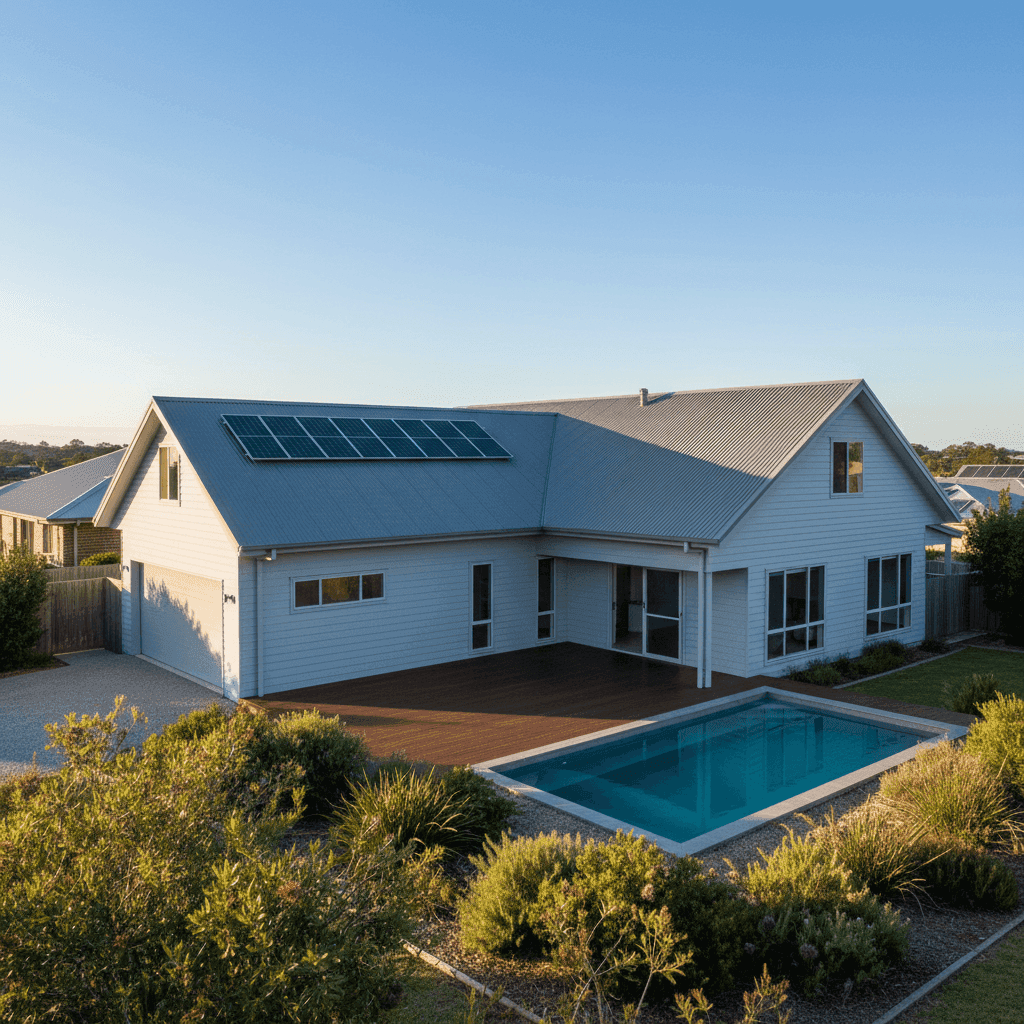
Hallidays Point is a relaxed coastal community on the Mid-North Coast of New South Wales, popular with families and sea-changers alike. If you own a free standing home in the area and you're wondering whether your home and contents insurance premium is reasonable, you're not alone — insurance costs have been rising across Australia, and understanding where your quote sits relative to the market can make a real difference to your household budget.
This article breaks down a recent home and contents insurance quote for a four-bedroom, two-bathroom free standing home in Hallidays Point (NSW 2430), and puts the numbers into context using suburb, state, and national data.
---
Is This Quote Fair?
The annual premium for this property came in at $7,251 per year (or $688 per month), covering a building sum insured of $1,215,000 and contents valued at $249,000, each with a $1,000 excess.
Our price rating for this quote is FAIR — Around Average.
That verdict makes sense when you look at the data. Within Hallidays Point itself, the suburb average premium sits at $4,456 per year, but the 75th percentile — meaning the top quarter of quotes — reaches $7,267 per year. At $7,251, this quote lands just below that upper threshold, which tells us it's on the higher side locally, but not out of the ordinary for a well-appointed property with a higher-than-average sum insured.
It's also worth noting that the suburb sample size is relatively small (13 quotes), so local averages can shift meaningfully with just a few data points. A broader comparison gives a more complete picture.
You can explore the full pricing data for this postcode at the Hallidays Point insurance stats page.
---
How Hallidays Point Compares
Here's how this quote sits across different benchmarks:
| Benchmark | Premium |
|---|---|
| This quote | $7,251/yr |
| Hallidays Point suburb average | $4,456/yr |
| Hallidays Point suburb median | $4,087/yr |
| Hallidays Point 75th percentile | $7,267/yr |
| Mid-Coast LGA average | $5,840/yr |
| NSW average | $9,528/yr |
| NSW median | $3,770/yr |
| National average | $5,347/yr |
| National median | $2,764/yr |
A few things stand out here. The NSW average premium of $9,528 is notably higher than the NSW median of $3,770 — a gap that signals a small number of very high-risk or high-value properties are pulling the average upward. This quote at $7,251 sits well below the NSW average, which is a positive sign.
Compared to the national picture, this quote is above both the national average ($5,347) and median ($2,764), but those national figures include properties across a wide range of risk profiles and values — many with far lower building sums insured than $1,215,000.
Across NSW as a whole, premiums vary enormously depending on flood zones, bushfire exposure, coastal proximity, and property values. Hallidays Point sits in a relatively moderate risk environment, which helps keep premiums more competitive than in some other coastal NSW postcodes.
---
Property Features That Affect Your Premium
Several characteristics of this property have a direct bearing on what insurers charge. Understanding them helps you make sense of the quote — and potentially find ways to reduce it.
Hardiplank/Hardiflex external walls Fibre cement cladding like Hardiplank is generally viewed favourably by insurers. It's fire-resistant, durable, and less susceptible to rot or termite damage than timber weatherboards. This is likely contributing positively to the premium.
Steel/Colorbond roof Colorbond roofing is a staple of Australian residential construction and is well-regarded for its resilience in storms and bushfire conditions. Insurers typically price this roof type more competitively than tile or older roofing materials.
Slab foundation Concrete slab foundations are considered low-risk by most insurers — there's no underfloor cavity for moisture, pests, or fire to take hold. This is another factor working in the property's favour.
Timber and laminate flooring Flooring type can influence contents and building claims. Timber and laminate floors are common in Australian homes and don't typically attract a premium loading, though they can be more costly to replace after water damage than tiles.
Swimming pool A pool adds to the insured value of the property and can also introduce liability considerations. Most home and contents policies cover the pool structure under the building component, but it's worth confirming what's included — particularly for pool equipment and fencing.
Solar panels Solar panels are increasingly common across NSW, and most insurers now include them under building cover as a fixed fixture. However, it's important to confirm your policy explicitly covers panels for storm damage, hail, and accidental breakage. The replacement cost of a full solar system can be significant.
Ducted climate control Ducted air conditioning systems are expensive to repair or replace. Their inclusion in the building sum insured is appropriate — and at $1,215,000, this quote appears to account for the full cost of rebuilding a well-equipped 214 sqm home.
Building size and sum insured At 214 sqm with standard fittings, the $1,215,000 building sum insured equates to roughly $5,677 per sqm — which is on the higher end but not unreasonable for a coastal NSW property with a pool, solar, and ducted air conditioning when factoring in demolition, site preparation, and rebuild costs.
---
Tips for Homeowners in Hallidays Point
1. Review your sum insured annually Construction costs have risen sharply in recent years. An outdated sum insured can leave you underinsured — meaning you bear part of the rebuild cost yourself. Use a building calculator or speak to a local builder to sense-check your figure each year.
2. Bundle building and contents for potential savings This quote already combines home and contents cover, which is often the most cost-effective approach. If you haven't already, check whether your insurer offers a discount for bundling — many do.
3. Confirm solar panel and pool coverage explicitly Don't assume these features are automatically covered to their full replacement value. Ask your insurer to confirm what's included for solar panels (including inverters and mounting hardware) and pool equipment, and whether there are any sub-limits that could leave you out of pocket.
4. Compare quotes before renewal Insurers don't always reward loyalty with competitive pricing. The difference between the 25th percentile ($1,170/yr) and 75th percentile ($7,267/yr) in Hallidays Point alone shows just how wide the spread can be. Shopping around at renewal time — even if you ultimately stay with your current insurer — is one of the most effective ways to ensure you're not overpaying.
---
Ready to Compare?
Whether you're reviewing an existing policy or shopping for cover on a new property, comparing quotes is the smartest first step. At CoverClub, you can benchmark your premium against real data from your suburb, LGA, and state — so you always know where you stand.
Get a home insurance quote now and see how your premium compares to other homeowners in Hallidays Point and across NSW.